Exit demo 1Z0-064 Oracle Database 12c: Performance Management and Tuning PDF format · free preview

Oracle 1Z0-064 - Questions & Answers

Free preview · every answer includes a full explanation

Product page: https://prepkeys.com/1z0-064.html

Question 1
Multiple choice

Your database supports a mixed workload. The ERP application creates short sessions and performs
small, random I/Os; the REPORTING application executes long-running DSS queries.

You want to set a priority for the workload generated by the ERP application and optimize resource usage for them.

Which three objectives can be achieved by the Resource Manager? (Choose three.)

A.

limiting the amount of time that a session is idle and blocking other sessions of the ERP application

B.

limiting the amount of undo generated by operations performed by sessions created by the ERP application

C.

creating two resource plans with resource limits defined for the workload generated by the applications and automatically changing resource plans based on the workload

D.

allocating a lower percentage of CPU to sessions used by the REPORTING application than to those used by the ERP application

E.

limiting the physical I/O performed by the sessions or users of the ERP application that are connected to the database

Question 2
Multiple choice

Examine the partial TKPROF output for an SQL statement:
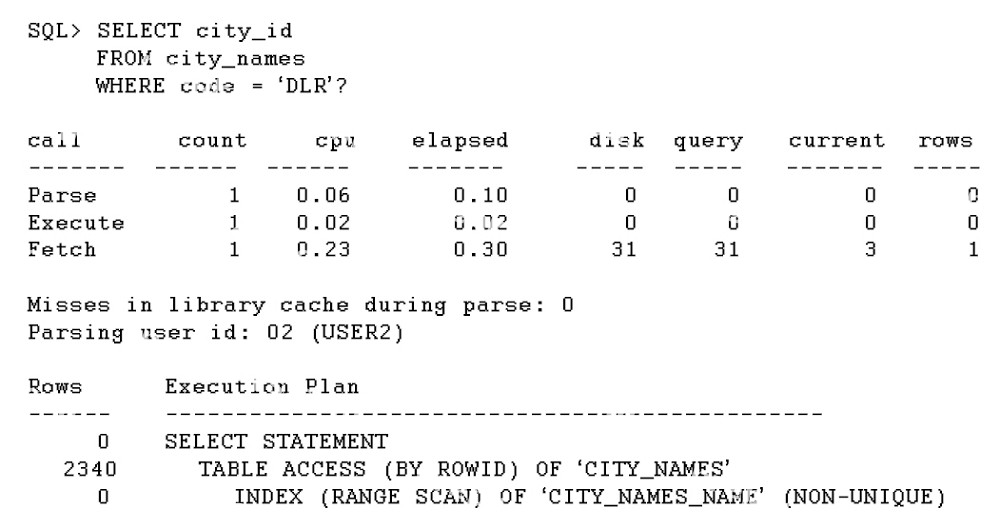
Which two inferences can definitely be made from this output? (Choose two.)

A.

Array fetch operations were not performed for this query.

B.

No hard parse was performed for this query.

C.

The number of logical I/Os is almost equal to the number of physical I/Os.

D.

Another transaction held a shared lock on the table, thereby causing a significant delay.

E.

An uncommitted transaction made a series of updates to the NAME_ID column just before the execution of this query.

Question 3
Single choice

In your database, the measured 99th percentile value is used as the maximum value. You set a warning threshold level of 110% of maximum trigger as an alert.

What is the outcome? (Choose the best answer.)

A.

It generates an error because the warning threshold cannot exceed 100%.

B.

It generates an error because the percentage of maximum threshold cannot be set with a significance-level threshold value.

C.

It generates an alert when an observed metric is 99% of the 99th percentile value as measured over the moving window baseline.

D.

It generates an alert when an observed metric is 110% of the 99th percentile value as measured over

the moving window baseline.

E.

It generates an alert when 1 in 100 observations for an observed metric exceeds the 99th percentile value as measured over the fixed baseline.

Question 4
Single choice

You want to capture AWR data to monitor performance variation every Monday between 9:00 AM and 12:00 PM for three months and automatically remove the older AWR data every fortnight.

How would you achieve this? (Choose the best answer.)

A.

Create AWR baselines.

B.

Create SQL plan baselines.

C.

Create repeating baseline templates.

D.

Create database services and make sure that user connections use them to connect to the database instance.

E.

Create a single baseline template.

Question 5
Multiple choice

Which two actions can reduce library cache latch contention for an OLTP application that repeatedly executes queries containing a mix of literals and bind variables? (Choose two.)

A.

setting the OPEN_CURSORS parameter to hold a sufficient number of concurrently open cursors

B.

coding the application such that a frequently executed statement is parsed only once and executed repeatedly as required

C.

setting the CURSOR_SHARING parameter to EXACT

D.

avoiding the granting of privileges on objects associated with cursors during peak load

E.

enabling Automatic Memory Management and allocating at least 50% of the available memory for SHARED_POOL_SIZE

F.

configuring shared server connections

Question 6
Multiple choice

You are administering a database that supports multiple applications, which make dedicated connections to the database instance by using different services.

You execute the command to enable tracing of the ORCL1 service:

Which two statements are true? (Choose two.)

A.

A single trace file is generated for all sessions mapped to the ORCL1 service.

B.

SQL trace is enabled for all modules and actions for sessions mapped to the ORCL1 service.

C.

A SQL trace file is generated for each session that maps to the ORCL1 service.

D.

A SQL trace file is generated for each of the modules using the ORCL1 service.

E.

SQL trace is not enabled for the service because a module name is not specified.

Question 7
Multiple choice

In which three situations can dynamic statistics be used? (Choose three.)

A.

when the sampling time is a small fraction of the total time for a query

B.

when an execution plan is suboptimal because of complex predicates

C.

when extended statistics are not available for SQL statements that use complex predicates

D.

when a query is on a partitioned table with a global index

E.

when index statistics are missing on a column that is used in SQL statements with highly selective filters

Question 8
Multiple choice

You want to generate statistics for new objects added to an OLTP application without affecting old statistics and the sessions that currently use them.

Which two tasks would you perform to test the new statistics? (Choose two.)

A.

Set the OPTIMIZER_USE_PENDING_STATISTICS initialization parameter to TRUE for the session.

B.

Set the STALE_PERCENT statistics preference to zero and then gather statistics.

C.

Set the PUBLISH statistics preference to FALSE and then gather statistics.

D.

Use the DBMS_STATS.PUBLISH_PENDING_STATS procedure to make pending statistics the current statistics.

E.

Set the NO_INVALIDATE statistics preference to FALSE and gather statistics without affecting old statistics.

Question 9
Multiple choice

You plan to upgrade your production database from Oracle Database 11g to 12c. As part of the upgrade, you want to introduce new indexes and materialized views. You have already created a test system with Oracle Database 12c, having the same structure and data as the production database, along with new schema objects to be added to the production database.

You want to identify regressed SQL statements, if any, which may have been caused by schema changes and the change in the optimizer version.

Which two methods would you use to achieve this? (Choose two.)

A.

Create an SQL Tuning Set (STS) for the SQL statements on the production database and submit as input to the SQL Tuning Advisor on the test database.

B.

Create an STS for the SQL statements on the production database and submit as input to the SQL Performance Analyzer with the OPTIMIZER_FEATURES_ENABLE parameter first set to 11.2.0.1, and then to 12.1.0.1on the test database.

C.

Generate an Automatic Workload Repository (AWR) compare periods report with snapshots taken before and after schema changes on the test database.

D.

Capture the production database workload, replay it on the test system by using Database Replay, and

analyze by using the workload replay compare period report.

E.

Create an STS for the SQL statements on the production database and submit as input to the SQL Access Advisor on the test database.

F.

Create an STS for the SQL statements on the production database before and after changes and submit as input to the SQL Performance Analyzer on the test database.

Question 10
Multiple choice

You recently joined a new team administering a database.

You notice that full table scans are performing poorly compared with full table scans on the databases you administered in a previous job.

You decide that performance problems are caused by a misconfiguration of factors affecting full table scans.

Which three factors should you investigate to determine the cause of the poorly performing Full Table Scans (FTS)? (Choose three.)

A.

value of DB_FILE_MULTIBLOCK_READ_COUNT

B.

storing query results in the result cache

C.

setting of the DISK_ASYNC_IO parameter to TRUE

D.

setting of the OPTIMIZER_MODE parameter to ALL_ROWS

E.

use of parallel queries

F.

block size of the tablespaces in which the tables being scanned are stored

G.

value of the OPTIMIZER_DYNAMIC_SAMPLING parameter

Showing 10 of 119 questions · Unlock the full set