Exit demo 1Z0-082 Oracle DBA Administration I PDF format · free preview

Oracle 1Z0-082 - Questions & Answers

Free preview · every answer includes a full explanation

Product page: https://prepkeys.com/1z0-082.html

Question 1
Single choice

The stores table has a column START_DATE of data type DATE, containing the date the row was inserted. You only want to display details of rows where START_DATE is within the last 25 months.

Which where clause can be used?

A.

WHERE MONTHS_BETWEEN(SYSDATE, start_date) <=25

B.

WHERE ADD_MONTHS(start_date, 25) <= SYSDATE

C.

WHERE TO_NUMBER(start date - SYSDATE) <= 25

D.

WHERE MONTHS_BETWEEN(start_date, SYSDATE) <= 25

Question 2
Single choice

Which statement is true about database links?

A.

Private database link creation requires the same user to exist in both the local and the remote databases.

B.

A public database link can be created only by SYS.

C.

A database link can be created only between two Oracle databases.

D.

A public database link can be used by a user connected to the local database instance to connect to any schema in the remote database instance.

E.

A database link created in a database allows a connection from that database's instance to the target database's Instance, but not vice versa.

Question 3
Multiple choice

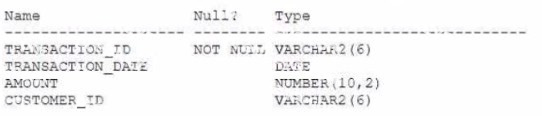
Examine this description of the books table containing 100 rows:
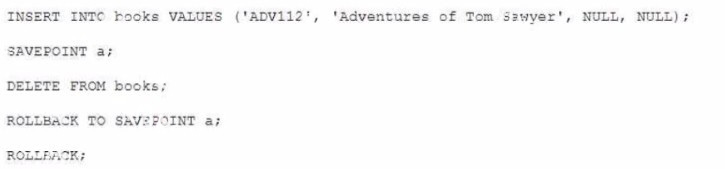
Now examine this sequence of statements Issued In a new session;
Examine this description of the books table containing 100 rows:

Which three statements are true?

A.

The second rollback command restores the row that was inserted.

B.

The first rollback command leaves the table's 100 original rows locked.

C.

The second rollback command rolls back the rollback to savepoint a command.

D.

The first rollback command leaves the inserted row locked.

E.

The first RollBack command restores the row that was inserted.

F.

The second rollback command restores the 100 rows that were in the table originally.

G.

The first rollback command restores the 100 rows that were in the table originally.

Question 4
Multiple choice

Which two statements are true about substitution variables?

A.

A substitution variable can be used with any clause in a SELECT statement.

B.

A substitution variable used to prompt for a column name must be enclosed in double quotation marks.

C.

A substitution variable used to prompt for a column name must be enclosed in single quotation marks.

D.

A substitution variable prefixed with & always prompts only once for a value in a session.

E.

A substitution variable can be used only in a SELECT statement.

F.

A substitution variable prefixed with && prompts only once for a value in a session unless it is set to undefined in the session.

Question 5
Multiple choice

Which three statements are true about single-row functions? (Choose three.)

A.

They can be used only in the WHERE clause of a SELECT statement

B.

The argument can be a column name, variable, literal or an expression

C.

The data type returned can be different from the data type of the argument

D.

They can be nested to any level

E.

They can accept only one argument

F.

They return a single result row per table

Question 6
Multiple choice

Examine the description of the BOOKS table:
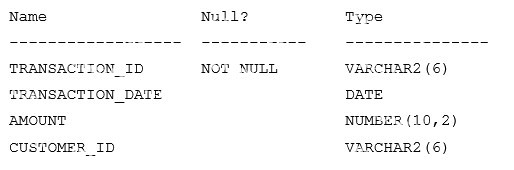
The table has 100 rows.

Examine this sequence of statements issued in a new session:

INSERT INTO books VALUES (`ADV112', `Adventures of Tom Sawyer', NULL, NULL);
SAVEPOINT a;
DELETE FROM books;
ROLLBACK TO SAVEPOINT a;
ROLLBACK;

Which two statements are true? (Choose two.)

A.

The second ROLLBACK command does nothing

B.

The second ROLLBACK command replays the delete

C.

The first ROLLBACK command restores the 101 rows that were deleted, leaving the inserted row still to be committed

D.

The second ROLLBACK command undoes the insert

E.

The first ROLLBACK command restores the 101 rows that were deleted and commits the inserted row

Question 7
Multiple choice

Which three statements are true about time zones, date data types, and timestamp data types in an Oracle database? (Choose three.)

A.

The CURRENT_TIMESTAMP function returns data without time zone information

B.

A TIMESTAMP WITH LOCAL TIMEZONE data type column is stored in the database using the time zone of the session that inserted the row

C.

A TIMESTAMP data type column contains information about year, month, and day

D.

The DBTIMEZONE function can return an offset from Universal Coordinated Time (UTC)

E.

The SESSIONTIMEZONE function can return an offset from Universal Coordinated Time (UTC)

Question 8
Multiple choice

Which three statements are true about external tables in Oracle 18c and later releases? (Choose three.)

A.

External table files can be used for other external tables in a different database

B.

The ORACLE_LOADER access driver can be used to unload data from a database into an external table

C.

The ORACLE_DATAPUMP access driver can be used to unload data from a database into an external table

D.

They cannot be partitioned

E.

The ORACLE_DATAPUMP access driver can be used to load data into a database from an external table

F.

They support UPDATEs but not INSERTs and DELETEs

Question 9
Multiple choice

Which two statements are true about trace files produced by the Oracle Database server? (Choose two.)

A.

They can be written by server processes

B.

Trace files are written to the Fast Recovery Area (FRA)

C.

They can be written by background processes

D.

All trace files contain error information that require contacting Oracle Support

E.

Trace file names are based on the database name concatenated with a sequential number

Question 10
Multiple choice

Which three statements are true about inner and outer joins? (Choose three.)

A.

A full outer join returns matched and unmatched rows

B.

An inner join returns matched rows

C.

Outer joins can only be used between two tables per query

D.

A full outer join must use Oracle syntax

E.

Outer joins can be used when there are multiple join conditions on two tables

F.

A left or right outer join returns only unmatched rows

Showing 10 of 176 questions · Unlock the full set