Exit demo 1Z0-1033-22 Oracle CPQ 2022 Implementation Professional PDF format · free preview

Oracle 1Z0-1033-22 - Questions & Answers

Free preview · every answer includes a full explanation

Product page: https://prepkeys.com/1z0-1033-22.html

Question 1
Single choice

How should an administrator set up a conditional restriction for access to a Product Family?

A.

by providing conditional access criteria in the Restricted Access section of the home page setup

B.

by setting up a restricted profile and user group in Commerce and hiding the add, reconfigure, and delete product options

C.

by hiding the model Punch-In on the home page by using JavaScript

D.

by writing a Constraint rule at the Product Family level

Question 2
Multiple choice

Identify two options to which transactions can be forwarded using forwarding rules. (Choose two.)

A.

any of the users who are part of the Approval group

B.

user groups

C.

users

D.

any email address registered in the CPQ Cloud system

Question 3
Single choice

When doing a part search from home page, you have the Create Quote button to create a new Transaction.

How do you change the label of this button?

A.

Open the Commerce Process admin page, navigate to Process Actions, and change the label of the
"_action_new_transaction" action.

B.

Go to the Process Invocation admin page, open the Part Search Results page, select navigation
"Rules" of the action that has the type "Start", and change the name of the invocation rule which points to the right commerce process.

C.

Go to the Process Invocation admin page, open the Part Search Results page, and change the name of the action that has the type "Start".

D.

Open the Text Administration admin page, go to "C", change the entry "Create Quote" and enter
"Translated Text."

Question 4
Multiple choice

Which two statements are true about Formulas? (Choose two.)

A.

Both attributes and library functions can be used as inputs for Formula Management.

B.

Only attributes can be used as inputs for Formula Management.

C.

Formulas can set both transaction-and line-level attributes.

D.

Formulas cannot be run in sequence to perform multi-step calculations.

Question 5
Single choice

What is the correct order of execution of Configuration rules for an attribute that has both Recommendation and Constraint rules written on it?

A.

Recommendation, Constraint, Hiding, Recommended Item

B.

Constraint, Hiding, Recommendation, Recommended Item

C.

Constraint, Recommendation, Constraint, Hiding, Recommended Item

D.

Hiding, Constraint, Recommendation, Recommended Item

E.

Recommendation, Recommended Item, Hiding, Constraint

Question 6
Multiple choice

You have implemented a Commerce Constraint rule, which has an Advanced action. While testing, you find that the attribute values specified in the rule are not being constrained, even though the condition is always true.

What are two reasons for this behavior? (Choose two.)

A.

The attribute is used as a condition for a Commerce Hiding rule.

B.

Configuration was not deployed after the rule was implemented.

C.

Commerce was not deployed after the rule was implemented.

D.

The rule is inactive

Question 7
Single choice

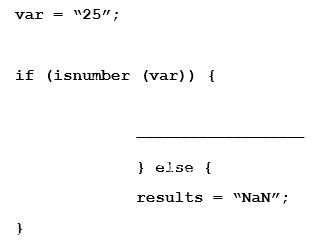
Given the following code:

Which statement will return the value for results as 25.0 when it is put in place of the blank line shown above the "}else{" statement?

A.

results = atoi (var);

B.

results = atof (var);

C.

results = stringtointeger (var);

D.

results = stringtofloat (var);

Question 8
Multiple choice

Which three discount types are available in pricing? (Choose three.)

A.

amount discount

B.

absolute price

C.

promotion discount

D.

quantity-dependent discount

E.

percent discount

Question 9
Multiple choice

Identify two supported procedures for moving commerce library functions between environments without
overwriting other functions. (Choose two.)

A.

Full commerce migration

B.

Webservices

C.

Granular migration

D.

Migration packages

E.

Bulk download/upload

Question 10
Single choice

How can you prevent users with the RestrictedAccess user type from creating a new transaction using Transaction Manager?

A.

Go to the Commerce Process admin page and open the participant profiles of the start step. Remove all user access rights entries for RestrictedAccess

B.

Navigate to the Process Invocation admin page and remove the user access rights entries for RestrictedAccess for all pages.

C.

Open the Commerce Process admin page, navigate to Process Actions, click Access Rights for the New Transaction action, and remove all company type and user type RestrictedAccess entries.

D.

Open the Commerce Process admin page, navigate to Process Manager, click Access Rights, and make sure that RestrictedAccesss user type is not selected.

Showing 10 of 94 questions · Unlock the full set