Exit demo 1Z0-1058 Oracle Risk Management Cloud 2019 Implementation Essentials PDF format · free preview

Oracle 1Z0-1058 - Questions & Answers

Free preview · every answer includes a full explanation

Product page: https://prepkeys.com/1z0-1058.html

Question 1
Multiple choice

Which three steps can be performed by using the Configure Module Objects pages? (Choose three.)

A.

Choose display (or hide) configurable options for: results, events, consequences and treatments.

B.

Set "object-perspective" association.

C.

Create object data import templates.

D.

Edit the assessment activity question and guidance text for all assessment types.

E.

View assessment response details for all assessment types.

Question 2
Multiple choice

Which three are true about implementing a best practice solution for Financial Reporting Compliance? (Choose three.)

A.

Large scope of project requires high effort for maintenance and administration.

B.

It promotes rapid implementation and go-live.

C.

It promotes go-live with minimal acceptance testing and user training.

D.

It provides maximum return on investment with minimum project risk.

E.

It promotes successful adoption and minimizes on-going cost of operation.

Question 3
Single choice

How do you populate the Control Method field with a new custom value, such as a third-party application'?

A.

Enter the new value directly in the Control method field.

B.

Use Lookup Meaning of the new lookup value.

C.

Use Lookup Code of the new lookup value.

D.

Use Lookup Type of the new lookup value.

Question 4
Multiple choice

Which three risk assessment activity types are available in Financial Reporting Compliance? (Choose three.)

A.

Design Review

B.

Qualitative Analysis

C.

Quantitative Analysis

D.

Certify

E.

Audit

F.

Assess Risk

Question 5
Single choice

You are implementing Advanced Access Controls and there is a requirement for a control to monitor user access to specific, client-defined access points which give users the ability to both initiate a purchase order and approve payments on that purchase order.

Which is a valid option to implement the control?

A.

From the "Access Entitlements" page create two entitlements containing the respective client-defined access points. Create an access model from the "Models" tab of Advanced Controls, based on the entitlements you created.

B.

Select Actions > Create Access Control from the "Controls" tab of Advanced Controls.

C.

Create an access model from the "Models" tab of Advanced Controls, and then define an access point filter for each individual client-defined access point.

D.

From the "Access Entitlements" page create two entitlements containing the respective client-defined access points. Create an access model from the "Models" tab of Advanced Controls, based on the entitlements you created. Finally, deploy an access control in the "Controls" tab of Advanced Controls, and select the access model you created.

E.

Create an access entitlement from the "Access Entitlements" page, then select Actions > Create
Access Control from the "Controls" tab of Advanced Controls, and select the entitlement you created.

Question 6
Single choice

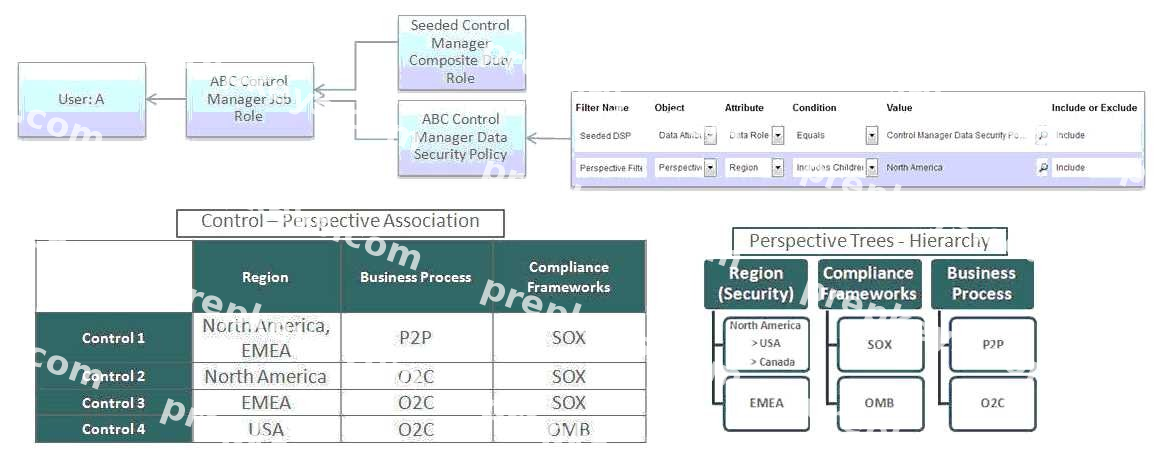
Which controls can user A manage for the following Control Manager role Configuration? See details of perspective trees and control-perspective association below.
A.

All controls

B.

Controls 2 and 4

C.

Controls 1, 2, and 4

D.

None

E.

Controls 1 and 2

Question 7
Single choice

Which filter can be used to identify expense reports that contain suspicious expense type combinations, such as, a report for a single trip that contains taxi, car rental, and mileage expenses?

A.

Inclusive function filter grouped by the "Expense Report Information" object's "Report Number" where the "Expense Type" has an "Equals" condition for values that include taxi, car, mileage.

B.

Inclusive function filter grouped by the "Expense Report Information" object's "Report Number" where the "Expense Type" has an "In" condition for values that include taxi, car, mileage.

C.

Inclusive function filter grouped by the "Expense Report Information" object's "Person" where the "Expense Type" has an "In" condition for values that include taxi, car, mileage.

D.

Inclusive function filter grouped by the "Expense Report Information" object's "Report Number" where the "Expense Type" has an "In" condition for values that include taxi, car, mileage.

E.

Inclusive function filter grouped by the "Expense Report Information" object's "Person" where the "Expense Type" has an "In" condition for values that include taxi, car, mileage.

Question 8
Multiple choice

You are implementing Advanced Access Controls for a client who wants to limit the seeded job role "Application Access Auditor". This job role should NOT include system configuration duties, but allows the user to monitor jobs schedules for Advanced Controls.
After the seeded job role is copied, that two duty roles should be removed to comply with the access restrictions? (Choose two.)

A.

Access Control Manager

B.

Advanced Control System Administrator

C.

Access incident Results Manager

D.

Application Data Source Manager

E.

Access Model Manager

Question 9
Single choice

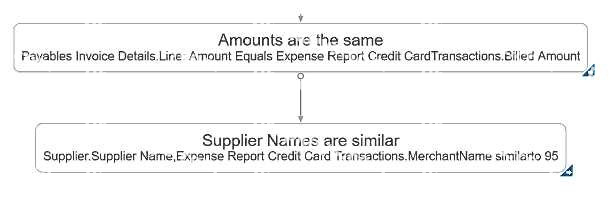
You have built a transaction model to identify possible duplicate charges between invoicing and expense credit cards. The model logic already includes two standard filters that identify amounts and suppliers that are the same or similar, as shown:
Which additional date filter will further refine the set of duplicate charges found?

A.

The "Payables Invoice" object's "Invoice Date" attribute is greater than the "Expense Report Credit Card Transaction" object's "Transaction Date" attribute.

B.

The "Expense Report Credit Card Transaction" object's "Last Updated Date" attribute is greater than the "Relative Value" of 3 months.

C.

The "Expense Report Credit Card Transaction" object's "Transaction Date" attribute is not blank.

D.

The "Payables Invoice" object's "Invoice Date" attribute is similar to the "Expense Report Credit Card Transaction" object's "Transaction Date" attribute within +/- 10 days.

Question 10
Multiple choice

Which two filters must be combined to identify different suppliers who use the same taxpayer ID? (Choose two.)

A.

Function filter grouping by "Supplier ID" where count is greater than 1.

B.

Standard filter where the "Supplier" object's "Supplier ID" is equal to itself.

C.

Function filter grouping by "Taxpayer ID" where count is greater than 1.

D.

Standard filter where the "Supplier" object's "Allow Withholding Tax" is not blank.

E.

Standard filter where the "Supplier" object's "Taxpayer ID" is not blank.

Showing 10 of 75 questions · Unlock the full set