Exit demo 1Z0-1084-21 Oracle Cloud Infrastructure Developer 2021 Associate PDF format · free preview

Oracle 1Z0-1084-21 - Questions & Answers

Free preview · every answer includes a full explanation

Product page: https://prepkeys.com/1z0-1084-21.html

Question 1
Single choice

Which one of the statements describes a service aggregator pattern?

A.

It is implemented in each service separately and uses a streaming service

B.

It involves implementing a separate service that makes multiple calls to other backend services

C.

It uses a queue on both sides of the service communication

D.

It involves sending events through a message broker

Question 2
Multiple choice

Which two statements accurately describe an Oracle Functions application?

A.

A small block of code invoked in response to an Oracle Cloud Infrastructure (OCI) Events service

B.

A Docker image containing all the functions that share the same configuration

C.

An application based on Oracle Functions, Oracle Cloud Infrastructure (OCI) Events and OCI API Gateway services

D.

A common context to store configuration variables that are available to all functions in the application

E.

A logical group of functions

Question 3
Multiple choice

You have been asked to create a stateful application deployed in Oracle Cloud Infrastructure (OCI)
Container Engine for Kubernetes (OKE) that requires all of your worker nodes to mount and write data to persistent volumes.

Which two OCI storage services should you use?

A.

Use OCI File Services as persistent volume.

B.

Use GlusterFS as persistent volume.

C.

Use OCI Block Volume backed persistent volume.

D.

Use open source storage solutions on top of OCI.

E.

Use OCI Object Storage as persistent volume.

Question 4
Single choice

You are a consumer of Oracle Cloud Infrastructure (OCI) Streaming service.

Which API should you use to read and process the stream?

A.

ListMessages

B.

GetMessages

C.

GetObject

D.

ReadMessages

Question 5
Multiple choice

Which two handle Oracle Functions authentication automatically?

A.

Oracle Cloud Infrastructure SDK

B.

cURL

C.

Oracle Cloud Infrastructure CLl

D.

Signed HTTP Request

E.

Fn Project CLI

Question 6
Single choice

You are building a cloud native, serverless travel application with multiple Oracle Functions in Java, Python and Node.js. You need to build and deploy these functions to a single applications named travel-app.

Which command will help you complete this task successfully?

A.

oci fn function deploy --ap travel-ap --all

B.

fn deploy --ap travel-ap -- all

C.

oci fn application --application-name-ap deploy --all

D.

fn function deploy --all --application-name travel-ap

Question 7
Single choice

A pod security policy (PSP) is implemented in your Oracle Cloud Infrastructure Container Engine for Kubernetes cluster

Which rule can you use to prevent a container from running as root using PSP?

A.

NoPrivilege

B.

RunOnlyAsUser

C.

MustRunAsNonRoot

D.

forbiddenRoot

Question 8
Single choice

You are working on a serverless DevSecOps application using Oracle Functions. You have deployed a Python function that uses the Oracle Cloud Infrastructure (OCI) Python SDK to stop any OC1 Compute instance that does not comply with your corporate security standards There are 3 non compliant OCI Compute instances.
However, when you invoke this function none of the instances were stopped.

How should you troubleshoot this?

A.

There is no way to troubleshoot a function running on Oracle Functions.

B.

Enable function logging in the OCI console, include some print statements in your function code and use logs to troubleshoot this.

C.

Enable function remote debugging in the OCI console, and use your favorite IDE to inspect the function running on Oracle Functions.

D.

Enable function tracing in the OCI console, and go to OCI Monitoring console to see the function stack trace.

Question 9
Single choice

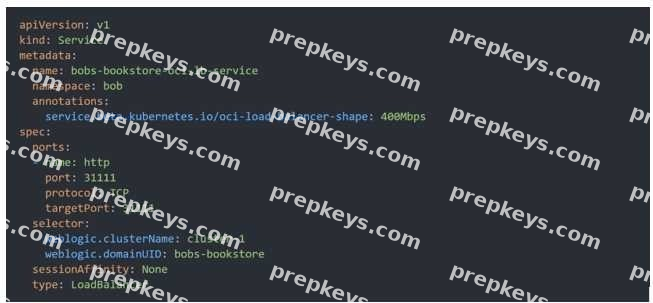
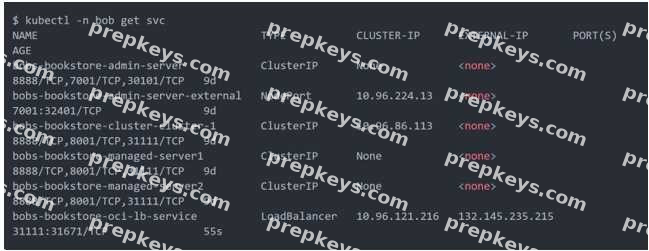
Which statement accurately describes Oracle Cloud Infrastructure (OCI) Load Balancer integration with OCI Container Engine for Kubernetes (OKE)?
A.

OKE service provisions an OCI Load Balancer instance for each Kubernetes service with LoadBalancer type in the YAML configuration.

B.

OCI Load Balancer instance provisioning is triggered by OCI Events service for each Kubernetes service with LoadBalancer type in the YAML configuration.

C.

OCI Load Balancer instance must be manually provisioned for each Kubernetes service that requires traffic balancing.

D.

OKE service provisions a single OCI Load Balancer instance shared with all the Kubernetes services with LoadBalancer type in the YAML configuration.

Question 10
Single choice

Which Oracle Cloud Infrastructure (OCI) load balancer shape is used by default in OCI container Engineer for Kubernetes?

A.

400 Mbps

B.

8000 Mbps

C.

There is no default. The shape has to be specified.

D.

100 Mbps

Showing 10 of 72 questions · Unlock the full set