Oracle 1Z0-242 - Questions & Answers
Free preview · every answer includes a full explanation
Product page: https://prepkeys.com/1z0-242.html
Evaluate this PeopleCode snippet.
Local Array of Number &MyArray;
Local Any &Len, &Result;
&MyArray = CreateArray(3);
&MyArray[1] = 100;
&MyArray[2] = 200;
&MyArray[3] = 300;
&Result = &MyArray.POP();
&Len = &MyArray.LEN;
&End = &MyArray[&Len];
What are the correct values for &Result and &End?
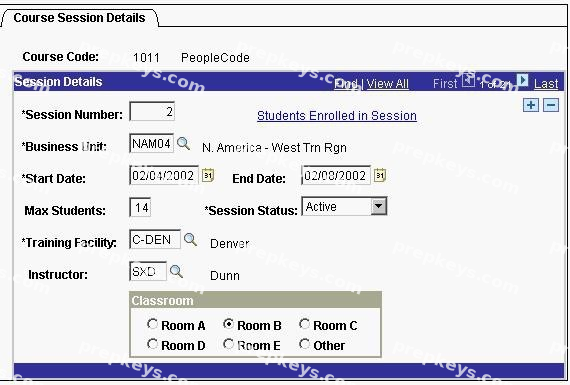
View the Exhibit.
An object-oriented PeopleCode program traverses the data buffer to get the value for Session Number (SESSION_NBR) in the Session Details record (PSU_CRS_SESSN) on the Course Sessions page. The program uses a built-in function to instantiate the Level 0 object, then uses object methods to instantiate the remaining data buffer objects.
Select the option that represents the order in which the program instantiates the data buffer objects.
Here is a snippet of PeopleCode that uses the Fetch method of the SQL class.
&SQL = CreateSQL("Select EFFORT_AMT from PS_PSU_TASK_EFFORT where TASK= :1",
PSU_TASK_TBL.TASK);
&Var1 = &SQL.Fetch(&Var2);
Select the two correct statements. (Choose two.)
The Customer Orders page uses data from the ITEM table to perform price calculations. You decide to write a PeopleCode program to create a stand-alone rowset that will load data from the ITEM table into the data buffer. Select three PeopleCode statements that can be used with stand-alone rowsets. (Choose three.)
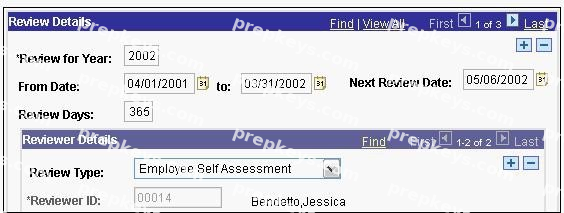
View the Exhibit.
On the Employee Review page, you have a business rule with these requirements:
1. If Review Type is Supervisor, then the prompt for Reviewer ID returns only supervisors.
2. If Review Type is Peer or Performance, then the prompt for Reviewer ID returns all employees.
Select the three steps required to implement this business rule. (Choose three.)
You want to examine the component buffer for the Customer Orders (PSU_CUST_ORDER ) component.
Which four steps are necessary? (Choose four.)
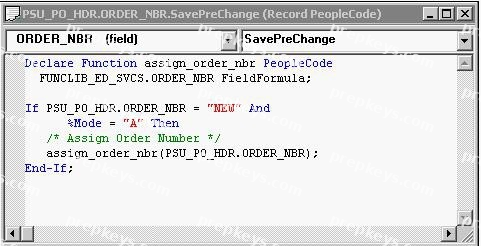
View the Exhibit.
Your client is upgrading its purchasing application to use object-oriented PeopleCode to incorporate the benefits of application classes.
The PeopleCode for the Purchase Order application is now encapsulated in an Application Package called PSU_PO. The assign_order_nbr function is now ORDER_NBR, a method of the ORDER class.
You are tasked with modifying this program to call the new ORDER_NBR method.
Which four PeopleCode statements will you use in the new program? (Choose four.)
You want to see exactly when a PeopleCode program fires in the context of the Component Processor flow.
Which two methods will work? (Choose two.)
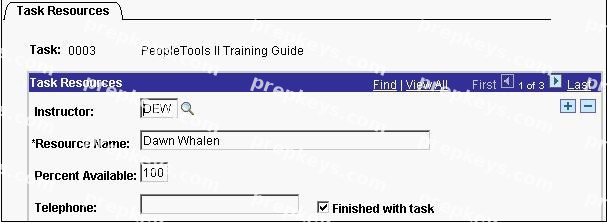
View the Exhibit.
A PeopleCode program at level 0 checks the values for Percent Available (PCT_AVAILABLE) at level 1.
Analyze this code snippet.
Local Rowset &RS_Level0, &RS_Level1;
Local Row &Row_Level0, &Row_Level1;
Local Record &Rec_TaskRsrc;
Local Field & Fld_PctAvail ;
&RS_Level0 = GetLevel0();
&Row_Level0 = &RS_Level0.GetRow(1);
&RS_Level1 = &Row_Level0.GetRowset(Scroll.PSU_TASK_RSRC); &Row_Level1 =
&RS_Level1.GetRow(1);
&Rec_TaskRsrc = &Row_Level1.GetRecord(Record.PSU_Task_RSRC); &Fld_PctAvail =
&Rec_TaskRsrc.GetField(Field.PCT_AVAILABLE); &Pct = &Fld_PctAvail.Value;
Select the correct option.
The Get Student Enrollments page uses a PeopleCode program to select and display rows based on user input. When the user clicks Refresh, FieldChange PeopleCode populates a stand-alone rowset using a Select method. When you test the program, the new rows are appended to the previous rows instead of replacing them.
How do you fix this problem?