Oracle 1Z0-809 - Questions & Answers
Free preview · every answer includes a full explanation
Product page: https://prepkeys.com/1z0-809.html
Given the definition of the Vehicle class:
Class Vehhicle {
int distance; //line n1
Vehicle (int x) {
this distance = x;
}
public void increSpeed(int time) { //line n2
int timeTravel = time; //line n3
class Car {
int value = 0;
public void speed () {
value = distance /timeTravel;
System.out.println ("Velocity with new speed"+value+"kmph");
}
}
new Car().speed();
}
}
and this code fragment:
Vehicle v = new Vehicle (100);
Given:
IntStream stream = IntStream.of (1,2,3);
IntFunction<Integer> inFu= x -> y -> x*y; //line n1
IntStream newStream = stream.map(inFu.apply(10)); //line n2
newStream.forEach(System.output::print);
Which modification enables the code fragment to compile?
Given the code fragment:
List<Integer> values = Arrays.asList (1, 2, 3);
values.stream ()
.map(n -> n*2) //line n1
.peek(System.out::print) //line n2
.count();
What is the result?
Given the code fragment:
public class Foo {
public static void main (String [ ] args) {
Map<Integer, String> unsortMap = new HashMap< > ( );
unsortMap.put (10, "z");
unsortMap.put (5, "b");
unsortMap.put (1, "d");
unsortMap.put (7, "e");
unsortMap.put (50, "j");
Map<Integer, String> treeMap = new TreeMap <Integer, String> (new
Comparator<Integer> ( ) {
@Override public int compare (Integer o1, Integer o2) {return o2.compareTo
(o1); } } );
treeMap.putAll (unsortMap);
for (Map.Entry<Integer, String> entry : treeMap.entrySet () ) {
System.out.print (entry.getValue () + " ");
}
}
}
What is the result?
Which two reasons should you use interfaces instead of abstract classes? (Choose two.)
Given:
public class Counter {
public static void main (String[ ] args) {
int a = 10;
int b = -1;
assert (b >=1) : "Invalid Denominator";
int = a / b;
System.out.println (c);
}
}
What is the result of running the code with the -ea option?
Given:
class Bird {
public void fly () { System.out.print("Can fly"); }
}
class Penguin extends Bird {
public void fly () { System.out.print("Cannot fly"); }
}
and the code fragment:
class Birdie {
public static void main (String [ ] args) {
fly( ( ) -> new Bird ( ));
fly (Penguin : : new);
}
/* line n1 */
}
Which code fragment, when inserted at line n1, enables the Birdie class to compile?
Given:
1. abstract class Shape {
2. Shape ( ) { System.out.println ("Shape"); }
3. protected void area ( ) { System.out.println ("Shape"); }
4. }
5.
6. class Square extends Shape {
7. int side;
8. Square int side {
9. /* insert code here */
10. this.side = side;
11. }
12. public void area ( ) { System.out.println ("Square"); }
13. }
14. class Rectangle extends Square {
15. int len, br;
16. Rectangle (int x, int y) {
17. /* insert code here */
18. len = x, br = y;
19. }
20. void area ( ) { System.out.println ("Rectangle"); }
21. }
Which two modifications enable the code to compile? (Choose two.)
Given:
class Sum extends RecursiveAction { //line n1
static final int THRESHOLD_SIZE = 3;
int stIndex, lstIndex;
int [ ] data;
public Sum (int [ ]data, int start, int end) {
this.data = data;
this stIndex = start;
this. lstIndex = end;
}
protected void compute ( ) {
int sum = 0;
if (lstIndex ?stIndex<;= THRESHOLD_SIZE) {
for (int i = stIndex; i < lstIndex; i++) {
sum += data [i];
}
System.out.println(sum);
} else {
new Sum (data, stIndex + THRESHOLD_SIZE, lstIndex).fork( );
new Sum (data, stIndex,
Math.min (lstIndex, stIndex + THRESHOLD_SIZE)
).compute ();
}
}
}
and the code fragment:
ForkJoinPool fjPool = new ForkJoinPool ( );
int data [ ] = {1, 2, 3, 4, 5, 6, 7, 8, 9, 10}
fjPool.invoke (new Sum (data, 0, data.length));
and given that the sum of all integers from 1 to 10 is 55.
Which statement is true?
Given the content of Operator.java, EngineOperator.java, and Engine.java files:
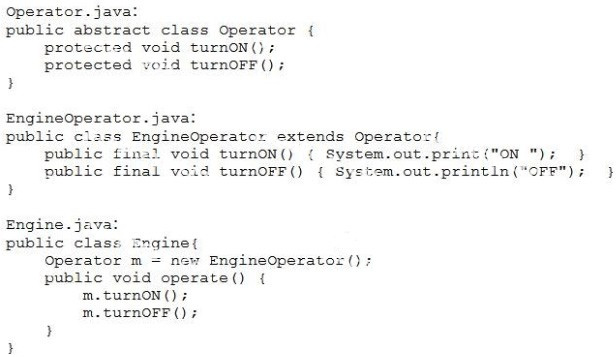
and the code fragment:

What is the result?