Exit demo 1Z0-858 Java Enterprise Edition 5 Web Component Developer Certified Professional PDF format · free preview

Oracle 1Z0-858 - Questions & Answers

Free preview · every answer includes a full explanation

Product page: https://prepkeys.com/1z0-858.html

Question 1
Single choice

To take advantage of the capabilities of modern browsers that use web standards, such as XHTML and CSS, your web application is being converted from simple JSP pages to JSP Document format. However, one of your JSPs, /scripts/screenFunctions.jsp, generates a JavaScript file. This file is included in several web forms to create screen-specific validation functions and are included in these pages with the following statement:

10. <head>
11. <script src='/scripts/screenFunctions.jsp'
12. language='javascript'
13. type='application/javascript'> </script>
14. </head>
15. <!-- body of the web form -->

Which JSP code snippet declares that this JSP Document is a JavaScript file?

A.

<%@ page contentType='application/javascript' %>

B.

<jsp:page contentType='application/javascript' />

C.

<jsp:document contentType='application/javascript' />

D.

<jsp:directive.page contentType='application/javascript' />

E.

No declaration is needed because the web form XHTML page already declares the MIME type of the /

scripts/screenFunctions.jsp file in the <script> tag.

Question 2
Multiple choice

Given the JSP code:
10. <html>
11. <body>
12. <jsp:useBean id='customer' class='com.example.Customer' />
13. Hello, ${customer.title} ${customer.lastName}, welcome
14. to Squeaky Beans, Inc.
15. </body>
16. </html>

Which three types of JSP code are used? (Choose three.)

A.

Java code

B.

template text

C.

scripting code

D.

standard action

E.

expression language

Question 3
Single choice

You have built a collection of custom tags for your web application. The TLD file is located in the file: / WEB-INF/myTags.xml. You refer to these tags in your JSPs using the symbolic name: myTags.

Which deployment descriptor element must you use to make this link between the symbolic name and the TLD file name?

A.

<taglib><name>myTags</name><location>/WEB-INF/myTags.xml</location></taglib>

B.

<tags><name>myTags</name><location>/WEB-INF/myTags.xml</location></tags>

C.

<tags><tags-uri>myTags</taglib-uri><tags-location>/WEB-INF/myTags.xml</tags- location></tags>

D.

<taglib><taglib-uri>myTags</taglib-uri><taglib-location>/WEB-INF/myTags.xml</taglib- location></

taglib>

Question 4
Single choice

Which implicit object is used in a JSP page to retrieve values associated with <context-param> entries in the deployment descriptor?

A.

config

B.

request

C.

session

D.

application

Question 5
Single choice

You have created a JSP that includes instance variables and a great deal of scriptlet code. Unfortunately, after extensive load testing, you have discovered several race conditions in your JSP scriptlet code. To fix these problems would require significant recoding, but you are already behind schedule.

Which JSP code snippet can you use to resolve these concurrency problems?

A.

<%@ page isThreadSafe='false' %>

B.

<%@ implements SingleThreadModel %>

C.

<%! implements SingleThreadModel %>

D.

<%@ page useSingleThreadModel='true' %>

E.

<%@ page implements='SingleThreadModel' %>

Question 6
Single choice

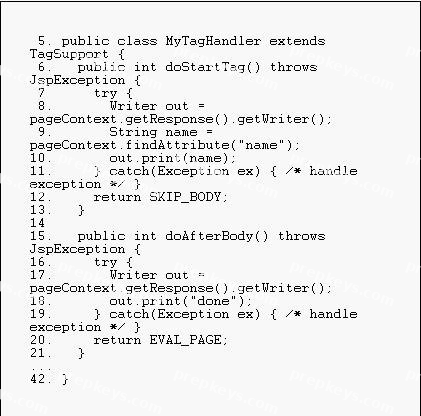
Click the Exhibit button.

The attribute "name" has a value of "Foo,"

What is the result if this tag handler's tag is invoked?
100% Real Q&As | 100% Real Pass

A.

Foo

B.

done

C.

Foodone

D.

An exception is thrown at runtime.

E.

No output is produced from this code.

F.

Compilation fails because of an error in this code.

Question 7
Single choice

You are building a web application that will be used throughout the European Union; therefore, it has
significant internationalization requirements. You have been tasked to create a custom tag that generates a message using the java.text.MessageFormat class. The tag will take the resourceKey attribute and a
variable number of argument attributes with the format, arg<N>. Here is an example use of this tag and its
output:

<t:message resourceKey='diskFileMsg' arg0='MyDisk' arg1='1247' />

generates:

The disk "MyDisk" contains 1247 file(s).

Which Simple tag class definition accomplishes this goal of handling a variable number of tag attributes?

A.

public class MessageTag extends SimpleTagSupportimplements VariableAttributes {private Map

attributes = new HashMap();public void setVariableAttribute(String uri,String name, Object value)
{this.attributes.put(name, value);}// more tag handler methods}

B.

The Simple tag model does NOT support a variable number of attributes.

C.

public class MessageTag extends SimpleTagSupportimplements DynamicAttributes {private Map

attributes = new HashMap();public void putAttribute(String name, Object value) {this.attributes.put
(name, value);}// more tag handler methods}

D.

public class MessageTag extends SimpleTagSupportimplements VariableAttributes {private Map

attributes = new HashMap();public void putAttribute(String name, Object value) {this.attributes.put
(name, value);}// more tag handler methods}

E.

public class MessageTag extends SimpleTagSupportimplements DynamicAttributes {private Map

attributes = new HashMap();public void setDynamicAttribute(String uri, String name,Object value)
{this.attributes.put(name, value);}// more tag handler methods}

Question 8
Single choice

Given the JSP code:

<% request.setAttribute("foo", "bar"); %>
and the Classic tag handler code:

5. public int doStartTag() throws JspException {
6. // insert code here
7. // return int
8. }

Assume there are no other "foo" attributes in the web application.

Which invocation on the pageContext object, inserted at line 6, assigns "bar" to the variable x?

A.

String x = (String) pageContext.getAttribute("foo");

B.

String x = (String) pageContext.getRequestScope("foo");

C.

It is NOT possible to access the pageContext object from within doStartTag.

D.

String x = (String)pageContext.getRequest().getAttribute("foo");

100% Real Q&As | 100% Real Pass

E.

String x = (String) pageContext.getAttribute("foo",PageContext.ANY_SCOPE);

Question 9
Multiple choice

Which two statements about tag files are true? (Choose two.)

A.

Classic tag handlers and tag files CANNOT reside in the same tag library.

B.

A file named foo.tag, located in /WEB-INF/tags/bar, is recognized as a tag file by the container.

C.

A file named foo.tag, bundled in a JAR file but NOT defined in a TLD, triggers a container translation

error.

D.

A file named foo.tag, located in a web application's root directory, is recognized as a tag file by the

container.

E.

If files foo1.tag and foo2.tag both reside in /WEB-INF/tags/bar, the container will consider them part of

the same tag library.

Question 10
Single choice

The sl:shoppingList and sl:item tags output a shopping list to the response and are used as follows:

11. <sl:shoppingList>
12. <sl:item name="Bread" />
13. <sl:item name="Milk" />
14. <sl:item name="Eggs" />
15. </sl:shoppingList>

The tag handler for sl:shoppingList is ShoppingListTag and the tag handler for sl:item is ItemSimpleTag.

ShoppingListTag extends BodyTagSupport and ItemSimpleTag extends SimpleTagSupport.

Which is true?

A.

ItemSimpleTag can find the enclosing instance of ShoppingListTag by calling getParent() and casting

the result to ShoppingListTag.

B.

ShoppingListTag can find the child instances of ItemSimpleTag by calling super.getChildren() and

casting each to an ItemSimpleTag.

C.

It is impossible for ItemSimpleTag and ShoppingListTag to find each other in a tag hierarchy because

one is a Simple tag and the other is a Classic tag.

D.

ShoppingListTag can find the child instances of ItemSimpleTag by calling getChildren() on the

PageContext and casting each to an ItemSimpleTag.

E.

ItemSimpleTag can find the enclosing instance of ShoppingListTag by calling findAncestorWithClass()

on the PageContext and casting the result to ShoppingListTag.

Showing 10 of 276 questions · Unlock the full set