Oracle 1Z0-895 - Questions & Answers
Free preview · every answer includes a full explanation
Product page: https://prepkeys.com/1z0-895.html
A developer needs to deliver a large-scale enterprise application that connects developer chooses an EJB 3.1-compliant application server, which three are true about the EJB business component tier? (Choose three.)
A developer examines a list of potential enterprise applications and selects the most appropriate technologies to use for each application.
For which two applications is EJB an appropriate solution? (Choose two.)
Which two statements are true? (Choose two.)
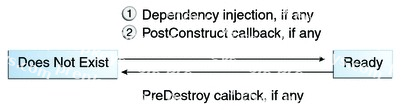
Assume you would like to receive notification from the container as a stateless session bean transitions to and from the ready state.
Which of the following life cycle back annotations would you use? (Choose one.)
Which API must an EJB 3.1 container make available to enterprise beans at runtime? (Choose one)
A developer wants to write a stateful session bean using the following interface as local business interface:
1. package acme;
2. public interface Bar {
3. public void bar ();
4. }
Assuming there is not an ejb-jar.xml file, which code can be inserted into Lines 4-6 below to define the bean with the ejb name of BarBean?
1. package acme;
2. import javax.ejb.*;
3. import java.io.*;
4.
5.
6.
7. }
A developer creates a stateful session bean that is used by many concurrent clients. The clients are written
by other development team; and it is assumed that these clients might not remove the bean when ending
their session. The number of concurrent sessions will be greater than the defined bean cache size.
The developer must consider that the state of the session bean can be influenced by either passivation or timeout.
Which three actions should the developer take to make the bean behave correctly in passivation and timeout situations? (Choose three.)
A stateful session bean contains a number of instance variables. The types of instance variables A and B are serializable. Instance variable B is a complex type which is populated by many business calls, and can, therefore, not be refilled by the client without starting all over. A helper instance variable C is defined as having a Serializable type, and can hold all the information which is in variable B. for example, B is of type XML-DOM tree and C of Type String.
Which two solutions, when combined, maintain the state of the session bean over a passivation and activation by the container? (Choose two.)
A developer writes a stateful session bean FooBean with one remote business interface Foo. Foo defines an integer / setter method pair implemented as:
10. private int value;
11. public void setValue (int i) {value = i; }
12. public int getValue () {return value; }
A session bean ClientBean has a business method doSomething and an ejb-ref with ejb-ref-name "fooRef" that is mapped to FooBean's Foo interface.
11. @Resource private SessionContext SessionCtx;
12. public void doSomething () {
13. Foo foo1 = (Foo) sessionCtx.lookup("fooRef");
14. Foo foo2 = (Foo) sessionCtx.lookup("fooRef");
15. foo1.setvalue(1);
Which statement is true after the code at line 15 completes?
A developer writes a stateless session bean FooBean with one remote business interface FooRemote containing one business method foo. Method foo takes a single parameter of application-defined type
MyData.
11. public class MyData implements java.io.Serialization {
12. int a;
13. }
Methods foo is implemented with the FooBean class as:
11. public void foo (MyData data) {
12. data.a = 2;
13. }
Another session bean within the same application has a reference to FooRemote in variable fooRef and calls method foo with the following code:
11. MyData data = new MyData();
12. data.a = 1;
13. fooRef.foo(data);
14. System.out.printIn(data.a);
What is the value of data.a when control reaches Line 14 of the client?