Exit demo 1Z0-997-22 Oracle Cloud Infrastructure 2022 Architect Professional PDF format · free preview

Oracle 1Z0-997-22 - Questions & Answers

Free preview · every answer includes a full explanation

Product page: https://prepkeys.com/1z0-997-22.html

Question 1
Multiple choice

A company has an application that processes confidential data. The data is currently stored in an on-premises data center. A solution architect needs to move this data to Oracle Cloud Infrastructure (OCI)
Object Storage and ensure data is encrypted in-transit to OCI.

Which two steps should the solution architect perform to set up the most cost-effective connection between on-premises data center and OCI?

A.

Set up private end point for accessing Object Storage.

B.

Attach an Internet Gateway to Virtual Cloud network(VCN).

C.

Configure a service gateway accessing Object Storage.

D.

Set up an IPsec tunnel between the customer equipment and software VPN on an oci instance

E.

Configure a private peering connection on the Oracle FastConnect

F.

Set up VPN Connect between the customer equipment and the Dynamic Routing Gateway.

Question 2
Single choice

You are working as a solutions architect for an online retail store In Frankfurt which uses multiple compute instance VMs spread among three availability domains In the eu-frankfurt-1 region.

You noticed the website Is having very high traffic, so you enabled autoscaling to sun tee me no f your application but, you observed that one of the availability domains is not receiving any traffic.

What could be wrong In this situation?

A.

Autoscaling only works with single availability domains.

B.

You have to manually acid all three availability domains to your load balancer configuration.

C.

Autoscaling can be enabled for multiple availability domains only in uk-london t region.

D.

Autoscaling is using an Instance Pool configured to create instances in two availability Domains.

E.

You forgot to attach a load balancer to your instance pool configuration.

Question 3
Single choice

A global media organization is working on a project which lets users upload their videos to the site. After upload is complete, the video should be automatically processed by an Al algorithm. The algorithm will try to recognize certain actions in the videos so that it can be used to show related advertisements in future.
The development team wants to focus on writing Al code and not worry about underlying infrastructure for high availability, scalability, security and monitoring.

Which Oracle Cloud Infrastructure (OCI) services would meet these requirements?

A.

OCI Object Storage, OCI Events service and OCI Functions.

B.

Oracle Container Engine for Kubernetes, OCI Notifications and OCI Object Storage.

C.

OCI Events, Oracle Container Engine for Kubernetes and OCI Digital Assistant.

D.

OCI Resource Manager, OCI Functions and OCI Events service.

Question 4
Single choice

You developed a microservices based application that runs on Oracle Cloud Infrastructure (OCI) Container Engine for

Kubernetes (OKE). It has multiple endpoints that needs to be exposed to the public internet.

What Is the most cost-effective way to expose multiple application endpoints without adding complexity to the application?

A.

Use clusterlP service type in Kubernetesfor each of yourservice endpointand use a load balancerto expose the endpoints.

B.

Use separate load balancerinstancefor each service but use the 100 Mbps loadbalanceroption.

C.

Deploy an Ingress controllerand use it to expose each endpointwith its own routing endpoint.

D.

Use NodePort service type in Kubernetesfor each of yourservice endpointand use node's public IP address to acccess the applications.

Question 5
Multiple choice

A cloud engineer needs to enable routing between two Virtual Cloud Networks (VCN) from his tenancy.
The VCNs are in the same region but in different compartments. After reviewing the IPv4 CIDR prefixes of the two VCNs, he notices that there are no overlapping CIDR blocks.

Which THREE are valid Oracle Cloud Infrastructure (OCI) options for connecting and routing between the two VCNs? (Choose three.)

A.

Create two DRGs in the tenancy. Attach one VCN to one of the DRGs; attach the other VCN to the
second DRG. In each one of the DRGs, create a Virtual Circuit Attachment.
Select FastConnect Partner as the FastConnect type. Select any vendor from the list and complete the circuit at the partner site. Once the FastConnect IPv4 BGP field is in the UP state in each one of the Virtual Circuits, add a route rule in each one of the VCNs' route table to the other VCN using the DRG as the next hop.

B.

Create two DRGs in the tenancy. Attach one VCN to one of the DRGs; attach the other VCN to the
second DRG. In each one of the DRGs, create a Remote Peering Connection (RPC). Establish a connection from one RPC to the other. In each one of the VCNs' route table, add a route rule to the other VCN using the DRG as the next hop.

C.

Create a DRG in the tenancy; add one of the VCN as a VCN attachment. In the other VCN, create a
Local Peering Gateway (LPG). Peer the DRG to the LPG. In the VCN attached to the DRG, add a route rule in the route table that points to the DRG as the next hop. In the other VCN, add a route rule in the route table that points to the LPG as the next hop.

D.

Add an LPG to each one of the VCNs. In one of the LPG, establish a Peering Connection to the other LPG. In each one of the VCN route table, add a route rule to the other VCN using the LPG as the next hop.

E.

Create a DRG in the tenancy; add one of the VCNs as a VCN attachment. In the other VCN, create a
Local Peering Gateway (LPG). Peer the DRG to the LPG. In the VCN attached to the DRG, enable BGP routing for the route to propagate to the VCN. In the other VCN add a route rule in the route table that points to the LPG as the next hop.

F.

Create a Dynamic Routing Gateway (DRG) in the tenancy, add the two VCNs as VCN attachments and add routes in each one of the VCN route tables with the DRG as the next hop for the CIDR prefix of the other VCN.

Question 6
Single choice

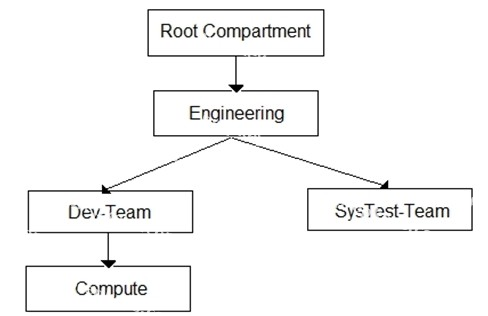
Given this compartment structure:

You are managing a compute instance that currently resides in the Compute compartment. The Virtual Cloud Network (VCN) into which the compute instance was originally deployed, also resides in this compartment. To support a project-related task, you need to move just the compute instance to the SysTest-Team compartment. You log into your Oracle Cloud Infrastructure (OCI) account and use the Move Resource option to place the compute instance in the new compartment.

What will be the result of your attempt to move the compute instance to the new compartment? (Choose the best answer.)

A.

The move will be successful. The compute instance's public and private IP addresses will stay the same. The compute instance will remain associated with the VCN from the source compartment.

B.

The move will fail and you will be prompted to move the VCN first. Once VCN is moved to the target compartment, the compute instance can be moved.

C.

After moving the compute instance, you must move the compute instance VNIC as a separate action.
The public and private IP addresses of the instance will remain unchanged and it will still be associated with the VCN from the source compartment.

D.

The move will be successful. However, the compute instance's public and private IP addresses will change, and it will be associated to the first VCN that was created in the new, target compartment.

Question 7
Single choice

A large London based eCommerce company is running Oracle DB System Virtual RAC database on Oracle Cloud Infrastructure (OCI) for their eCommerce application activity. They are launching a new product soon, which is expected to sell in large quantities all over the world.

The application architecture should have minimal cost, no data loss, no performance impacts during the database backup windows and should have minimal downtime.

A.

Launch a new VM RAC database in another availability domain, launch a compute instance, deploy Oracle GoldenGate on it and then configure it to replicate the data from the eCommerce Database over to the new RAC database using GoldenGate. Take backups from the new VM RAC database.

B.

Turn off automated backups from the eCommerce database, implement Oracle Data Guard with the Standby database deployed on another availability domain, take backups from the standby database.

C.

Launch a new VM RAC database in another availability domain, launch a compute instance, deploy Oracle GoldenGate on it and then configure bi-directional replication from the eCommerce Database over to the new VM RAC database using GoldenGate. Take backups from the new VM RAC database.

D.

Turn off automatic backups from the eCommerce database, implement Oracle Active Data Guard with the standby database deployed on another availability domain, and take backups from the standby database.

Question 8
Single choice

You are working as a cloud engineer for an IoT startup company which is developing a health monitoring pet collar for dogs and cats. The company collects biometric Information of the pet every second and then sends it to Oracle Cloud Infrastructure (OCI) Your task is to come up with an architecture which will accept and process the monitoring data as well as provide complete trends and health reports to the pet owners.
The portal should be highly available, durable, and scalable with an additional feature for showing real time biometric data analytics.

Which architecture will help you meet this requirement?

A.

Use OCI Streaming Service to collect the incoming biometric data. Use Oracle Functions to process the date and show the results on a real-time dashboard and store the results lo OCI Object Storage Store the data In OCI Autonomous Data warehouse (ADW) to handle analytics.

B.

Launch an open source Hadoop cluster to collect the Incoming biometrics data Use an Open source Fluentd cluster to analyze the-data me results to OCI Autonomous Transaction Processing (ADW)to handle complex analytics

C.

Create an OCI Object Storage bucket to collect the incoming biometric data from the smart pet collar Fetch the data horn OC\ Object storage to OCI Autonomous Data Warehouse (ADW) every day and run analytics Jobs with it

D.

Use OCI Streaming Service to collect the incoming biometric data. Use an open source Hadoop cluster to analyze the data horn streaming service. Store the results to OCI Autonomous Data warehouse (ADW) to handle complex analytics.

Question 9
Single choice

You are designing the network infrastructure for two application servers: appserver-1 and appserver-2 running in two different subnets inside the same Virtual Cloud Network (VCN) Oracle Cloud Infrastructure (OCI). You have a requirement where your end users will access appserver-1 from the internet and appserver-2 from the on-premises network. The on-premises network is connected to your VCN over a FastConnect virtual circuit.

How should you design your routing configuration to meet these requirements?

A.

Configure a single routing table (Route Table-1) that has two set of rules. One that has route to internet via the internet Gateway and another that propagate specific routes for the on-premise network via the Dynamic Routing Gateway. Associate the routing table with all the VCN subnets.

B.

Configure a single routing table (Routing Table-1) that has two set of rules: one that has route to internet via the Internet Gateway and another that propagates specific routes for the on-premises network via Dynamic Routing Gateway (DRG). Associate the routing table with the VCN.

C.

Configure two routing tables: Route Table-1 that has a route to internet via the Internet gateway.
Associate this route table to the subnet containing appserver-1. Route Table-2 that propagate specific routes for the on-premises network via the Dynamic Routing Gateway (DRG) Associate this route table to subnet containing appserver-2.

D.

Configure two routing table (Route table-1 Route Table-2) that have rule to route all traffic via the Dynamic Routing Gateway (DRG) Associate the two routing tables with all the VCN subnets.

Question 10
Single choice

A telecom company has an application running in Oracle Cloud Infrastructure (OCI) Germany Central (eu-frankfurt-1) region. They want to configure Disaster Recovery (DR) site in the OCI UK South (uk-london-1) region.

Which is the most cost effective option to help set up application and persistence layers in the DR site?

A.

Application layer: configure events service rule in eu-frankfurt-1 region to filter Health Checks event failure and route traffic to uk-london-1 region in the event of a disaster.
Persistence layer: set up policy to schedule cross-region automated backups of block volumes between eu-frankfurt-1 and uk-london-1 regions.

B.

Application layer: configure Traffic Management steering policy with Load Balancing policy between servers in eu-frankfurt-1 and uk-london-1 regions.
Persistence layer: set up policy to schedule cross-region automated backups of block volumes between eu-frankfurt-1 and uk-london-1 regions.

C.

Application layer: Set us a public laod balancerin the eu-frankfurt-1 region. Create a backend set with instances running in bothuk-frankfurt-1 and uk-london-1 regions.
Persistence layer: Set up OCI Object Storage replication from eu-frankfurt-1 region to uk-london-1 region.

D.

Application layer: configure Traffic Management steering policy with Failover policy between servers in eu-frankfurt-1 and uk-london-1 regions.
Persistence layer: set up policy to schedule cross-region automated backups of file systems in File Storage service between eu-frankfurt-1 and uk-london-1 regions.

Showing 10 of 165 questions · Unlock the full set