Cisco 200-101 - Questions & Answers
Free preview · every answer includes a full explanation
Product page: https://prepkeys.com/200-101.html
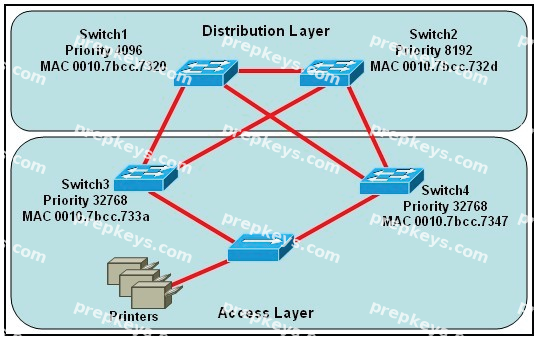
Refer to the exhibit
.
Which switch provides the spanning-tree designated port role for the network segment that services the printers?
Switch1
Switch2
Switch3
Switch4
Explanation:
First, the question asks what switch services the printers, so it can be Switch 3 or Switch 4 which is connected directly to the Printers.
Designated port is a port that is in the forwarding state. All ports of the root bridge are designated ports.
Switch 3 and Switch 4 has same priority so it will see on lowest MAC address and here switch 3 has lowest MAC address. So switch 3 segment will play a Designated port role. By comparing the MAC address of Switch 3 and Switch 4 we found that the MAC of Switch 3 is smaller. Therefore the interface connected to the Printers of Switch 3 will become designated interface and the interface of Switch 4 will be blocked.
Refer to the exhibit.
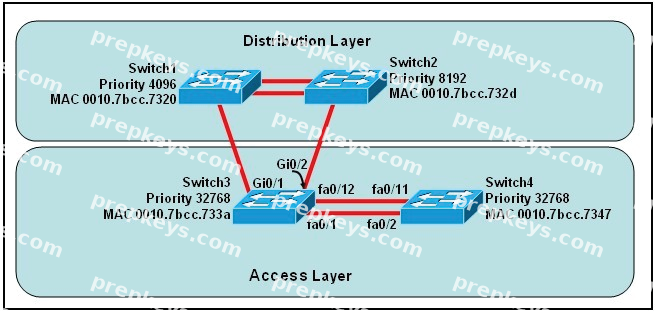
At the end of an RSTP election process, which access layer switch port will assume the discarding role?
Switch3, port fa0/1
Switch3, port fa0/12
Switch4, port fa0/11
Switch4, port fa0/2
Switch3, port Gi0/1
Switch3, port Gi0/2
Explanation: In this question, we only care about the Access Layer switches (Switch3 & 4). Switch 3 has a lower bridge ID than Switch 4 (because the MAC of Switch3 is smaller than that of Switch4) so both ports of Switch3 will be in forwarding state. The alternative port will surely belong to Switch4.
Switch4 will need to block one of its ports to avoid a bridging loop between the two switches. But how does Switch4 select its blocked port? Well, the answer is based on the BPDUs it receives from Switch3. A BPDU is superior than another if it has:
1. A lower Root Bridge ID 2. A lower path cost to the Root
3. A lower Sending Bridge ID 4. A lower Sending Port ID
These four parameters are examined in order. In this specific case, all the BPDUs sent by Switch3 have the same Root Bridge ID, the same path cost to the Root and the same Sending Bridge ID. The only parameter left to select the best one is the Sending Port ID (Port ID = port priority + port index). In this case the port priorities are equal because they use the default value, so Switch4 will compare port index values, which are unique to each port on the switch, and because Fa0/12 is inferior to Fa0/1, Switch4 will select the port connected with Fa0/1 (of Switch3) as its root port and block the other port -> Port fa0/11 of Switch4 will be
blocked (discarding role)
Refer to the exhibit.
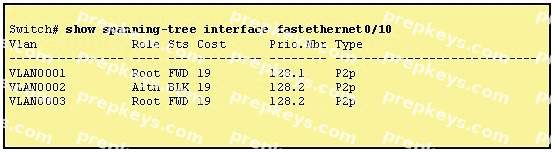
Given the output shown from this Cisco Catalyst 2950, what is the reason that interface FastEthernet 0/10 is not the root port for VLAN 2?
This switch has more than one interface connected to the root network segment in VLAN 2.
This switch is running RSTP while the elected designated switch is running 802.1d Spanning Tree.
This switch interface has a higher path cost to the root bridge than another in the topology.
This switch has a lower bridge ID for VLAN 2 than the elected designated switch.
Explanation: These four parameters are examined in order to make root bridge , root port , designated port. Other switch has lowest Sending Bridge ID or Sending
Port ID so vlan 2 is not the root port.
1. A lower Root Bridge ID 2. A lower path cost to the Root
3. A lower Sending Bridge ID 4. A lower Sending Port ID
Which two of these statements regarding RSTP are correct? (Choose two.)
RSTP cannot operate with PVST+.
RSTP defines new port roles.
RSTP defines no new port states.
RSTP is a proprietary implementation of IEEE 802.1D STP.
RSTP is compatible with the original IEEE 802.1D STP.
Explanation:
http://www.cisco.com/en/US/tech/tk389/tk621/technologies_white_paper09186a0080094cfa.shtml
Port Roles
The role is now a variable assigned to a given port. The root port and designated port roles remain, while the blocking port role is split into the backup and alternate port roles. The Spanning Tree Algorithm (STA) determines the role of a port based on Bridge Protocol Data Units (BPDUs). In order to simplify matters, the thing to remember about a BPDU is there is always a method to compare any two of them and decide whether one is more useful than the other. This is based on the value stored in the BPDU and occasionally on the port on which they are received. This considered, the information in this section explains practical approaches to port roles.
Compatibility with 802.1D RSTP is able to interoperate with legacy STP protocols. However, it is important to note that the inherent fast convergence benefits of 802.1w are lost when it interacts with legacy bridges.
Refer to the exhibit.
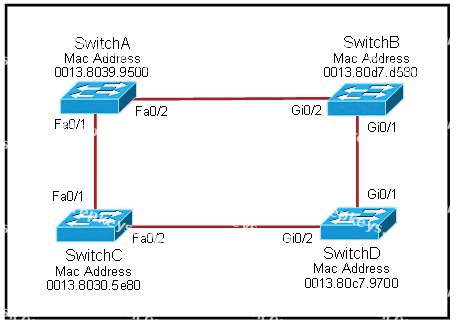
Each of these four switches has been configured with a hostname, as well as being configured to run RSTP. No other configuration changes have been made.
Which three of these show the correct RSTP port roles for the indicated switches and interfaces? (Choose three.)
SwitchA, Fa0/2, designated
SwitchA, Fa0/1, root
SwitchB, Gi0/2, root
SwitchB, Gi0/1, designated
SwitchC, Fa0/2, root
SwitchD, Gi0/2, root
Explanation:
The question says "no other configuration changes have been made" so we can understand these switches have the same bridge priority. SwitchC has lowest MAC address so, it will become root bridge and 2 of its ports (Fa0/1 & Fa0/2) will be designated ports (DP). Because SwitchC is the root bridge the 2 ports nearest SwitchC on SwitchA (Fa0/1) and SwitchD (Gi0/2) will be root ports (RP) -> B and F are correct.
SwitchB must have a root port so which port will it choose? To answer this question we need to know about STP cost and port cost.
In general, "cost" is calculated based on bandwidth of the link. The higher the bandwidth on a link, the lower the value of its cost. Below are the cost values you should memorize: Link speed Cost SwitchB will choose the interface with lower cost to the root bridge as the root port so we must calculate the cost on interface Gi0/1 & Gi0/2 of SwitchB to the root bridge. This can be calculated from the "cost to the root bridge" of each switch because a switch always advertises its cost to the root bridge in its BPDU. The receiving switch will add its local port cost value to the cost in the BPDU.
SwitchC advertises its cost to the root bridge with a value of 0. Switch D adds 4 (the cost value of 1Gbps link) and advertises this value (4) to SwitchB. SwitchB adds another 4 and learns that it can reach SwitchC via Gi0/1 port with a total cost of 8. The same process happens for SwitchA and SwitchB learns that it can reach SwitchC via Gi0/2 with a total cost of 23 -> Switch B chooses Gi0/1 as its root port.
Now our last task is to identify the port roles of the ports between SwitchA & SwitchB. It is rather easy as the MAC address of SwitchA is lower than that of SwitchB so Fa0/2 of SwitchA will be designated port while Gi0/2 of SwitchB will be alternative port.
Which port state is introduced by Rapid-PVST?
learning
listening
discarding
forwarding
Explanation:
Spanning Tree from PVST+ to Rapid-PVST Migration Configuration Example Reference 1:
http://www.cisco.com/en/US/products/hw/switches/ps708/products_configuration_example09186a00807
b0670.shtml
Reference 2:
http://www.cisco.com/en/US/tech/tk389/tk621/technologies_white_paper09186a0080094cfa.shtml
Explanation:
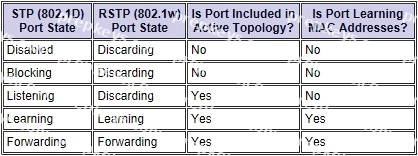
PVST+ is based on IEEE802.1D Spanning Tree Protocol (STP). But PVST+ has only 3 port states (discarding, learning and forwarding) while STP has 5 port states (blocking, listening, learning, forwarding and disabled). So discarding is a new port state in PVST+.
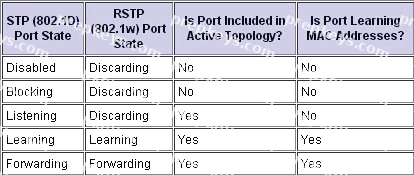
Background Information 802.1D Spanning Tree Protocol (STP) has a drawback of slow convergence. Cisco Catalyst switches support three types of STPs, which are PVST+, rapid-PVST+ and MST. PVST+ is based on IEEE802.1D standard and includes Cisco proprietary extensions such as BackboneFast, UplinkFast, and PortFast. Rapid-PVST+ is based on IEEE 802.1w standard and has a faster convergence than 802.1D. RSTP (IEEE 802.1w) natively includes most of the Cisco proprietary enhancements to the 802.1D Spanning Tree, such as BackboneFast and UplinkFast. Rapid-PVST+ has these unique features:
Uses Bridge Protocol Data Unit (BPDU) version 2 which is backward compatible with the 802.1D STP, which uses BPDU version 0.
All the switches generate BPDUs and send out on all the ports every 2 seconds, whereas in 802.1D STP only the root bridge sends the configuration BPDUs. Port Roles--Root port, designated port, alternate port and backup port.
Port States--Discarding, Learning, and Forwarding.
Port Types--Edge Port (PortFast), Point-to-Point and Shared port. Rapid-PVST uses RSTP to provide faster convergence. When any RSTP port receives legacy 802.1D BPDU, it falls back to legacy STP and the inherent fast convergence benefits of 802.1w are lost when it interacts with legacy bridges.
Which two states are the port states when RSTP has converged? (Choose two.)
discarding
listening
learning
forwarding
disabled
Explanation:
Understanding Rapid Spanning Tree Protocol (802.1w)
http://www.cisco.com/en/US/tech/tk389/tk621/technologies_white_paper09186a0080094cfa.shtml
Port States
There are only three port states left in RSTP that correspond to the three possible operational states. The 802.1D disabled, blocking, and listening states are merged into a unique 802.1w discarding state.
RSTP only has 3 port states which are discarding, learning and forwarding. When RSTP has converged there are only 2 port states left: discarding and forwarding.
Which three statements about RSTP are true? (Choose three.)
RSTP significantly reduces topology reconverging time after a link failure.
RSTP expands the STP port roles by adding the alternate and backup roles.
RSTP port states are blocking, discarding, learning, or forwarding.
RSTP provides a faster transition to the forwarding state on point-to-point links than STP does.
RSTP also uses the STP proposal-agreement sequence.
RSTP uses the same timer-based process as STP on point-to-point links.
Explanation:
http://www.cisco.com/en/US/tech/tk389/tk621/technologies_white_paper09186a0080094cfa.shtml
Convergence
Cisco enhanced the original 802.1D specification with features such as Uplink Fast, Backbone Fast, and Port Fast to speed up the convergence time of a bridged network. The drawback is that these mechanisms are proprietary and need additional configuration.
Alternate and Backup Port Roles These two port roles correspond to the blocking state of 802.1D. A blocked port is defined as not being the designated or root port. A blocked port receives a more useful BPDU than the one it sends out on its segment.
Remember that a port absolutely needs to receive BPDUs in order to stay blocked. RSTP introduces these two roles for this purpose.
Rapid Transition to Forwarding State Rapid transition is the most important feature introduced by 802.1w. The legacy STA passively waited for the network to converge before it turned a port into the forwarding state. The achievement of faster convergence was a matter of tuning the conservative default parameters (forward delay and max_age timers) and often put the stability of the network at stake. The new rapid STP is able to actively confirm that a port can safely transition to the forwarding state without having to rely on any timer configuration. There is now a real feedback mechanism that takes place between RSTP-compliant bridges. In order to achieve fast convergence on a port, the protocol relies upon two new variables: edge ports and link type.
At which layer of the OSI model is RSTP used to prevent loops?
physical
data link
network
transport
Explanation: RSTP and STP operate on switches and are based on the exchange of Bridge Protocol Data Units (BPDUs) between switches. One of the most important fields in BPDUs is the Bridge Priority in which the MAC address is used to elect the Root Bridge , RSTP operates at Layer 2.
http://www.cisco.com/en/US/tech/tk389/tk621/technologies_white_paper09186a0080094cfa.shtml
What is one benefit of PVST+?
PVST+ supports Layer 3 load balancing without loops.
PVST+ reduces the CPU cycles for all the switches in the network.
PVST+ allows the root switch location to be optimized per VLAN.
PVST+ automatically selects the root bridge location, to provide optimized bandwidth usage.
Explanation:
Per VLAN Spanning Tree (PVST)
Introduction
http://www.cisco.com/en/US/tech/tk389/tk621/tk846/tsd_technology_support_sub-protocol_home.html
Per VLAN Spanning Tree (PVST) maintains a spanning tree instance for each VLAN configured in the network. This means a switch can be the root bridge of a VLAN while another switch can be the root bridge of other VLANs in a common topology. For example, Switch 1 can be the root bridge for Voice data while Switch 2 can be the root bridge for Video data. If designed correctly, it can optimize the network traffic.
http://www.ciscopress.com/articles/article.asp?p=102157&seqNum=4
Showing 10 of 148 questions · Unlock the full set