Cisco 200-105 - Questions & Answers
Free preview · every answer includes a full explanation
Product page: https://prepkeys.com/200-105.html
Which protocol authenticates connected devices before allowing them to access the LAN?
802.1d
802.11
802.1w
802.1x
802.1X authentication involves three parties: a supplicant, an authenticator, and an authentication server.
The supplicant is a client device (such as a laptop) that wishes to attach to the LAN/WLAN. The term
'supplicant' is also used interchangeably to refer to the software running on the client that provides credentials to the authenticator. The authenticator is a network device, such as an Ethernet switch or wireless access point; and the authentication server is typically a host running software supporting the
RADIUS and EAP protocols.
The authenticator acts like a security guard to a protected network. The supplicant (i.e., client device) is not allowed access through the authenticator to the protected side of the network until the supplicant's identity has been validated and authorized. An analogy to this is providing a valid visa at the airport's arrival immigration before being allowed to enter the country. With 802.1X port-based authentication, the supplicant provides credentials, such as user name/password or digital certificate, to the authenticator, and the authenticator forwards the credentials to the authentication server for verification. If the authentication server determines the credentials are valid, the supplicant (client device) is allowed to access resources located on the protected side of the network.
What is a difference between TACACS+ and RADIUS in AAA?
Only TACACS+ allows for separate authentication.
Only RADIUS encrypts the entire access-request packet.
Only RADIUS uses TCP.
Only TACACS+ couples authentication and authorization.
Authentication and Authorization RADIUS combines authentication and authorization. The access-accept packets sent by the RADIUS server to the client contain authorization information. This makes it difficult to decouple authentication and authorization.
TACACS+ uses the AAA architecture, which separates AAA. This allows separate authentication solutions that can still use TACACS+ for authorization and accounting. For example, with TACACS+, it is possible to use Kerberos authentication and TACACS+ authorization and accounting. After a NAS authenticates on a Kerberos server, it requests authorization information from a TACACS+ server without having to re-authenticate. The NAS informs the TACACS+ server that it has successfully authenticated on a Kerberos server, and the server then provides authorization information. During a session, if additional authorization checking is needed, the access server checks with a TACACS+ server to determine if the user is granted permission to use a particular command. This provides greater control over the commands that can be executed on the access server while decoupling from the authentication mechanism.
Which statement about the IP SLAs ICMP Echo operation is true?
The frequency of the operation is specified in milliseconds.
It is used to identify the best source interface from which to send traffic to a destination.
It is configured in enable mode.
It is used to determine the one-way delay between devices.
This module describes how to configure an IP Service Level Agreements (SLAs) Internet Control Message Protocol (ICMP) Echo operation to monitor end-to-end response time between a Cisco router and devices using IPv4 or IPv6. ICMP Echo is useful for troubleshooting network connectivity issues. This module also demonstrates how the results of the ICMP Echo operation can be displayed and analyzed to determine how the network IP connections are performing.
ICMP Echo Operation
The ICMP Echo operation measures end-to-end response time between a Cisco router and any devices using IP. Response time is computed by measuring the time taken between sending an ICMP Echo request message to the destination and receiving an ICMP Echo reply.
In the figure below ping is used by the ICMP Echo operation to measure the response time between the source IP SLAs device and the destination IP device. Many customers use IP SLAs ICMP-based operations, in-house ping testing, or ping-based dedicated probes for response time measurements.
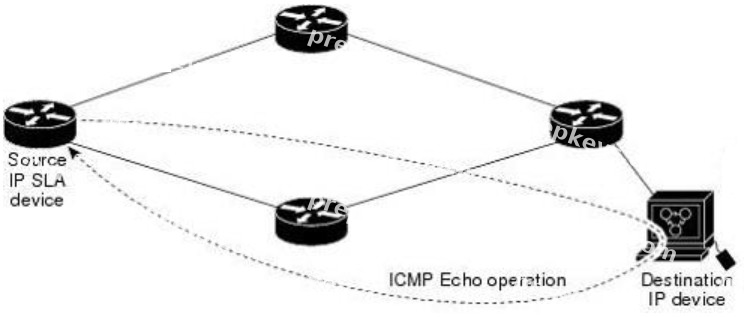
The IP SLAs ICMP Echo operation conforms to the same IETF specifications for ICMP ping testing and the two methods result in the same response times.
Configuring a Basic ICMP Echo Operation on the Source Device SUMMARY STEPS
1. enable
2. configure terminal
3. ip sla operation-number
4. icmp-echo {destination-ip-address | destination-hostname} [source-ip {ip-address | hostname} | source-
interface interface-name]
5. frequency seconds
6. end
Which type of interface can negotiate an IP address for a PPPoE client?
Ethernet
dialer
serial
Frame Relay
References:
http://www.cisco.com/c/en/us/td/docs/ios-xml/ios/bbdsl/configuration/xe-3s/bba-pppoe-client.html#GUID-FFFC40B9-3F50-484A-92FF-7458E7E4FC47
Which option is a benefit of switch stacking?
It provides redundancy with no impact on resource usage.
It simplifies adding and removing hosts.
It supports better performance of high-needs applications.
It provides higher port density with better resource usage.
A stackable switch is a network switch that is fully functional operating standalone but which can also be set up to operate together with one or more other network switches, with this group of switches showing the characteristics of a single switch but having the port capacity of the sum of the combined switches.
What is the first step you perform to configure an SNMPv3 user?
Configure server traps.
Configure the server group.
Configure the server host.
Configure the remote engine ID.
To configure an SNMP server user, specify an SNMP group or a table that maps SNMP users to SNMP views. Then, specify the IP address or port number for the remote SNMP agent of the device where the user resides. Also, before you configure remote users for a particular agent, configure the SNMP engine ID by using the snmp-server engineID command for the remote agent. The SNMP engine ID of the remote agent is required to compute the authentication or privacy digests for the SNMP password. If the remote engine ID is not configured first, the configuration command will fail.
SUMMARY STEPS
1. enable
2. configure terminal 3. snmp-server group [group-name {v1 | v2c | v3 [auth | noauth | priv]}] [read read-view] [writewrite-view]
[notify notify-view] [access access-list] 4. snmp-server engineID {local engine-id | remote ip-address [udp-port udp-port-number] [vrfvrf-name]
engine-id-string} 5. snmp-server user user-name group-name [remote ip-address [udp-port port]] {v1 | v2c | v3[encrypted]
[auth {md5 | sha} auth-password]} [access access-list]
6. end
References:
https://www.cisco.com/c/en/us/td/docs/ios-xml/ios/snmp/configuration/xe-3se/3850/snmp-xe-3se-3850-book/nm-snmp-snmpv3.html#GUID-E9B523ED-2DEE-44AE-BBEC-ABE75EF40B2A
Which spanning-tree feature places a port immediately into a forwarding state?
BPDU guard
PortFast
loop guard
UDLD
UplinkFast
PortFast causes a switch or trunk port to enter the spanning tree forwarding state immediately, bypassing the listening and learning states. You can use PortFast on switch or trunk ports that are connected to a single workstation, switch, or server to allow those devices to connect to the network immediately, instead of waiting for the port to transition from the listening and learning states to the forwarding state.
How can you disable DTP on a switch port?
Configure the switch port as a trunk.
Add an interface on the switch to a channel group.
Change the operational mode to static access.
Change the administrative mode to access.
Switchport Mode Access: This puts the interface (ACCESS PORT) into a PERMANENT NON-TRUNKING mode and negotiates to convert the link into a NON-TRUNK link. The port would be a dedicated Layer 2 access port! Switchport Nonegotiates: Prevents the interface from generating DTP Frames. You can use this command only when the interface switchport mode is (ACCESS/TRUNK).
If host Z needs to send data through router R1 to a storage server, which destination MAC address does host Z use to transmit packets?
the host Z MAC address
the MAC address of the interface on R1 that connects to the storage server
the MAC address of the interface on R1 that connects to host Z.
the MAC address of the storage server interface.
Which Cisco platform can verify ACLs?
Cisco Prime Infrastructure
Cisco Wireless LAN Controller
Cisco APIC-EM
Cisco IOS-XE
Showing 10 of 709 questions · Unlock the full set