Exit demo 352-011 Cisco Certified Design Expert Practical PDF format · free preview

Cisco 352-011 - Questions & Answers

Free preview · every answer includes a full explanation

Product page: https://prepkeys.com/352-011.html

Question 1
Multiple choice

Which two options must be part of your network design to support dynamic mutual redistribution between multiple OSPFv2 and IS-IS boundaries, to avoid suboptimal routing? (Choose two)

A.

Matching OSPF external routes

B.

Route aggregation

C.

Route tagging

D.

Route filtering

E.

Disabling IS-IS wide metrics

Question 2
Single choice

Which DCI technology utilizes a "flood and learn" technique to populate the Layer 2 forwarding table?

A.

OTV

B.

E-VPN

C.

VPLS

D.

LISP

Question 3
Single choice

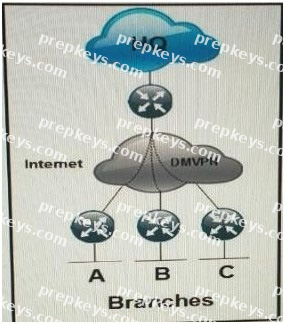
Refer to the exhibit.

Which routing solution is the most scalable to connect the branches to the HQ and to connect the branches together over the internet using DMVPN?

A.

EIGRP

B.

EIGRP with the branch routers setup as stubs

C.

OSPF with each branch router as an ABR

D.

IS-IS L2 in all locations

E.

OSPF Area 0 in all locations

Question 4
Multiple choice

Which two functions are performed at the distribution layer of the three-layer hierarchical network design model? (Choose two)

A.

Fast transport

B.

QoS classification and marking boundary

C.

Fault isolation

D.

Redundancy and load balancing

E.

Reliability

Question 5
Multiple choice

In which two ways is a network design improved by including IP Event Dampening? (Choose two)

A.

Provides sub-second convergence

B.

Quickly detects network failures

C.

Prevent routing loops

D.

Improves network stability

E.

Reduces processing load

Question 6
Single choice

Which option reduces jitter in a VoIP network?

A.

Deploy WRED

B.

Deploy call Admission Control

C.

Adjust the playout delay buffer at the receiver

D.

Increase the bandwidth of the links

Question 7
Single choice

There is an MPLS-enabled link constantly flapping on an MPLS VPN network.
Given that the network runs OSPF as the IGP protocol, which design mechanism will stabilize the network and avoid constant re-convergence?

A.

IP Event Dampening

B.

OSPF fast hellos

C.

IP SLA

D.

Partial SPF

Question 8
Single choice

Which solution prevents microloops from be formed during network convergence time?

A.

RSVP-TE

B.

LFA

C.

Prefix suppression

D.

RLFA

Question 9
Single choice

Company ABC grew organically and now their single-area OSPF network has an unacceptably slow convergence time after a topology change.
To address the slow convergence time, they want to introduce a multiarea OSPF design and implement address summarization at the area border routers, which option should be their main concern about this redesign?

A.

Routing is suboptimal

B.

SPF calculation takes longer

C.

Operations complexity is increased

D.

More memory is needed across the routers on the network

Question 10
Multiple choice

The enterprise customer ABC Corp will deploy a centralized unified communications application to provide voice, and instant messaging to their branch offices. Some of the branch offices are located in remote locations and are connected via a 1.5 Mb/s Layer 3 VPN connection.

Which two ways are the most cost-effective to ensure that this new application is implemented properly? (Choose two)

A.

Use a low bitrate codec such as G 711

B.

Set voice activity detection to avoid sending packets when the conversations is silent

C.

Enable VRF-Lite on the CE router to create a separate voice VRF

D.

Set LFI on the WAN connections to interleave the small voice packets with the large data packets

E.

Set WAN optimization on the CE router to compress the voice packets for improved bandwidth utilization and performance

F.

Use a low bitrate codec such as G 729

Showing 10 of 249 questions · Unlock the full set