Exit demo 642-437 Implementing Cisco Unified Communications Voice over IP and QoS v8.0 (CVOICE v8.0) PDF format · free preview

Cisco 642-437 - Questions & Answers

Free preview · every answer includes a full explanation

Product page: https://prepkeys.com/642-437.html

Question 1
Multiple choice

Which three Cisco IOS commands are required to configure a voice gateway as a DHCP server to support a data subnet with the IP address of 10.1.30.0/24 and a default gateway of 10.1.30.1/24? (Choose three.)

A.

ip dhcp pool

B.

subnet 10.1.30.1 255.255.255.0

C.

ip dhcp pool data

D.

network 10.1.30.1/24

E.

network 10.1.30.0 255.255.255.0

F.

default-gw 10.1.30.1/24

G.

default-router 10.1.30.1

Question 2
Multiple choice

Which four Cisco IOS commands are required to configure a DHCP server on a voice gateway to support a voice subnet so that both IP addresses and the IP address of the TFTP server are provided? The voice subnet has an address of 10.1.130.0/24, the default gateway is 10.1.130.1/24, and the TFTP server is located at 10.1.5.2. (Choose four.)

A.

subnet 10.1.130.1/24

B.

ip dhcp pool voice

C.

default-router 10.1.130.1

D.

option 150 10.1.5.2

E.

network 10.1.130.0 255.255.255.0

F.

dhcp pool voice

G.

option 150 ip 10.1.5.2

H.

default-gw 10.1.130.1

Question 3
Single choice

The router with the IP address of 10.1.120.1 needs to be configured to use the device 10.1.140.1 as the clock source.

Which configuration command will accomplish this task?

A.

clock source 10.1.140.1

B.

ntp server 10.1.140.1

C.

clock set 10.1.140.1

D.

ntp source ip addr 10.1.140.1

E.

ntp client 10.1.120.1 server 10.1.140.1

Question 4
Multiple choice

Which four types of ephone-dns are supported by SCCP in Cisco Unified Communications Manager Express? (Choose four.)

A.

single-line

B.

dual-line

C.

shared-line, nonexclusive

D.

two directory numbers with one telephone number

E.

dual-number

F.

octo-line

Question 5
Single choice

In which situation would an administrator configure telephony services, but not configure any individual ephones?

A.

Phones that are controlled by Cisco Unified Communications Manager Express

B.

Cisco Unified Communications Manager SRST fallback

C.

Cisco Unified Communications Manager Express with HSRP

D.

Remotely located phones that are controlled by a third-party PBX

E.

This is not a valid scenario. Ephones are always required.

Question 6
Single choice

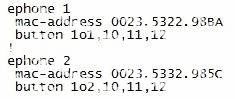
Refer to the exhibit.

Which type of ephone-dn is configured for the two ephones that are shown?
A.

single-line-octo

B.

hunt line

C.

shared-line, nonexclusive

D.

two directory numbers with one telephone number

E.

shared-line, overlay

F.

octo-line

Question 7
Multiple choice

Refer to the exhibit.

A new Cisco Unified Communications Manager Express system has been deployed and the technician is trying to add the first new IP phone to the system. The phone powers up, but it does not register with the system. The technician has verified that the phone is getting the proper VLAN information from Cisco Discovery Protocol. The phone is also getting the correct IP address and TFTP server address from DHCP. The phone has been assigned to an ephone and the correct MAC address is configured.
With the information provided, which two of the following does the administrator need to verify to resolve this situation? (Choose two.)

A.

Verify that the ip helper-address is correctly configured.

B.

Verify that telephony-service has been configured.

C.

Verify that the ephone has a button assigned.

D.

Verify that the tftp-server path has been configured.

E.

Verify that the Cisco Unified Communications Manager Express service is running.

F.

Verify that the correct phone type files are in the tftp-server path.

Question 8
Single choice

The administrator has added a new ephone-dn and a new ephone to the Cisco Unified Communications Manager Express system, but the new phone will not register with the system.
If other phones are operating properly, which of the following should the administrator do first to try to resolve the issue?

A.

Reboot the router.

B.

Remove the ephone, then re-add the ephone.

C.

Verify that the url authentication is configured for the correct authentication URL.

D.

Verify that the url services is configured to the correct URL for services.

E.

Enter the command no telephony-service, then enter telephony service in global configuration mode.

F.

Enter the command no create cnf-files, then enter create cnf-files under the telephony-service configuration.

Question 9
Multiple choice

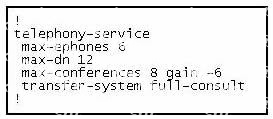
Refer to the exhibit.

Cisco Unified Communications Manager Express has been partially configured to support 6 IP phones and 12 directory numbers. The Cisco Unified Communications Manager Express will use the IP address 10.1.130.1/24.

Which two elements of the configuration are missing from the command output and need to be added so that phones do not auto-register, but can manually register with Cisco Unified Communications Manager Express? (Choose two.)

A.

ip address 10.1.130.1

B.

no reg-ephone

C.

create profile

D.

ip source-address 10.1.130.1

E.

create cnf-files

F.

no auto-reg-ephone

Question 10
Multiple choice

Which three functions are associated with MGCP? (Choose three.)

A.

Control is implemented by a series of plain-text commands that are sent over UDP port 2427 between Cisco Unified Communications Manager and the gateway.

B.

A PRI backhaul channel forwards PRI Layer 2 (Q.921) signaling information via a TCP connection from the gateway to the call agent.

C.

MGCP uses a separate channel for backhauling signaling information between the call agent and the gateway.

D.

The gateway maintains a separate dial plan for redundancy in case the call agent fails.

E.

Users query the call agent to determine the location of the call recipient.

F.

A call agent uses control messages to direct its gateways and their operational behavior.

Showing 10 of 256 questions · Unlock the full set