Cisco 642-524 - Questions & Answers
Free preview · every answer includes a full explanation
Product page: https://prepkeys.com/642-524.html
Tom works as a network administrator for the P4S company. The primary adaptive security appliance in an active/standby failover configuration failed, so the secondary adaptive security appliance was automatically activated. Tom then fixed the problem. Now he would like to restore the primary to active status.
Which one of the following commands can reactivate the primary adaptive security appliance and restore it to active status while issued on the primary adaptive security appliance?
For the following commands, which one enables the DHCP server on the DMZ interface of the Cisco ASA with an address pool of 10.0.1.100-10.0.1.108 and a DNS server of 192.168.1.2?
Look at the following exhibit carefully, which one of the four diagrams displays a correctly configured network for a transparent firewall?
What is the effect of the per-user-override option when applied to the access-group command syntax?
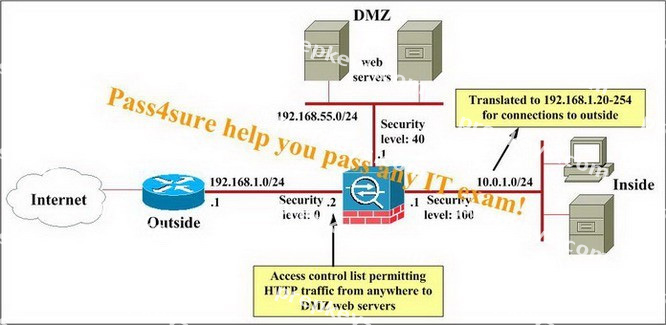
John works as a network administrator for the P4S company. According to the exhibit, the only traffic that John would like to allow through the corporate Cisco ASA adaptive security appliance is inbound HTTP to the DMZ network and all traffic from the inside network to the outside network. John also has configured the Cisco ASA adaptive security appliance, and access through it is now working as expected with one exception: contractors working on the DMZ servers have been surfing the Internet from the DMZ servers, which (unlike other Company XYZ hosts) are using public, routable IP addresses. Neither NAT statements nor access lists have been configured for the DMZ interface.
What is the reason that the contractors are able to surf the Internet from the DMZ servers?
(Note: The 192.168.X.X IP addresses are used to represent routable public IP addresses even though the 192.168.1.0 network is not actually a public routable network.)
In order to recover the Cisco ASA password, which operation mode should you enter?
Which three statements correctly describe protocol inspection on the Cisco ASA adaptive security appliance? (Choose three.)
Observe the following commands, which one verifies that NAT is working normally and displays active NAT translations?
Multimedia applications transmit requests on TCP, get responses on UDP or TCP, use dynamic ports, and use the same port for source and destination, so they can pose challenges to a firewall.
Which three items are true about how the Cisco ASA adaptive security appliance handles multimedia applications? (Choose three.)
What is the result if the WebVPN url-entry parameter is disabled?