Cisco 642-642 - Questions & Answers
Free preview · every answer includes a full explanation
Product page: https://prepkeys.com/642-642.html
Which of the following configurations requires the use of hierarchical policy maps?
the use of nested class-maps with class-based marking
the use of a strict priority-class queue within CBWFQ
the use of class-based WRED within a CBWFQ class queue
the use of CBWFQ inside class-based shaping
the use of both the bandwidth and shape statements within a CBWFQ class queue
Explanation:
Class-based weighted fair queuing (CBWFQ) extends the standard WFQ functionality to provide support for user-defined traffic classes. By using CBWFQ, network managers can define traffic classes based on several match criteria, including protocols, access control lists (ACLs), and input interfaces. A FIFO queue is reserved for each class, and traffic belonging to a class is directed to the queue for that class. More than one IP flow, or "conversation", can belong to a class. Once a class has been defined according to its match criteria, the characteristics can be assigned to the class. To characterize a class, assign the bandwidth and maximum packet limit. The bandwidth assigned to a class is the guaranteed bandwidth given to the class during congestion. CBWFQ assigns a weight to each configured class instead of each flow. This weight is proportional to the bandwidth configured for each class. Weight is equal to the interface bandwidth divided by the class bandwidth. Therefore, a class with a higher bandwidth value will have a lower weight. By default, the total amount of bandwidth allocated for all classes must not exceed 75 percent of the available bandwidth on the interface. The other 25 percent is used for control and routing traffic. The queue limit must also be specified for the class. The specification is the maximum number of packets allowed to accumulate in the queue for the class. Packets belonging to a class are subject to the bandwidth and queue limits that are configured for the class.
In a managed CE scenario, the customer's network is supporting VoIP and bulk file transfers.
According to the best practices, which QoS mechanisms should be applied on the WAN edge CE-PE 56-kbps Frame Relay link on the CE outbound direction?
LLQ, CB-WRED, CB-Marking, FRTS, FRF.12, and CB-RTP header compression
CBWFQ, FRTS, FRF.12, and CB-RTP header compression
WRR, CB-WRED, CB-Marking, FRF.12, and CB-RTP header compression
WRR, FRTS, FRF.12, and CB-RTP header compression
LLQ, CB-WRED, CB-Policing, and CB-TCP and CB-RTP header compressions
CBWFQ, CB-WRED, CB-Marking, CB-Policing, and FRTS
Explanation:
1. WRED can be combined with CBWFQ. In this combination CBWFQ provides a guaranteed percentage of the output bandwidth, WRED ensures that TCP traffic is not sent faster than CBWFQ can forward it.
The abbreviated configuration below shows how WRED can be added to a policy-map specifying CBWFQ: Router(config)#policy-map prioritybwRouter(config-pmap)#class class-default fair- queueRouter(config- pmap-c)#class prioritytraffic bandwidth percent 40 random-detect The random-detect parameter specifies that WRED will be used rather than the default tail-drop action.
2. The LLQ feature brings strict Priority Queuing (PQ) to CBWFQ. Strict PQ allows delay-sensitive data such as voice to be sent before packets in other queues are sent. Without LLQ, CBWFQ provides WFQ based on defined classes with no strict priority queue available for real-time traffic. For CBWFQ, the weight for a packet belonging to a specific class is derived from the bandwidth assigned to the class. Therefore, the bandwidth assigned to the packets of a class determines the order in which packets are sent. All packets are serviced fairly based on weight and no class of packets may be granted strict priority. This scheme poses problems for voice traffic that is largely intolerant of delay, especially variation in delay. For voice traffic, variations in delay introduce irregularities of transmission manifesting as jitter in the heard conversation. LLQ provides strict priority queuing for CBWFQ, reducing jitter in voice conversations.
LLQ enables the use of a single, strict priority queue within CBWFQ at the class level. Any class can be made a priority queue by adding the priority keyword. Within a policy map, one or more classes can be given priority status. When multiple classes within a single policy map are configured as priority classes, all traffic from these classes is sent to the same, single, strict priority queue. Although it is possible to queue various types of real-time traffic to the strict priority queue, it is strongly recommend that only voice traffic be sent to it because voice traffic is well-behaved, whereas other types of real-time traffic are not.
Moreover, voice traffic requires that delay be non-variable in order to avoid jitter. Real-time traffic such as video could introduce variation in delay, thereby thwarting the steadiness of delay required for successful voice traffic transmission. When the priority command is specified for a class, it takes a bandwidth argument that gives maximum bandwidth in kbps. This parameter specifies the maximum amount of bandwidth allocated for packets belonging to the class configured. The bandwidth parameter both guarantees bandwidth to the priority class and restrains the flow of packets from the priority class. In the event of congestion, policing is used to drop packets when the bandwidth is exceeded.
Voice traffic queued to the priority queue is UDP-based and therefore not adaptive to the early packet drop characteristic of WRED. Because WRED is ineffective, the WRED random-detect command cannot be used with the priority command. In addition, because policing is used to drop packets and a queue limit is not imposed, the queue-limit command cannot be used with the priority command.
Refer to the partial router configuration.
Which two of the following statements are true? (Choose two.)
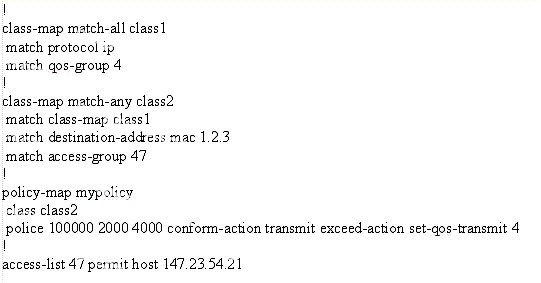
Regardless of destination IP address, all traffic sent to Mac address 1.2.3 will be subject to policing
All traffic from a server with the IP address of 147.23.54.21 will be subject to policing.
Any IP packet will be subject to policing.
The class-map class1 command will set the qos-group value to 4 for all IP packets.
Only those packets which satisfy all of the matches in class1 and class2 will be subject to policing.
The configuration is invalid since it refers to a class map within a different class.
Explanation:
The class-map command is used to define a traffic class. The purpose of a traffic class is to classify traffic that should be given a particular QoS. A traffic class contains three major elements, a name, a series of match commands, and if more than one match command exists in the traffic class, an instruction on how to evaluate these match commands. The traffic class is named in the class-map command line. For example, if the class-map cisco command is entered while configuring the traffic class in the CLI, the traffic class would be named cisco.
Switch(config)#class-map ciscoSwitch(config-cmap)# match commands are used to specify various criteria for classifying packets. Packets are checked to determine whether they match the criteria specified in the match commands. If a packet matches the specified criteria, that packet is considered a member of the class and is forwarded according to the QoS specifications set in the traffic policy. Packets that fail to meet any of the matching criteria are classified as members of the default traffic class and will be subject to a separate traffic policy The policy-map command is used to create a traffic policy. The purpose of a traffic policy is to configure the QoS features that should be associated with the traffic that has been classified in a user-specified traffic class. A traffic
policy contains three elements:
The policy-map shown below creates a traffic policy named policy 1. The policy applies to all traffic classified by the previously defined traffic-class "cisco" and specifies that traffic in this example should be allocated bandwidth of 3000 kbps. Any traffic which does not belong to the class "cisco" forms part of the catch-all class-default class and will be given a default bandwidth of 2000 kbps. Switch(config)#policy-map policy1Switch(config-pmap)#class ciscoSwitch(config-pmap- c)#bandwidth 3000Switch(config-pmap-c)
#exitSwitch(config-pmap)#class class-defaultSwitch(config- pmap-c)#bandwidth 2000Switch(config-pmap)
#exit
In an unmanaged CE router implementation, how does the service provider enforce the SLA?
by marking on the CE to PE link and using CBWFQ and CB-WRED on the PE to P link
by marking on the CE to PE link and using class-based policing on the PE to P link
by using class-based policing on the CE to PE link to limit the customer's input rate
by using class-based random discard on the CE to PE link to limit the customer's input rate
Explanation:
In an unmanaged Router Implementation, Service provider can enforce SLA By using class based policy on the CE to PE link to limit the customer's input rate.
When configuring a Cisco Catalyst switch to accommodate an IP phone with an attached PC, it is desired that the trust boundary be set between the IP phone and the switch.
Which two commands on the switch are recommended to set the trust boundary as described? (Choose two.)
mls qos trust device cisco-phone
switchport priority extend trust
mls qos trust cos
no mls qos trust dscp
mls qos trust extend [cos value]
mls qos cos 5
Explanation:
mls qos trust [cos] :
By default, the port is not trusted. All traffic is sent through one egress queue. Use the cos keyword to classify ingress packets with the packet CoS values. The egress queue assigned to the packet is based on the packet CoS value. When this keyword is entered, the traffic is sent through the four QoS queues.
Normally, the QoS information from a PC connected to an IP Phone should not be trusted. This is because the PC's applications might try to spoof CoS or Differentiated Services Code Point (DSCP) settings to gain premium network service. In this case, use the cos keyword so that the CoS bits are overwritten to value by the IP Phone as packets are forwarded to the switch. If CoS values from the PC cannot be trusted, they should be overwritten to a value of 0.
According to the best practices, in a service provider network, which statement is true as related to the QoS policy that should be implemented on the inbound provider (P) to provider (P) router link?
In the DiffServ model, all ingress and egress QoS processing are done at the network edge (for example, PE router), so no input or output QoS policy will be needed on the P to P link.
Class-based marking should be implemented because it will be needed for the class-based queuing that will be used on the P router output.
Traffic policing should be implemented to rate-limit the ingress traffic into the P router.
Because traffic should have already been policed and marked on the upstream ingress PE router, no input QoS policy is needed on the P to P link.
Explanation:
A Frame Relay interface has been configured for adaptive shaping with a minimum rate of 15 kbps.
The current maximum transmit rate is 56 kbps.
If three FECNs are received over the next 4 seconds, what will be the maximum transmit rate after the last FECN has been received?
10 kbps
37 kbps
7 kbps
15 kbps
28 kbps
56 kbps
Explanation:
User specified traffic shaping can be performed on a Frame Relay interface or sub-interface with the traffic-shape rate command. The traffic-shape adaptive command can be specified to allow the shape of the traffic to dynamically adjust to congestion experienced by the Frame-Relay provider. This is achieved through the reception of Backward Explicit Congestion Notifications (BECN) from the Frame Relay switch.
When a Frame Relay switch becomes congested it sends BECNs in the direction the traffic is coming from and it generates Forward Explicit Congestion Notifications (FECN) in the direction the traffic is flowing to.
If the traffic-shape fecn-adapt command is configured at both ends of the link, the far end will reflect FECNs as BECNs. BECNs notify the sender to decrease the transmission rate. If the traffic is one-way only, such as multicast traffic, there is no reverse traffic with BECNs to notify the sender to slow down.
Therefore, when a DTE device receives a FECN, it first determines if it is sending any data in return. If it is sending return data, this data will get marked with a BECN on its way to the other DTE device. However, if the DTE device is not sending any data, the DTE device can send a Q.922 TEST RESPONSE message with the BECN bit set.
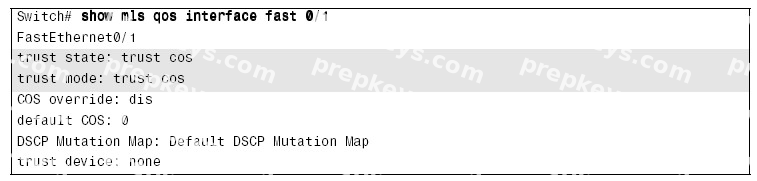
Based on the following show output, which statement is true?
WG1S1#sh mls qos interface fa0/1
FastEthernet0/1
trust state: not trusted
trust mode: trust cos
COS override: dis
default COS: 0
pass-through: none
trust device: cisco-phone
A Cisco IP Phone is not connected to the fa0/1 switch port.
All incoming DSCP markings are trusted.
All incoming CoS markings are trusted.
DSCP markings from the Cisco IP Phone are trusted.
Explanation:
mls qos trust [cos] :
By default, the port is not trusted. All traffic is sent through one egress queue. Use the cos keyword to classify ingress packets with the packet CoS values. The egress queue assigned to the packet is based on the packet CoS value. When this keyword is entered, the traffic is sent through the four QoS queues. The Output shown that Phone is not connected with Switch Port.
In a typical converged campus network, which two of the following are considered QoS best practices? (Choose two.)
Traffic classification and marking is performed as close to the traffic source as possible.
NBAR is used at the high speed core layer to discover and classify network applications.
Catalyst switches should use weighted round robin (WRR) queuing giving the voice traffic the highest priority.
Ensure voice traffic is serviced by a weighted fair queue.
Traffic classification and marking is performed at the high speed core layer.
Only a reasonable number of applications should be classified into the mission-critical traffic class.
Explanation:
A Cisco Catalyst switch has an IP phone connected to its Fastethernet0/2 port. The IP phone has an attached PC. The Fastethernet0/2 port on the switch has been configured with the commands mls qos trust cos, mls qos trust device cisco-phone, and switchport priority extend trust.
What will happen to a data frame with a CoS of 5 that is sent from the PC through the IP phone to port Fastethernet0/2 on the switch?
While the packet will pass through the IP phone without modification, the switch will, by default,
override the CoS priority with the switch default CoS priority.
The switch will instruct the phone to allow the packet through without modification only if the phone has been configured to do so.
The IP phone will allow the data packet through without modifying the CoS settings of the data frame.
The IP phone will, by default, overwrite the switch CoS value and mark the data packet as CoS 0.
Explanation:
In a typical network, you connect a Cisco IP Phone to a switch port. Traffic sent from the telephone to the switch is typically marked with a tag that uses the 802.1Q header. The header contains the VLAN information and the CoS 3-bit field, which determines the priority of the packet. For most Cisco IP Phone configurations, the traffic sent from the telephone to the switch is trusted to ensure that voice traffic is properly prioritized over other types of traffic in the network. By using the mls qos trust cos interface configuration command, you can configure the switch port to which the telephone is connected to trust the CoS labels of all traffic received on that port. In some situations, you also might connect a PC or workstation to the IP phone. In these cases, you can use the switchport priority extend cos interface configuration command to configure the telephone through the switch CLI to override the priority of the traffic received from the PC. With this command, you can prevent a PC from taking advantage of a high-priority data queue. However, if a user bypasses the telephone and connects the PC directly to the switch, the CoS labels generated by the PC are trusted by the switch (because of the trusted CoS setting) and can allow misuse of high-priority queues. The trusted boundary feature solves this problem by using the CDP to detect the presence of a Cisco IP Phone (such as the Cisco IP Phone 7910, 7935, 7940, and 7960) on a switch port. If the telephone is not detected, the trusted boundary feature disables the trusted setting on the switch port and prevents misuse of a high-priority queue.
Showing 10 of 85 questions · Unlock the full set