Exit demo 642-731 Conducting Cisco Unified Wireless Site Survey PDF format · free preview

Cisco 642-731 - Questions & Answers

Free preview · every answer includes a full explanation

Product page: https://prepkeys.com/642-731.html

Question 1
Single choice

In an outdoor mesh environment, which is the purpose of deploying one of the access points relatively higher than the others?

A.

The MAPs need to be mounted higher than the first hop RAPs so that the mesh units can accomplish radio line of sight.

B.

Elevated MAPs are connected to the switches, providing better bandwidth that all the RAPs utilize for client connectivity.

C.

An AP deployed as a RAP needs to be mounted in a higher elevation to provide clear connectivity to first hop MAPs.

D.

Root APs need clear line of sight to provide the best bandwidth to all of its RAPs, so the higher the better.

Question 2
Single choice

You have a customer that is building a new campus of four 3-story buildings that you have just completed the site survey for. The customer is interested in the amount of rack space they will need to allocate in either the building MDF or in the data center for controllers. Each building is going to require 75 APs to support voice and data.

How should the controllers be deployed to provide the least number of controllers, the highest redundancy, and the easiest management?

A.

Use the distributed deployment method in each building MDF with the N + N redundancy method.

B.

Use the centralized deployment method in the data center with the N + N + 1 redundancy method.

C.

Use the distributed deployment method in each building MDF with the N + 1 redundancy method.

D.

Use the centralized deployment method in the data center with the N + 1 redundancy method.

E.

Use the distributed deployment method in each building MDF with the N + N +1 redundancy method.

F.

Use the centralized deployment method in the data center with the N + N redundancy method.

Question 3
Single choice

Which option allows the maximum 2.4-GHz channel usage for a survey and data deployment in the ETSI domain?

A.

1, 6, 11

B.

1, 5, 9, 13

C.

1, 6, 9, 14

D.

1, 6, 11, 14

Question 4
Multiple choice

Which two issues do access and backhaul radios experience in mesh networks? (Choose two.)

A.

The access radio has to connect to two or several points.

B.

The access cell usually covers more area at ground level that may have more sources of reflection and interference.

C.

The access cell radio range is larger than the backhaul radio range, which causes the backhaul cell radio to suffer from more interference.

D.

Backhaul radios are a bottleneck for throughput.

E.

RAPs help MAPs avoid coverage holes.

Question 5
Single choice

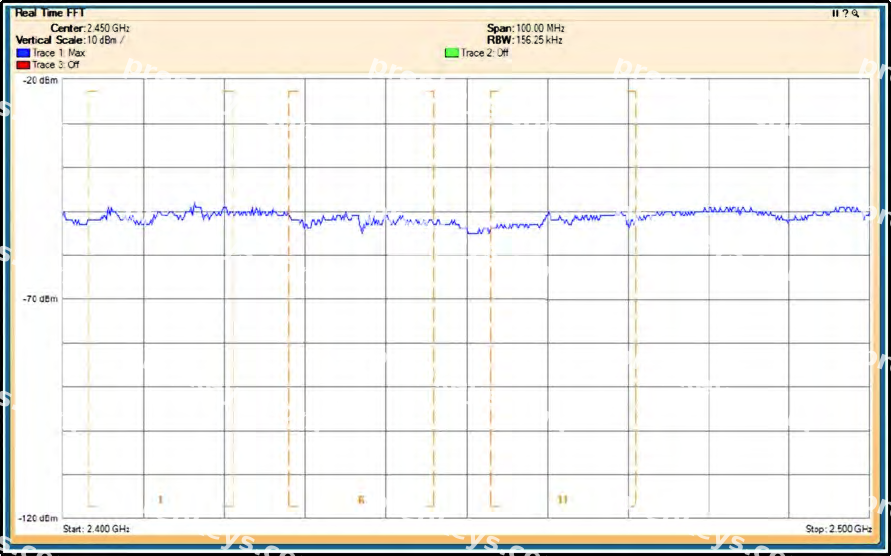
Refer to the exhibit. Clients are being disconnected from the WLAN.

Which source of interference can cause a Denial of Service?
A.

jammer

B.

microwave oven

C.

Bluetooth devices

D.

wireless video camera

E.

ZigBee device

Question 6
Single choice

You have a client that would like to upgrade their 2.4-GHz point-to-point wireless bridge link between buildings in their facility in Mexico. Currently, they have radios from vendor A that are transmitting at 14 dBm with 6 dBm antennas. They would like to upgrade the radios to vendor B but keep the existing antennas. The new radios from vendor B have a fixed transmit power of 7 dBm.

How should you proceed?

A.

Install the new radios with existing vendor A antennas.

B.

Install new radios with replacement vendor A antennas rated at 13 dBm.

C.

Install new radios with replacement vendor A antennas rated at 30 dBm.

D.

Install the new radios with new vendor B antennas rated at 29 dBm.

E.

Install the new radios with new vendor B antennas rated at 13 dBm.

Question 7
Single choice

Refer to the exhibit.

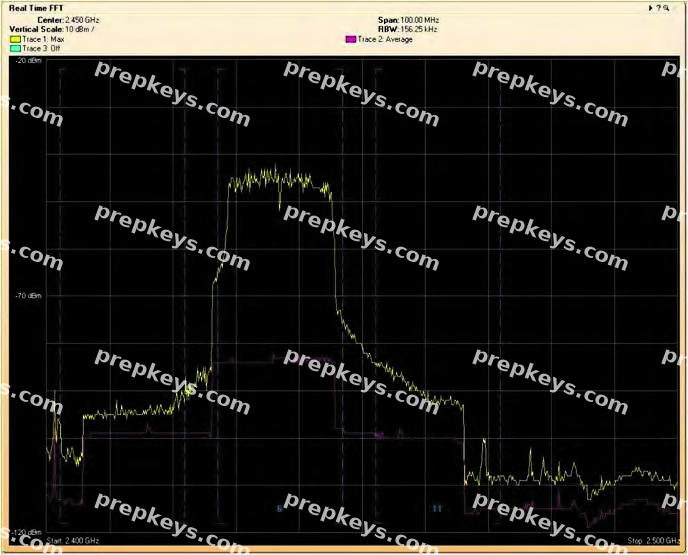
After performing a Layer 1 survey using Cisco Spectrum Expert, what is the result indicated by the visual screen?

A.

Normal 802.11b activity

B.

Normal 802.11g activity

C.

Microwave oven interference

D.

Video camera interference

E.

Bluetooth device interference

Question 8
Multiple choice

What two types of antennas have a high gain, narrow beam width, and are typically used for point-to-point bridging? (Choose two.)

A.

dipole antenna

B.

Yagi antenna

C.

patch antenna

D.

parabolic dish antenna

E.

omni-directional

F.

monopole antenna

Question 9
Single choice

When planning a site survey, what Cisco tool can an engineer use to estimate the number of required APs?

A.

MSE Location Tracking

B.

WCS Planning Mode

C.

WLC NetFlow Exporter

D.

LWAP Monitor Mode

E.

WCS Map Editor

Question 10
Multiple choice

In which two ways does the type of industry vertical change the way you prepare to perform a wireless site survey? (Choose two.)

A.

In most cases the specific industry vertical impact is not unique and information used to prepare for a site survey can be reused from one vertical to another.

B.

The first step in preparing for a site survey for a specific industry vertical is to review the individual industry standards for a WLAN deployment to ensure compliance with all known standards.

C.

Each industry vertical has its own specific challenges that need to be considered prior to completion of the WLAN site survey.

D.

Prior to performing a site survey for a customer, their specific industry vertical has very little impact on site survey process. Only post-survey design is impacted by the industry vertical.

Showing 10 of 193 questions · Unlock the full set