Microsoft 70-458 - Questions & Answers
Free preview · every answer includes a full explanation
Product page: https://prepkeys.com/70-458.html
Note: This question is part of a series of questions that use the same set of answer choices. An answer choice may be correct for more than one question in the series.
You administer a Microsoft SQL Server 2012 server that hosts a transactional database and a reporting database. The transactional database is updated through a web application and is operational throughout the day. The reporting database is only updated from the transactional database.
The recovery model and backup schedule are configured as shown in the following table:
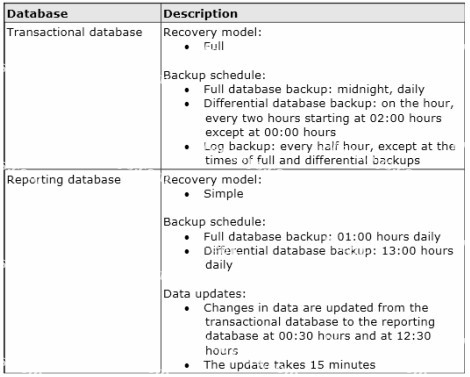
One of the hard disk drives that stores the reporting database fails at 16:40 hours. You need to ensure that the reporting database is restored. You also need to ensure that data loss is minimal.
What should you do?
Note: This question is part of a series of questions that use the same set of answer choices. An answer choice may be correct for more than one question in the series.
You administer a Microsoft SQL Server 2012 server that hosts a transactional database and a reporting database. The transactional database is updated through a web application and is operational throughout the day. The reporting database is only updated from the transactional database.
The recovery model and backup schedule are configured as shown in the following table:
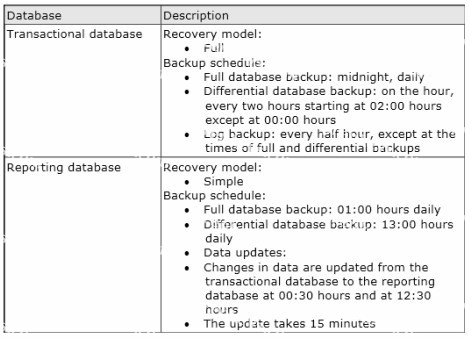
One of the hard disk drives chat stores the transactional database fails at 23:32 hours. Attempts to create a tail log backup are unsuccessful.
You need to ensure that the transactional database is restored.
You also need to ensure that data loss is minimal, What should you do?
Note: This question is part of a series of questions that use the same set of answer choices. An answer choice may be correct for more than one question in the series.
You administer a Microsoft SQL Server 2012 server that hosts a transactional database and a reporting database. The transactional database is updated through a web application and is operational throughout the day. The reporting database is only updated from the transactional database.
The recovery model and backup schedule are configured as shown in the following table:
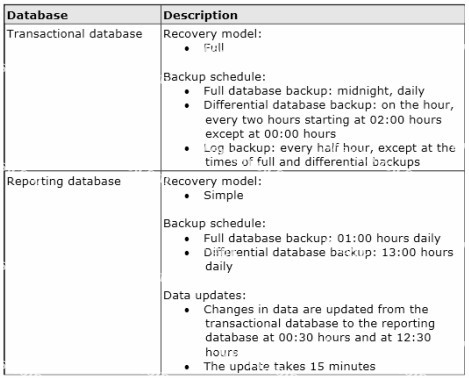
At 16:20 hours, you discover that pages 17, 137, and 205 on one of the database files are corrupted on the transactional database.
You need to ensure that the transactional database is restored. You also need to ensure that data loss is minimal.
What should you do?
Note: This question is part of a series of questions that use the same set of answer choices. An answer choice may be correct for more than one question in the series.
You administer a Microsoft SQL Server 2012 server that hosts a transactional database and a reporting database. The transactional database is updated through a web application and is operational throughout the day. The reporting database is only updated from the transactional database.
The recovery model and backup schedule are configured as shown in the following table:
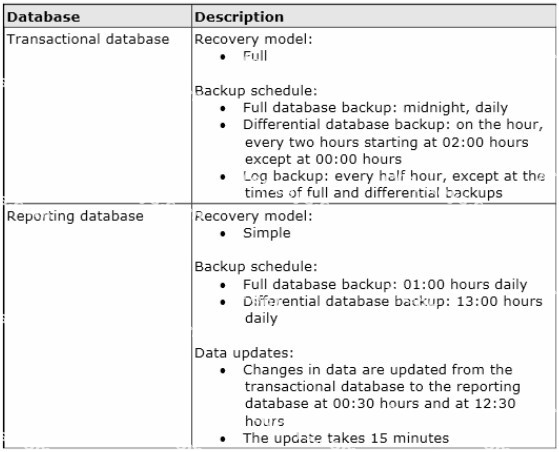
The differential backup of the reporting database fails. Then, the reporting database fails at 14:00 hours.
You need to ensure that the reporting database is restored. You also need to ensure that data loss is minimal.
What should you do?
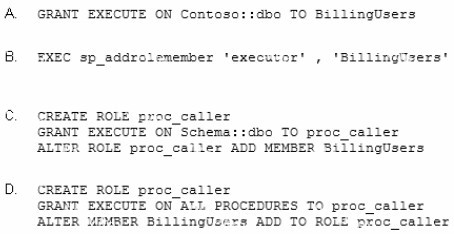
You administer a Microsoft SQL Server 2012 database named Contoso that contains a single user-defined database role namedBillingUsers.
All objects in Contoso are in the dbo schema.
You need to grant EXECUTE permissions for all stored procedures in Contoso to BillingUsers.
Which Transact-SQL statement should you use?
You administer a Windows Azure SQL Database database named Inventory that contains a stored procedure named p_AddInventory.
Users need to be able to SELECT from all tables in the database and execute the stored procedure. You need to grant only the necessary permissions.
What should you do?
You administer a Microsoft SQL Server 2012 database that has Trustworthy set to on. You create a stored procedure that returns database-level information from Dynamic Management Views.
You grant User1 access to execute the stored procedure.
You need to ensure that the stored procedure returns the required information when User1 executes the stored procedure. You need to achieve this goal by granting the minimum permissions required.
What should you do? Choose all that apply.
You administer a SQL Server 2012 database instance.
You need to configure the SQL Server Database Engine service on a failover cluster.
Which user account should you use?
You administer a Microsoft SQL Server 2012 database instance.
You plan to migrate the database to Windows Azure SQL Database. You verify that all objects contained in the database are compatible with Windows Azure SQL Database.
You need to ensure that database users and required server logins are migrated to Windows Azure SQL Database.
What should you do?
You are a database administrator for a Microsoft SQL Server 2012 environment.
You want to deploy a new application that will scale out the workload to at least five different SQL Server instances.
You need to ensure that for each copy of the database, users are able to read and write data that will then be synchronized between all of the database instances.
Which feature should you use?