Microsoft 70-496 - Questions & Answers
Free preview · every answer includes a full explanation
Product page: https://prepkeys.com/70-496.html
You are planning to install a new Microsoft Visual Studio Team Foundation Server (TFS) 2012 server.
You need to ensure that the minimum supported version of Microsoft SQL Server is installed.
Which version should you install?
To support your development team's upgrade from Visual Studio 2010 to Visual Studio 2012, you also upgrade from Team Foundation Server (TFS) 2010 to TFS
2012.
You need to provide a TFS 2012 test environment that:
Includes data and source code from your existing TFS 2010 environment and Allows your developers to test the new TFS 2012 and Visual Studio 2012 features while keeping the current TFS 2010 environment intact.

What should you do?
Your network environment includes a Microsoft Visual Studio Team Foundation Server (TFS) 2012 server and a virtual test environment that uses Lab Management 2012 along with System Center Virtual Machine Manager (SCVMM) 2010.
You want to install a test virtual machine that is hosted within a lab environment.
You need to ensure that the test virtual machine can support all the features of Lab Management 2012.
Which component should you install on the test virtual machine?
Your network environment includes a Microsoft Visual Studio Team Foundation Server (TFS) 2012 server named TFS1. SharePoint and Reporting Services components are also installed and configured for TFS on the same server.
You need to be able to access the SharePoint Project Portal from the TFS server by using the following URL: http: //tfs.fabrikam.com.
What should you do?
Your network environment includes a Team Foundation Server (TFS) 2012 named TFS1 that contains two project collections named PC1 and PC2. A build server named Bi is configured with a build controller named C1 and an agent named A1 that runs build definitions created in Pd.
A development team wants to create a gated check-in build definition on PC2.
You need to perform a supported infrastructure enhancement to run PC2 build definitions.
What should you do?
Your network environment is configured according to the following table:
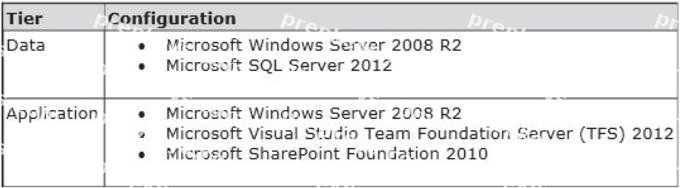
Your TFS environment is configured with the following URLs:
TFS: http: //tfssrv: 8080/tfs
Reporting: http: //tfssrv/reports
SharePoint: http: //tfssrv/sites
You need to configure only the TFS URL to be the following fully qualified domain name (FQDN): http: //tfs.contoso.com.

You log on to the application-tier server.
What should you do next?
Your network environment includes a Microsoft Visual Studio Team Foundation Server (TFS) 2012 server and a test environment that is based on non-Hyper-V- based virtualized machines.
You need to be able to run tests on all the test machines.
Which two actions should you perform? (Each correct answer presents part of the solution.
Choose two.)
Your network environment includes a Microsoft Visual Studio Team Foundation Server 2012 (TFS) server. A single build machine is installed with one controller and two agents. The working directories are configured to use the following working directory:
$(SystemDrive)\Builds\$(BuildAgentId)\$(BuildDefinitionPath). Your system drive is running out of space and some builds often fail with the following error:
"The specified path, file name, or both are too long. The fully qualified file name must be less than 260 characters, and the directory name must be less than 248 characters."
You need to meet the following requirements:
Point the working path to drive D.
Construct a working directory that can be used to define the shortest unique path for each build agent it is used on.
What should you do?
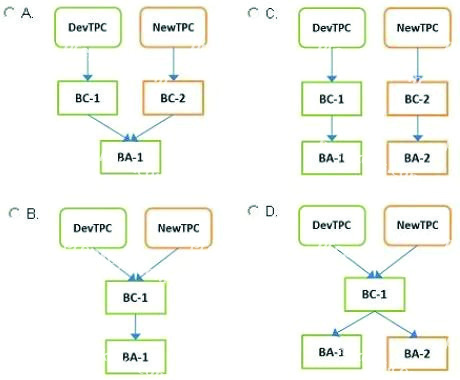
Your network environment includes a Microsoft Visual Studio Team Foundation Server (TFS) 2012 server. Your TFS environment currently consists of a single team project collection (TPC) named DevTPC, one build controller named BC-1, and one build agent named BA-1.
You need to create a separate TFS test environment by cloning your existing environment. You need to achieve this goal by utilizing as few new TFS services as possible.
Which of the following diagrams shows the correct architecture for solving this problem?
Your client's network environment includes a Microsoft Visual Studio Team Foundation Server (TFS) 2012) server installed at its main office. Branch offices have limited bandwidth connecting to the main office.
Client team members at one of the branch offices report that it is taking too long to retrieve files from source control.
You need to speed up the source control access for their most commonly accessed files.
What should you do?