Microsoft 70-740 - Questions & Answers
Free preview · every answer includes a full explanation
Product page: https://prepkeys.com/70-740.html
Your network contains an Active Directory domain. The domain contains a new file server named Server1 that runs a Server Core installation of Windows Server 2016.
Server1 has an ReFS-formatted volume D: and NTFS-formatted volume E: The volumes do not contain any data.
You install the Data Deduplication role service on Server1.
You need to implement Data Deduplication for volumes on D: and E:.
Solution: From Windows PowerShell, you run Enable-DeDupVolume-Volume D:,E:.
Does this meet the goal?
In this section, you'll see one or more sets of questions with the same scenario and problem Each question presents a unique solution to the problem, and you must determine whether the solution meets the stated goals. Any of the solutions might solve the problem. It is also possible that none of the solutions solve the problem.
Once you answer a question in this section, you will NOT be able to return to it. As a result, these questions will not appear in the review screen
Note: This question is part of a series of questions that present the same scenario. Each question in the series contains a unique solution. Determine whether the solution meets the stated goals.
Your network contains an Active Directory domain named contoso.com. The domain contains a DNS
server named Server1. All client computers run Windows 10.
On Server1, you have the following zone configuration
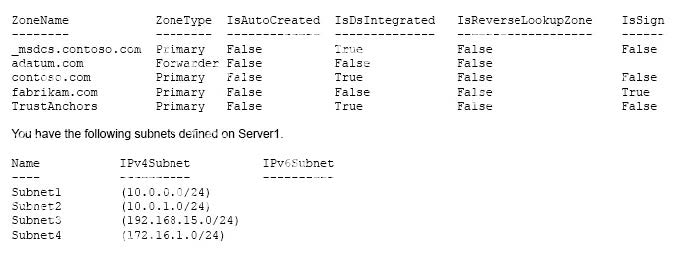
You need to prevent Server1 from resolving queries from DNS clients located on Subnet4 Server1 must resolve queries from all other DNS clients
Solution: From Windows Firewall with Advanced Security on Server1, you create an inbound rule.
Does this meet the goal?
You need to implement network virtualization.
On which object should you configure the virtual subnet ID?
You have two Hyper-V hosts named Server1 and Server2 that run Windows Server 2016. Server1 and Server2 are connected to the same network.
On Server1 and Server2, you create an external network switch named Switch1.
You have the virtual machines shown in the following table.

All three virtual machines are connected to Switch1.
You need to prevent applications in VM3 from being able to capture network traffic from VM1 or VM2. The solution must ensure that VM1 retains network connectivity.
What should you do?
You have Nano Setver image named Diskl .vhdx.
You mount Diskl .vhdx.
You need to add a folder that contains several files to the image.
Which tool or cmdlet you should use?
Active Directory Recycle Bin is enabled. You discover that a support technician accidentally removed 100 users from an Active Directory group named Group1 an hour ago. You need to restore the membership of Group1.
What should you do?
You have a server named Server1 that runs Windows Server 2016. Server1 is a Hyper-V host that hosts a
virtual machine named VM1.
Server1 has three network adapter cards that are connected to virtual switches named vSwitch1, vSwitch2 and vSwitch3. You configure NIC Teaming on VM1 as shown in the exhibit. (Click the Exhibit button.)
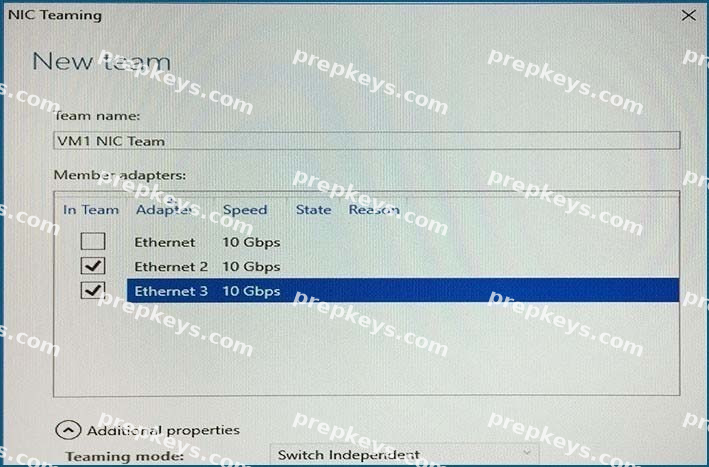
You need to ensure that VM1 will retain access to the network if a physical network adapter card fails on Server1.
What should you do?
Note: This question is part of a series of questions that present the same scenario. Each question in the series contains a unique solution that might meet the stated goals. Some question sets might have more than one correct solution, while others might not have a correct solution.
After you answer a question in this section, you will NOT be able to return to it. As a result, these questions will not appear in the review screen.
You have two servers that run Windows Server 2016.
You plan to create a Network load Balancing (NLB) cluster that will contain both servers.
You need to configure the network cards on the servers for the planned NLB configuration.
Solution: You configure the network cards to be on the same subnet and to have dynamic IP addresses.
You configure the cluster to use multicast.
Does this meet the goal?
Your network contains an Active Directory domain named contoso.com. The domain contains two servers, Server and Server2 that run Windows Sewer 2016.
Each server has an operating system disk and four data disks. All of the disks are locally attached SATA disks. Data disk, is initialized as an MBR disk, and has a single NITS volume.
You plan to implement Storage Spaces Direct by using the data disks on Server1 and Server2.
You need to prepare the data disks for the Storage Spaces Direct implementation.
What should you do?
Note: This question is part of a series of questions that use the same similar answer choices An answer choice may be correct for more than one question in the series Each question is independent of the other questions in this series. Information and details provided in a question apply only to that question
You have a Hyper-V host named Server1 that runs Windows Server 2016 Server1 has a virtual machine named VM1 that uses a single VHDX file VM1 is configured shown in the following table
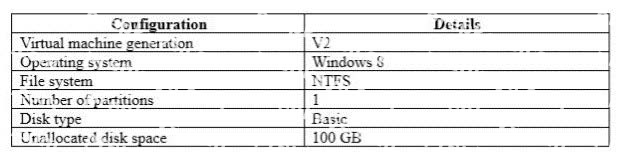
You plan to use VM1 as a virtual Machine Template to deploy shielded virtual machines You need to ensure that VM1 can be used to deploy shielded virtual machines.
What should you run?