Microsoft 70-741 - Questions & Answers
Free preview · every answer includes a full explanation
Product page: https://prepkeys.com/70-741.html
You have a server named Server1 that runs Windows Server 2016.
Server1 will be used as a VPN server.
You need to configure Server1 to support VPN Reconnect.
Which VPN protocol should you use?
You are implementing a new network. The network contains a DHCP server named DHCP1 that runs Windows Server 2016. DHCP1 contains a scope named Scope1 for the 192.168.0/24 subnet.
Your company has the following policy for allocating IP addresses:
1. All server addresses must be excluded from DHCP scopes
2. All client computers must receive IP addresses from Scope1
3. All Windows servers must have IP addresses in the range of 192.168.0.200 to 192.168.0.240
4. All other network devices must have IP addresses in the range of 192.168.0.180 to 192.168.0.199
You deploy a print device named Print1.
You need to ensure that Print1 adheres to the policy for allocating IP addresses.
Which command should you use?
Your network contains an Active Directory domain named contoso.com. The domain contains a DHCP server
named Server2 that runs Windows Server 2016.
Server2 has 10 IPv4 scopes.
You need to ensure that the scopes are backed up every 30 minutes to the folder D:\DHCPBackup.
What should you run?
Note: This question is part of a series of questions that present the same scenario. Each question in the series contains a unique solution that might meet the stated goals. Some question sets might have more than one correct solution, while others might not have a correct solution. After you answer a question in this sections, you will NOT be able to return to it. As a result, these questions will not appear in the review screen.
You have a server named Server1 that has the Network Policy and Access Services server role installed.
You create a Shared Secret Network Policy Server (NPS) template named Template1.
You need to view the shared secret string used for Template1.
Solution: From the Network Policy Server console, you view the properties of Template1.
Does this meet the goal?
You have an IP Address Management (IPAM) deployment that is used to manage all of the DNS servers on your network. IPAM is configured to use Group Policy provisioning.
You discover that a user adds a new mail exchanger (MX) record to one of the DNS zones.
You want to identify which user added the record.
You open Event Catalog on an IPAM server, and you discover that the most recent event occurred yesterday. You need to ensure that the operational events in the event catalog are never older than one hour.
What should you do?
You have an IP Address Management (IPAM) server named IPAM1 that runs Window Server 2016. IPAM1 manages all of the DHCP servers on your network.
You are troubleshooting an issue for a client that fails to receive an IP address from DHCP.
You need to ensure that from IPAM1, you can view all of the event data for the DHCP leases from the last
24 hours.
Solution: From Windows PowerShell, you run the Invoke-IpamServerProvisioning cmdlet.
Does this meet the goal?
Note: This question is part of a series of questions that present the same scenario. Each question in the series contains a unique solution that might meet the stated goals. Some question sets might have more than one correct solution, while others might not have a correct solution.
After you answer a question in this sections, you will NOT be able to return to it. As a result, these questions will not appear in the review screen.
You are a network administrator for a company named Contoso, Ltd. The network is configured as shown in the exhibit.
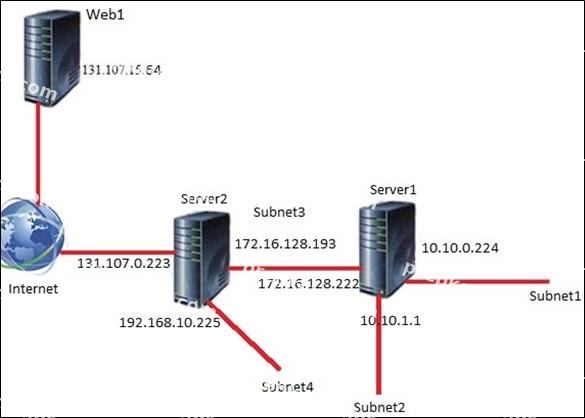
You install the Remote Access server role on Server2.
Server2 has the following configured:
1. Network address translation (NAT)
2. The DHCP Server server role
The Security Policy of Contoso states that only TCP ports 80 and 443 are allowed from the Internet to Server2.
You identify the following requirements:
1. Add 28 devices to Subnet2 for a temporary project.
2. Configure Server2 to accept VPN connections from the Internet.
3. Ensure that devices on Subnet2 obtain TCP/IP settings from DHCP on Server2.

Which VPN protocol should you configure on Server2?
You have a Hyper-V host named Server1 that runs Windows Server 2016. Server1 has two network
adapters that are Remote Direct Memory Access (RDMA)-enabled.
You need to verify whether Switch Embedded Teaming (SET) is enabled.
Which cmdlet should you use?
Note: This question is part of a series of questions that present the same scenario. Each question in the series contains a unique solution. Determine whether the solution meets the stated goals.
Your network contains an Active Directory domain named contoso.com. The domain contains a DNS
server named Server1. All client computers run Windows 10.
On Server1, you have the following zone configuration.
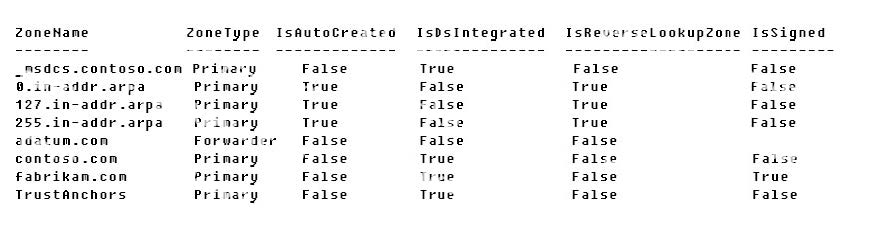
You need to ensure that all of the client computers in the domain perform DNSSEC validation for the fabrikam.com namespace.
Solution: From a Group Policy object (GPO) in the domain, you add a rule to the Name Resolution Policy Table (NRPT).
Does this meet the goal?
Note: This question is part of a series of questions that present the same scenario. Each question in the series contains a unique solution that might meet the stated goals. Some question sets might have more than one correct solution, while others might not have a correct solution.
After you answer a question in this section, you will NOT be able to return to it. As a result, these questions will not appear in the review screen.
You have a Hyper-V host named Server 1. Server1 connects to your corporate network.
Server1 has the virtual switches configured as shown in the following table.
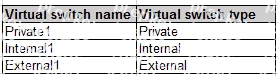
Server1 has two virtual machines named VM1 and VM2 that run Windows Server 2016. VM1 connects to Private1. VM2 has two network adapters.
You need to ensure that VM1 connects to the corporate network by using NAT.
Solution: You connect VM2 to Private1 and External1. You install the Remote Access server on VM2, and you configure NAT in the Routing and Remote Access console. You configure VM1 to use VM2 as the default gateway.
Does this meet the goal?