Microsoft 70-762 - Questions & Answers
Free preview · every answer includes a full explanation
Product page: https://prepkeys.com/70-762.html
Note: This question is part of a series of questions that use the same scenario. For your convenience, the scenario is repeated in each question. Each question presents a different goal and answer choices, but the text of the scenario is exactly the same in each question in this series.
You have a database that contains the following tables: BlogCategory, BlogEntry, ProductReview, Product, and SalesPerson. The tables were created using the following Transact SQL statements:
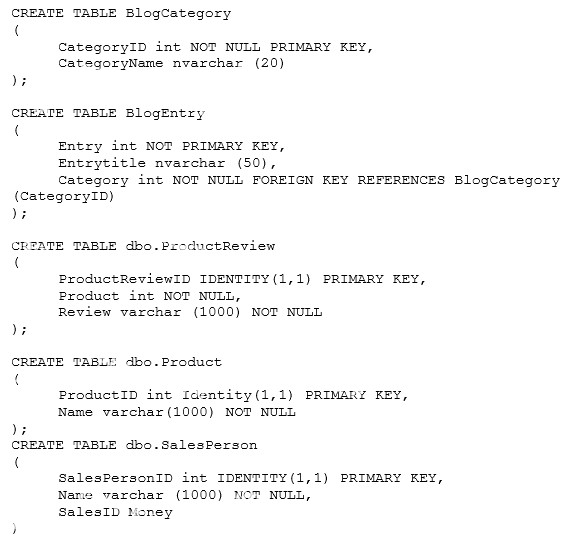
You must modify the ProductReview Table to meet the following requirements:
1. The table must reference the ProductID column in the Product table
2. Existing records in the ProductReview table must not be validated with the Product table.
3. Deleting records in the Product table must not be allowed if records are referenced by the
ProductReview table.
4. Changes to records in the Product table must propagate to the ProductReview table.
You also have the following databse tables: Order, ProductTypes, and SalesHistory, The transact-SQL statements for these tables are not available.
You must modify the Orders table to meet the following requirements:
1. Create new rows in the table without granting INSERT permissions to the table.
2. Notify the sales person who places an order whether or not the order was completed.
You must add the following constraints to the SalesHistory table:
- a constraint on the SaleID column that allows the field to be used as a record identifier
- a constant that uses the ProductID column to reference the Product column of the ProductTypes table
- a constraint on the CategoryID column that allows one row with a null value in the column
- a constraint that limits the SalePrice column to values greater than four
Finance department users must be able to retrieve data from the SalesHistory table for sales persons where the value of the SalesYTD column is above a certain threshold.
You plan to create a memory-optimized table named SalesOrder. The table must meet the following requirments:
- The table must hold 10 million unique sales orders.
- The table must use checkpoints to minimize I/O operations and must not use transaction logging.
- Data loss is acceptable.
Performance for queries against the SalesOrder table that use Where clauses with exact equality operations must be optimized.
You need to modify the design of the Orders table.
What should you create?
You have a database that is experiencing deadlock issues when users run queries.
You need to ensure that all deadlocks are recorded in XML format.
What should you do?
You are developing an application that connects to a database.
The application runs the following jobs:
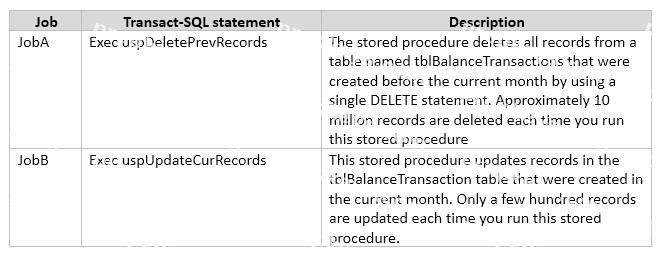
The READ_COMMITTED_SNAPSHOT database option is set to OFF, and auto-content is set to ON.
Within the stored procedures, no explicit transactions are defined.
If JobB starts before JobA, it can finish in seconds. If JobA starts first, JobB takes a long time to complete.
You need to use Microsoft SQL Server Profiler to determine whether the blocking that you observe in JobB is caused by locks acquired by JobA.
Which trace event class in the Locks event category should you use?
Note: This question is part of a series of questions that use the same scenario. For your convenience, the scenario is repeated in each question. Each question presents a different goal and answer choices, but the text of the scenario is exactly the same in each question in this series.
You have a database named DB1 that contains the following tables: Customer, CustomerToAccountBridge, and CustomerDetails. The three tables are part of the Sales schema. The database also contains a schema named Website. You create the Customer table by running the following Transact-SQL statement:
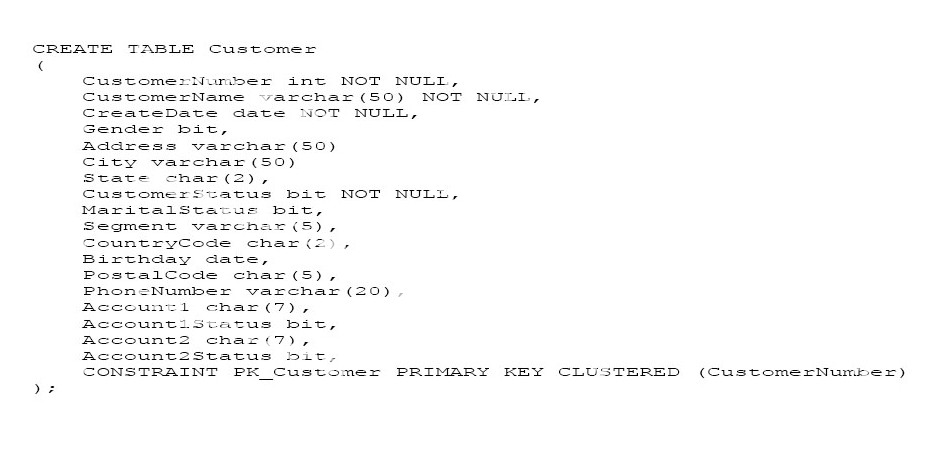
The value of the CustomerStatus column is equal to one for active customers. The value of the Account1Status and Account2Status columns are equal to one for active accounts. The following table displays selected columns and rows from the Customer table.

You plan to create a view named Website.Customer and a view named Sales.FemaleCustomers.
Website.Customer must meet the following requirements:
1. Allow users access to the CustomerName and CustomerNumber columns for active customers.
2. Allow changes to the columns that the view references. Modified data must be visible through the view.
3. Prevent the view from being published as part of Microsoft SQL Server replication.
Sales.Female.Customers must meet the following requirements:
1. Allow users access to the CustomerName, Address, City, State and PostalCode columns.
2. Prevent changes to the columns that the view references.
3. Only allow updates through the views that adhere to the view filter.
You have the following stored procedures: spDeleteCustAcctRelationship and spUpdateCustomerSummary. The spUpdateCustomerSummary stored procedure was created by running the following Transacr-SQL statement:
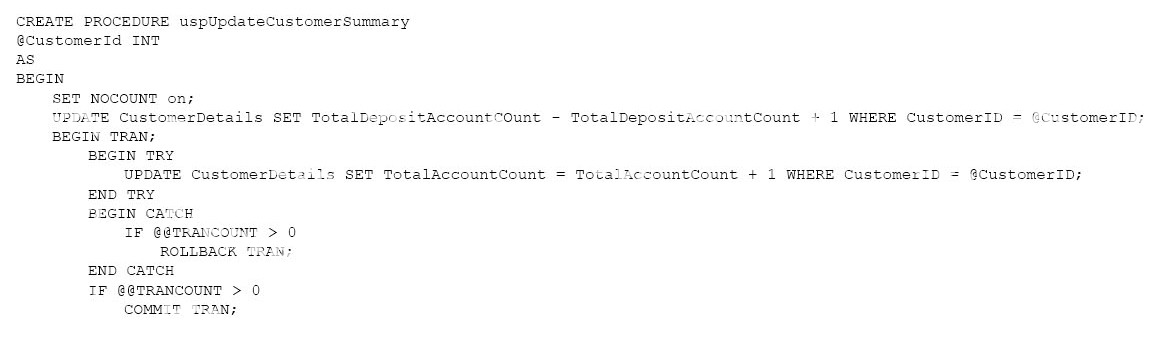
You run the spUpdateCustomerSummary stored procedure to make changes to customer account summaries. Other stored procedures call the spDeleteCustAcctRelationship to delete records from the CustomerToAccountBridge table.
You must update the design of the Customer table to meet the following requirements.
1. You must be able to store up to 50 accounts for each customer.
2. Users must be able to retrieve customer information by supplying an account number.
3. Users must be able to retrieve an account number by supplying customer information.
You need to implement the design changes while minimizing data redundancy.
What should you do?
Note: This question is part of a series of questions that use the same scenario. For your convenience, the scenario is repeated in each question. Each question presents a different goal and answer choices, but the text of the scenario is exactly the same in each question in this series.
You have a database named DB1 that contains the following tables: Customer, CustomerToAccountBridge, and CustomerDetails. The three tables are part of the Sales schema. The database also contains a schema named Website. You create the Customer table by running the following Transact-SQL statement:
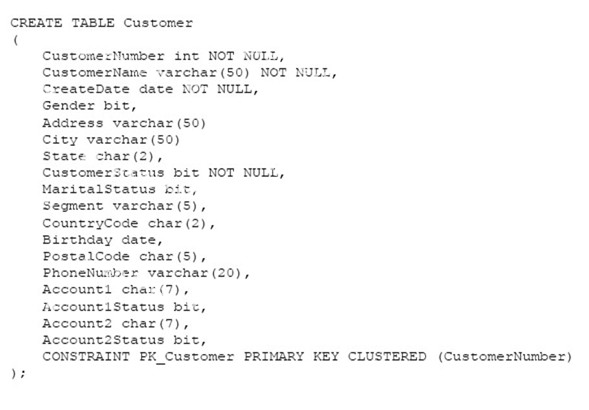
The value of the CustomerStatus column is equal to one for active customers. The value of the Account1Status and Account2Status columns are equal to one for active accounts. The following table displays selected columns and rows from the Customer table.

You plan to create a view named Website.Customer and a view named Sales.FemaleCustomers.
Website.Customer must meet the following requirements: Allow users access to the CustomerName and CustomerNumber columns for active customers.
Allow changes to the columns that the view references. Modified data must be visible through the view.
Prevent the view from being published as part of Microsoft SQL Server replication.
Sales.Female.Customers must meet the following requirements: Allow users access to the CustomerName, Address, City, State and PostalCode columns.
Prevent changes to the columns that the view references.
Only allow updates through the views that adhere to the view filter.
You have the following stored procedures: spDeleteCustAcctRelationship and spUpdateCustomerSummary. The spUpdateCustomerSummary stored procedure was created by running the following Transacr-SQL statement:
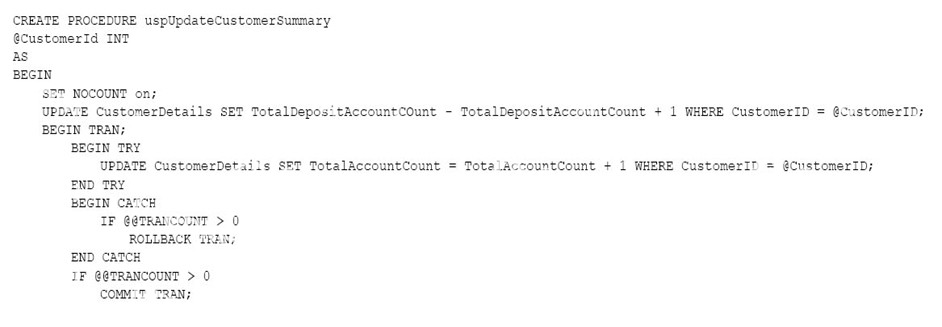
You run the uspUpdateCustomerSummary stored procedure to make changes to customer account summaries. Other stored procedures call the spDeleteCustAcctRelationship to delete records from the CustomerToAccountBridge table.
When you start uspUpdateCustomerSummary, there are no active transactions. The procedure fails at the second update statement due to a CHECK constraint violation on the TotalDepositAccountCount column.
What is the impact of the stored procedure on the CustomerDetails table?
Note: This question is part of a series of questions that use the same answer choices. An answer choice may be correct for more than one question on the series. Each question is independent of the other questions in this series. Information and details provided in a question apply only to that question.
You work on an OLTP database that has no memory-optimized file group defined.
You have a table names tblTransaction that is persisted on disk and contains the information described in the following table:
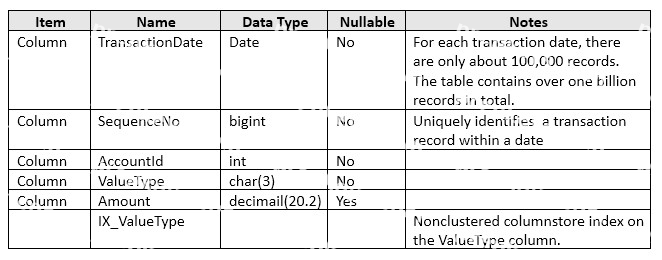
Users report that the following query takes a long time to complete.

You need to create an index that:
- improves the query performance
- does not impact the existing index
- minimizes storage size of the table (inclusive of index pages).
What should you do?
Note: This question is part of a series of questions that use the same or similar answer choices. An answer choice may be correct for more than one question in the series. Each question os independent of the other questions in this series.
Information and details provided in a question apply only to that question.
You have a database named DB1. There is no memory-optimized filegroup in the database.
You run the following query:
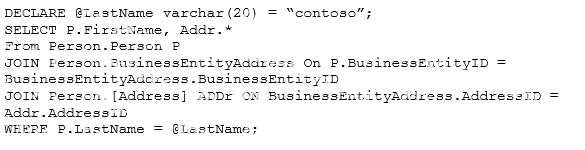
The following image displays the execution plan the query optimizer generates for this query:
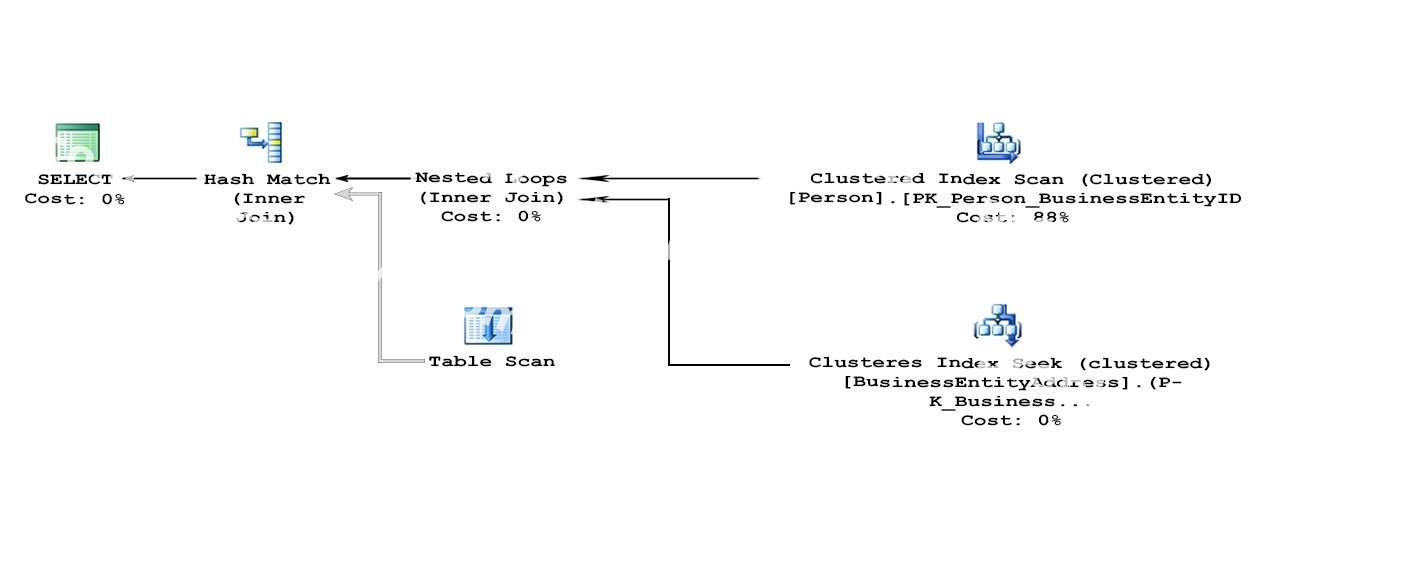
Users frequently run the same query with different values for the local variable @lastName. The table named Person is persisted on disk.
You need to create an index on the Person.Person table that meets the following requirements:
1. All users must be able to benefit from the index.
2. FirstName must be added to the index as an included column.
What should you do?
Note: The question is part of a series of questions that use the same or similar answer choices. An answer choice may be correct for more than one question in the series. Each question is independent of the other question in the series.
Information and details provided in a question apply only to that question.
You have a reporting database that includes a non-partitioned fact table named Fact_Sales. The table is persisted on disk.
Users report that their queries take a long time to complete. The system administrator reports that the table takes too much space in the database. You observe that there are no indexes defined on the table, and
many columns have repeating values.
You need to create the most efficient index on the table, minimize disk storage and improve reporting query performance.
What should you do?
Note: The question is part of a series of questions that use the same or similar answer choices. An answer choice may be correct for more than one question in the series. Each question is independent of the other question in the series.
Information and details provided in a question apply only to that question.
You have a database named DB1. The database does not use a memory-optimized filegroup. The database contains a table named Table1. The table must support the following workloads:
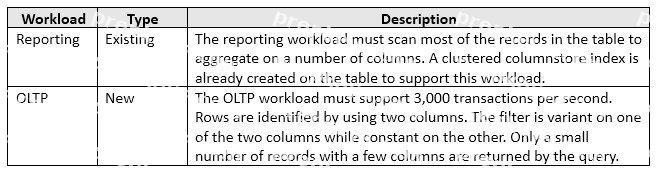
You need to add the most efficient index to support the new OLTP workload, while not deteriorating the
existing Reporting query performance.
What should you do?
Note: The question is part of a series of questions that use the same or similar answer choices. An answer choice may be correct for more than one question in the series. Each question is independent of the other question in the series.
Information and details provided in a question apply only to that question.
You have a database named DB1. The database does not have a memory optimized filegroup.
You create a table by running the following Transact-SQL statement:
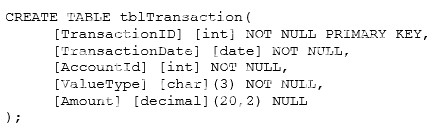
The table is currently used for OLTP workloads. The analytics user group needs to perform real-time operational analytics that scan most of the records in the table to aggregate on a number of columns.
You need to add the most efficient index to support the analytics workload without changing the OLTP application.
What should you do?