Microsoft 70-765 - Questions & Answers
Free preview · every answer includes a full explanation
Product page: https://prepkeys.com/70-765.html
Note: This question is part of a series of questions that use the same or similar answer choices. An answer choice may be correct for more than one question in the series. Each question is independent of the other questions in this series. Information and details provided in a question apply only to that question.
You have deployed several GS-series virtual machines (VMs) in Microsoft Azure. You plan to deploy Microsoft SQL Server in a development environment. Each VM has a dedicated disk for backups.
You need to backup a database to the local disk on a VM. The backup must be replicated to another region.
Which storage option should you use?
Note: This question is part of a series of questions that use the same or similar answer choices. An answer choice may be correct for more than one question in the series. Each question is independent of the other questions in this series. Information and details provided in a question apply only to that question.
You have a virtual machine (VM) in Microsoft Azure, which has a 2 terabyte (TB) database.
Microsoft SQL Server backups are performed by using Backup to URL.
You need to provision the storage account for the backups while minimizing costs.
Which storage option should you use?
Note: This question is part of a series of questions that use the same or similar answer choices. An answer choice may be correct for more than one question in the series. Each question is independent of the other questions in this series. Information and details provided in a question apply only to that question.
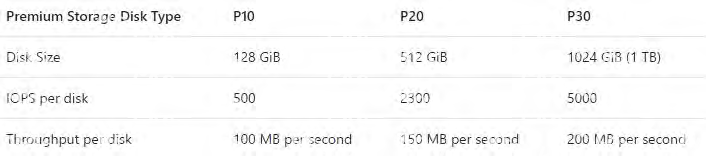
You have deployed a GS-series virtual machine (VM) in Microsoft Azure. You plan to deploy Microsoft SQL Server.
You need to deploy a 30 megabyte (MB) database that requires 100 IOPS to be guaranteed while minimizing costs.
Which storage option should you use?
Note: This question is part of a series of questions that use the same or similar answer choices. An answer choice may be correct for more than one question in the series. Each question is independent of the other questions in this series. Information and details provided in a question apply only to that question.
You have deployed several GS-series virtual machines (VMs) in Microsoft Azure. You plan to deploy Microsoft SQL Server in a development environment.
You need to provide storage to the environment that minimizes costs.
Which storage option should you use?
Note: This question is part of a series of questions that present the same scenario. Each question in the series contains a unique solution. Determine whether the solution meets stated goals.
Your company plans to use Microsoft Azure Resource Manager templates for all future deployments of SQL Server on Azure virtual machines.
You need to create the templates.
Solution: You use Visual Studio to create a JSON template that defines the deployment and configuration settings for the SQL Server environment.
Does the solution meet the goal?
Note: This question is part of a series of questions that present the same scenario. Each question in the series contains a unique solution. Determine whether the solution meets stated goals.
Your company plans to use Microsoft Azure Resource Manager templates for all future deployments of SQL Server on Azure virtual machines.
You need to create the templates.
Solution: You create the desired SQL Server configuration in an Azure Resource Group, then export the Resource Group template and save it to the Templates Library.
Does the solution meet the goal?
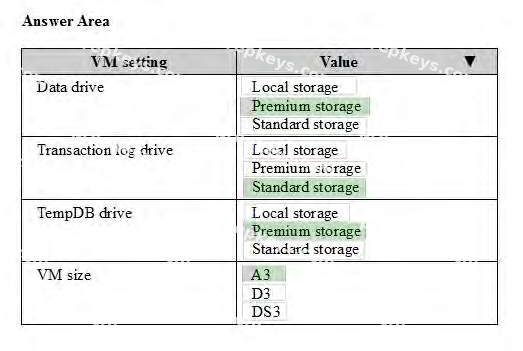
HOTSPOT
You plan to migrate a Microsoft SQL Server workload from an on-premises server to a Microsoft Azure virtual machine (VM). The current server contains 4 cores with an average CPU workload of 6 percent and a peak workload of 10 percent when using 2.4Ghz processors.
You gather the following metrics:
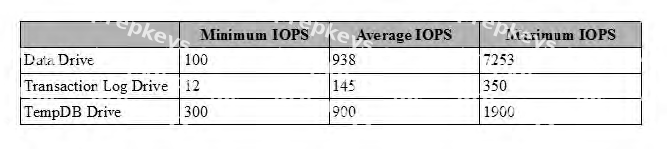
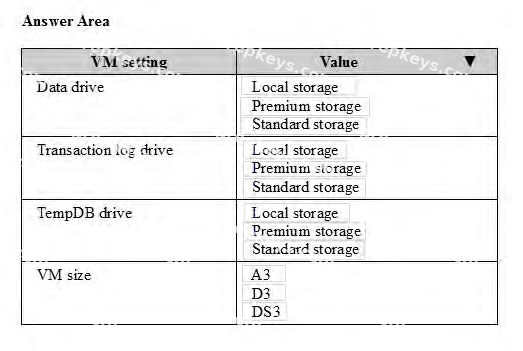
You need to design a SQL Server VM to support the migration while minimizing costs.
For each setting, which value should you use? To answer, select the appropriate storage option from each list in the answer area.
NOTE: Each correct selection is worth one point.
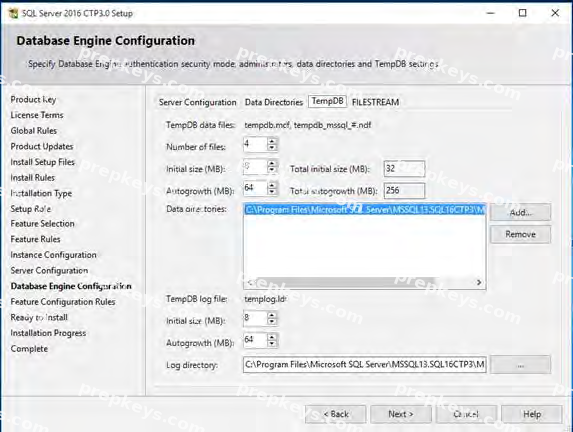
You have a Microsoft SQL Server 2014 named SRV2014 that has a single tempdb database file. The tempdb database file is eight gigabytes (GB) in size.
You install a SQL Server 2016 instance named SQL Server 2016 by using default settings.
The new instance has eight logical processor cores.
You plan to migrate the databases from SRV2014 to SRV2016.
You need to configure the tempdb database on SRV2016. The solution must minimize the number of
future tempdb autogrowth events.
What should you do?
Note: This question is part of a series of questions that present the same scenario. Each question in the series contains a unique solution. Determine whether the solution meets stated goals.
Your company plans to use Microsoft Azure Resource Manager templates for all future deployments of SQL Server on Azure virtual machines.
You need to create the templates.
Solution: You use Visual Studio to create a XAML template that defines the deployment and configuration settings for the SQL Server environment.
Does the solution meet the goal?
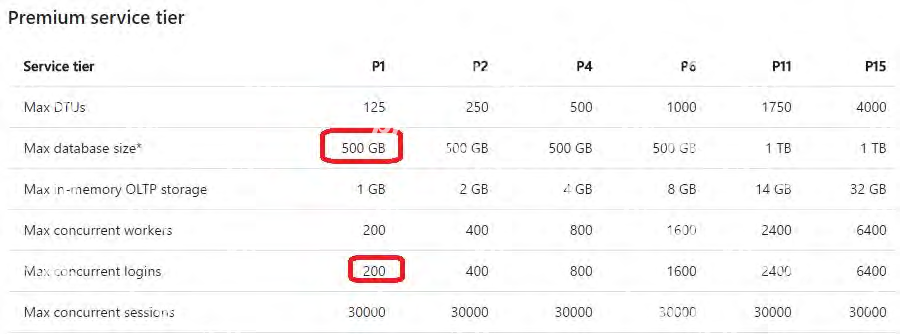
You plan to migrate a database To Microsoft Azure SQL Database. The database requires 500 gigabytes (GB) of storage.
The database must support 50 concurrent logins. You must minimize the cost associated with hosting the database.
You need to create the database.
Which pricing tier should you use?