Exit demo A00-212 SAS Advanced Programming Exam for SAS 9 PDF format · free preview

SAS Institute A00-212 - Questions & Answers

Free preview · every answer includes a full explanation

Product page: https://prepkeys.com/a00-212.html

Question 1
Single choice

The following SAS program is submitted:

%let test=one;

%let one=two;

%let two=three;

%let three=last;

%put what displays is &&&&&test;

What is the written to the SAS log?

A.

What displays is three

B.

What displays is two

C.

What displays is one

D.

What displays is last

Question 2
Single choice

What is the purpose of the SASFILE statement?

A.

It requests that SAS data set be opened and loaded into SAS memory one page at a time

B.

It requests that a SAS data set the opened and loaded into SAS memory one variable at a time

C.

It requests that a SAS data set be opened and loaded into SAS memory one observation at a time

D.

It requests that a SAS data set be opened and loaded into SAS memory in its entirety

Question 3
Single choice

Which one of the following is true regarding the KEEP statement?

A.

The KEEP statement is available in both the DATA and the PROC steps.

B.

The KEEP statement selects the variables read from the input data set(s).

C.

The KEEP statement applies to all data sets created within the same DATA step.

D.

The KEEP statement applies only to the first data set created within the same DATA step if more than one data set is created.

Question 4
Single choice

Given the data set shown in the left, the SAS program on the right is submitted.
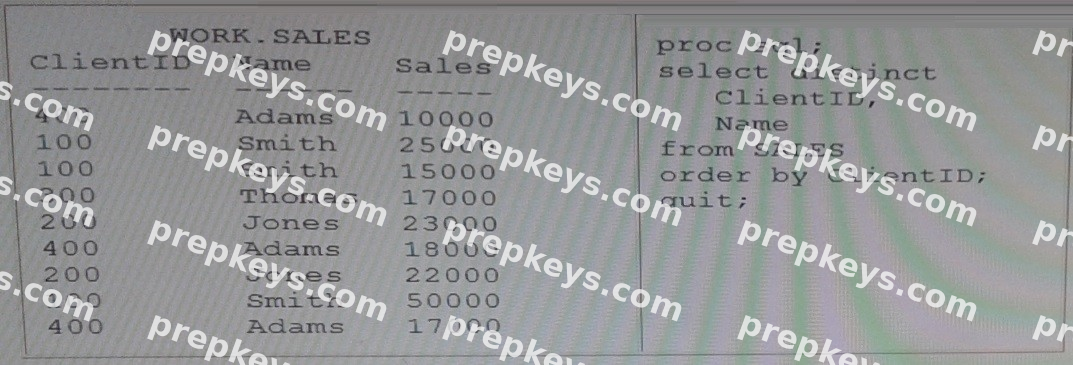
Which program will result in the identical report?
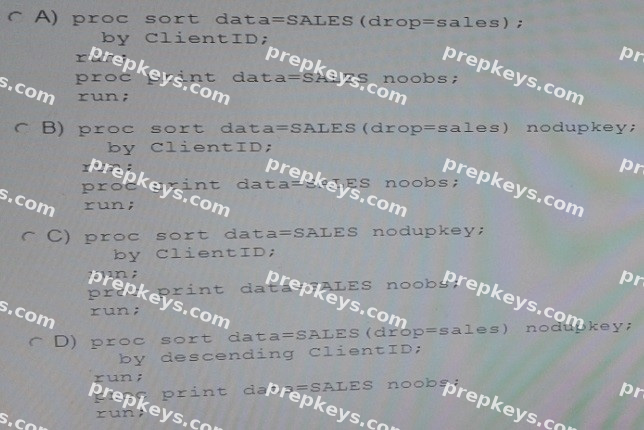
A.

Option A

B.

Option B

C.

Option C

D.

Option D

Question 5
Single choice

The following SAS program is submitted:

data temp;

length 1 b 3 x;

infile 'file reference';

input a b x;

run;

What is the result?

A.

The data set TEMP is not created because variables A and B have invalid lengths

B.

The data set TEMP is created, but variable X is not created

C.

The data set TEMP is not created because variable A has an invalid length

D.

The data set TEMP is created and variable X has a length of 8

Question 6
Single choice

Which of the following is true about the COMPRESS=YES data set option?

A.

It is most effective with numeric data that represents large numeric values

B.

It is most effective with character data that contains patterns, rather than simple repetitions

C.

It uses the Ross Data Compression method to compress numeric data

D.

It is most effective with character data that contains repeated characters

Question 7
Single choice

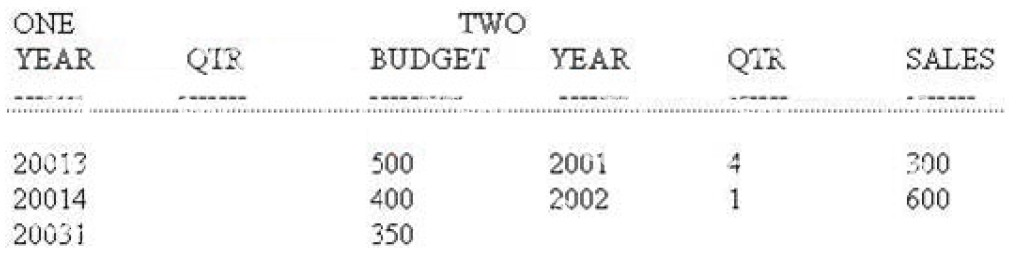
Given the SAS data sets ONE and TWO:

The following SAS program is submitted:

Proc sql;

Select two.*,budget from one <insert JOIN operator here> two on one.year=two.year,

Quit;

The following output is desired:
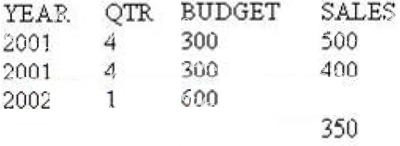
Which JOIN operator completes the program and generates the desired output?

A.

FULL JOIN

B.

INNER JOIN

C.

LEFT JOIN

D.

RIGHT JOIN

Question 8
Single choice

Which one of the following options displays the value of a macro variable in the SAS log?

A.

MACRO

B.

SOURCE

C.

SOURCE2

D.

SYMBOLGEN

Question 9
Single choice

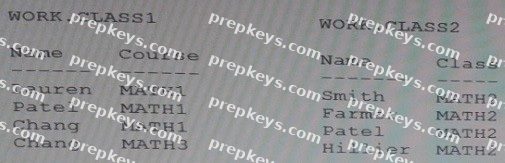
Given the SAS data sets:

The SAS program is submitted:

What output will be produced?

A.

Name
----------Lauren
Smith
Patel
Farmer
Chang
Hiller

B.

Name
----------Chang
Chang
Lauren

C.

Name
----------Patel
Chang

D.

Name
----------Lauren
Patel
Chang
Chang

Question 10
Single choice

The SAS data set TEMP has the following distribution of values for variable A: A Frequency

1 500,000

2 500,000

6 7,000,000

8 3,000

Which one of the following SAS programs requires the least CPU time to be processed?

A.

data new;
set temp;
if a = 8 then
b = 'Small ';
else if a in(1, 2) then
b = 'Medium';
else if a = 6 then
b = 'Large';
run;

B.

data new;
set temp;
if a in (1, 2) then
b = 'Medium';
else if a = 8 then
b = 'Small';
else if a = 6 then
b = 'Large';
run;

C.

data new;
set temp;
if a = 6 then
b = 'Large ';
else if a in (1, 2) then
b = 'Medium';
else if a = 8 then
b = 'Small';

D.

data new;
set temp;
if a = 6 then
b = 'Large ';
if a in (1, 2) then
b = 'Small';
run;

Showing 10 of 184 questions · Unlock the full set