Adobe AD0-E722 - Questions & Answers
Free preview · every answer includes a full explanation
Product page: https://prepkeys.com/ad0-e722.html
An Adobe Commerce Architect is troubleshooting an issue on an Adobe Commerce Cloud project that is not yet live.
The developers copied the Staging Database to Production in readiness to Go Live. However, when the developers test their Product Import feature, the new products do not appear on the front end.
The developers suspect the Varnish Cache is not being cleared. Staging seems to work as expected.
Production was working before the database migration.
What is the likely cause?
Due to a marketing campaign, a website is experiencing a very large number of simultaneously placed orders, which is affecting checkout performance. The website is in the production deploy mode.
Which two website settings can an Architect optimize to decrease the impact on checkout performance? (Choose two.)
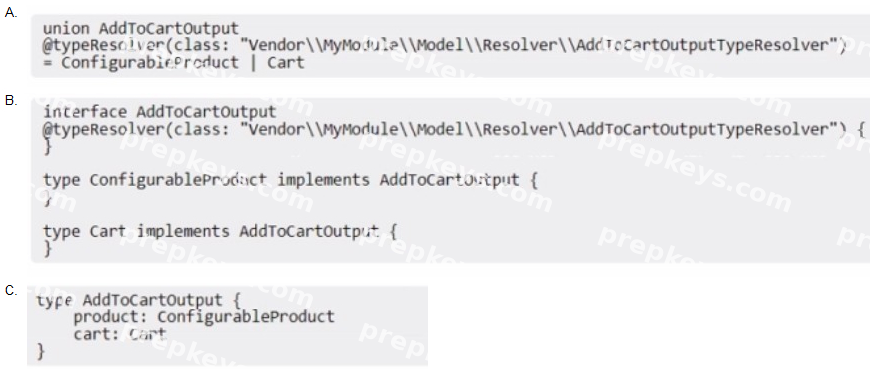
An Adobe Commerce Architect is creating a new GraphQL API mutation to alter the process of adding configurable products to the cart. The mutation accepts configurable product ID. If the given product has only one variant, then the mutation should add this variant to the cart and return not nullable Carttype. If the configurable product has more variants, then the mutation should return not nullable Conf igurableProduct type.
The mutation declaration looks as follows:

How should the Adobe Commerce Architect declare output of this mutation?
While reviewing a newly developed pull request that refactors multiple custom payment methods, the Architect notices multiple classes that depend on \Magento\Framework\Encryption\EncryptorInterface to decrypt credentials for sensitive data. The code that is commonly repeated is as follows:
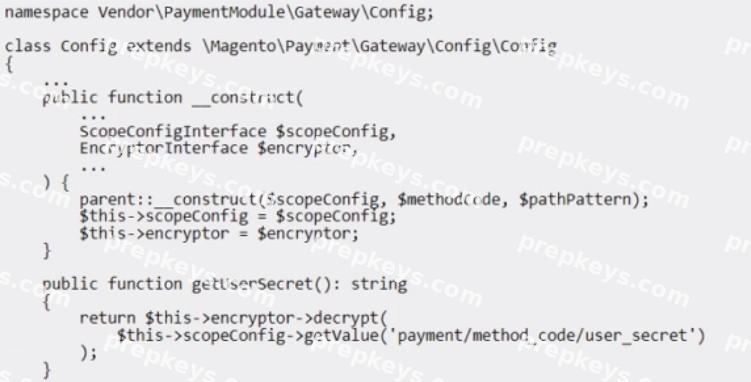
The Architect needs to recommend an optimal solution to avoid redundant dependency and duplicate code among the methods.
Which solution should the Architect recommend?
Since the last production deployment, customers can not complete checkout. The error logs show the
following message multiple times:
main.CRITICAL: Report ID: webapi-61b9fe83f0c3e; Message: Infinite loop detected, review the trace for
the looping path
The Architect finds a deployed feature that should limit delivery for some specific postcodes.
The Architect sees the following code deployed in etc/webapi_rest/di. xml and etc/frontend/di. Xml

LimitRates.php:
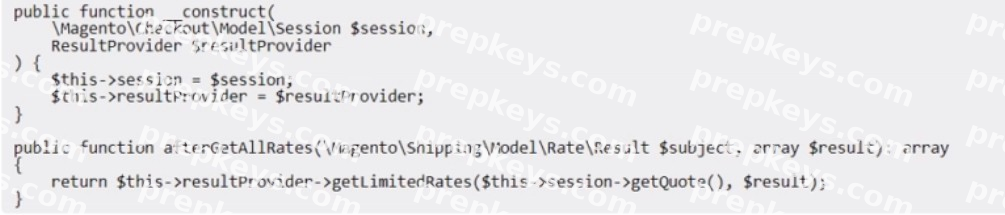
Which step should the Architect perform to solve the issue?
A third-party company needs to create an application that will integrate the Adobe Commerce system to
get orders data for reporting. The integration needs access to the GET /Vl/orders endpoint. It will call this endpoint automatically every hour around the clock. The merchant wants the ability to restrict or extend access to resources as well as to revoke the access using Admin Panel.
Which type of authentication available in Adobe Commerce should be used and implemented in a third-party system for this integration?
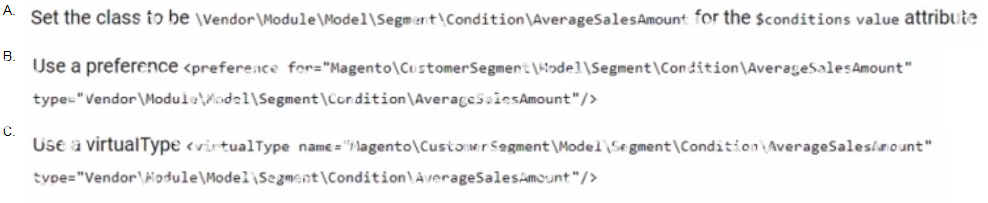
An Adobe Commerce Architect needs to create a new customer segment condition to enable admins to specify an Average sales amount' condition for certain segments.
The Architect develops the custom condition under Vendor\Module\Model\Segment\Condition
\AverageSalesAmount with all of its requirements:
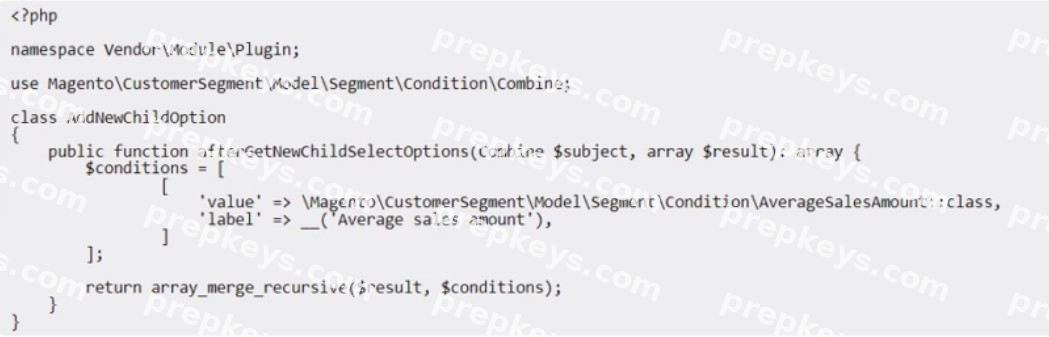
During testing, the following error appears:

What should the Architect do to fix the problem?
While developing a new functionality for a website in developer mode with all cache types enabled, an Adobe Commerce Developer needs to add \Magento\Sales\Model\Service\InvoiceService SinvoiceService as a new dependency to an existing page action controller in Vendor\CustomModule\Controller\Index
\Index . This is accomplished as follows:

After cleaning the f ull_page cache and reloading the page, the developer encounters the following exception:
Recoverable Error: Argument 2 passed to Vendor\CustomModule\Controller\Index\Index::__construct() must be an instance of
\Magento\Sales\Model\Service\InvoiceService [...
] Which action should the Architect recommend to the developer to fix this error?
An Adobe Commerce Architect needs to customize the workflow of a monthly installments payment extension. The extension is from a partner who is contracted with the default website Payment Service Provider (PSP), which has its own legacy extension (a module using deprecated payment method).
The installment payment partner manages only initializing a payment, and then hands the capture to be executed by the PSP Once the amount is successfully captured, the PSP notifies the website through a webhook. The goal of the webhook is only to create an "invoice" and save the "capture information" to be
used later for refund requests through the PSP itself.
The Architect needs the most simple solution to capture the requested behavior.
Which solution should the Architect implement?
An Architect is investigating a deployment issue with a server that is configured to work under the symlink directory /var/www/current, which lead to the latest released version of the application.
The deployment process performs the following steps:

After the last deployment, the merchant reported that the Adobe Commerce Import/Export functionality to export Customer Main File data is not working. The Architect discovered that the export file is not shown in the list of generated files.
Which change to the deployment process should be performed to solve this issue?