Exit demo C_HANAIMP_17 SAP Certified Application Associate - SAP HANA 2.0 (SPS05) PDF format · free preview

SAP C_HANAIMP_17 - Questions & Answers

Free preview · every answer includes a full explanation

Product page: https://prepkeys.com/c-hanaimp-17.html

Question 1
Single choice

You want to create a star schema using a calculation view. The measures are based on columns from two transaction tables. Dimension calculation views provide the attributes.

What is the correct approach?

A.

Combine the transaction tables using a join node in a calculation view of type cube.
Use the multi-join capability of the join node to connect the transactional tables with the dimension calculation views.

B.

Combine the transaction tables using a star join node in a calculation view of type cube with star join.
Use a join node to join the dimensions to the fact table.

C.

Combine the transaction tables using an aggregation node in a calculation view of type cube with star

join.
Use a star join node to join the dimensions to the fact table.

D.

Combine the transaction tables using a join node in a calculation view of type cube with star join.
Use a star join node to join the dimensions to the fact table.

Question 2
Single choice

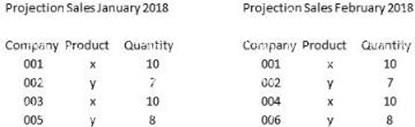
A calculation view consumes the data sources shown in the graphic. You want to identify which companies SQLd products in January 2018 AND February 2018.

What is the optimal way to do this?
A.

Use a full outer join.

B.

Use a union node.

C.

Use an left outer join.

D.

Use an intersect node

Question 3
Single choice

In SAP Web IDE, you rename a dimension calculation view that is used by a cube calculation view.
Afterward, you perform the following build operations:

*Build the dimension calculation view as a single object.

*Build the entire SAP HANA database module.

What is the outcome of the build operations?

A.

The first build fails.
The second build fails.

B.

The first build is successful.
The second build is successful.

C.

The first build fails.
The second build is successful.

D.

The first build is successful.

The second build fails.

Question 4
Multiple choice

What do you use a hierarchy function for? Note: There are 3 correct answers.

A.

Calculate distance between root and each hierarchy node

B.

Identify hierarchy nodes that have no parent

C.

Count the number of siblings for each hierarchy node

D.

Determine the shortest path between each pair of nodes

E.

Describe the relationship between nodes using attributes

Question 5
Multiple choice

You import a project that includes an SAP HANA database(HDB) module to your workspace. You need to create a calculation view that uses data from one table located in an external schema. Which of the following items must you build?

Note: There are 2 correct answers to this question.

A.

Synonym

B.

.hdinamespacefile

C.

Authorization

D.

Project

Question 6
Multiple choice

When using the CONTAINS predicate, what are the restrictions you must keep in mind? Note: There are 2 correct answers to this question.

A.

Non-physical columns, such as calculated columns, are not search-relevant.

B.

The NOT (-) operator can only be specified directly after the OR operator.

C.

Wild cards * and ? are supported for text columns but not string columns.

D.

If several tables are joined, all columns mentioned in the CONTAINS predicate must come from only one of the tables.

Question 7
Multiple choice

You deleted the design-time file of a calculation view in your HDB module.

Which of the following is the optimal way to ensure that the corresponding runtime object is also removed from the database? Note: There are 2 correct answers to this question.

A.

Delete the folder that contained the deleted design-time file.

B.

Build the folder that contained the deleted design-time file.

C.

Build the project that contained the deleted design-time file.

D.

Run a DELETE statement in an SQL console connected to the HDI container.

Question 8
Single choice

You created a table using the SQL conSQLe inside the HANA Deployment Infrastructure (HDI) container of your project. You add this table as a data source to a calculation view and try to build it.

What do you observe in the SAP HANA database container?

A.

The build is successful, and you get the expected data.

B.

The build fails, and the table is dropped.

C.

The build fails but the table is not dropped.

D.

The build is successful, but the data preview is empty.

Question 9
Single choice

What restrictions apply to a Graph node that you include in a calculation view?

A.

It must be the first node in the dataflow.

B.

It must be the final node in the dataflow.

C.

Its data source must be provided by a projection node.

D.

It cannot be included in a calculation view of type dimension.

Question 10
Single choice

Your Web IDE for SAP HANA was updated to a new version. You want to implement the new features of calculation view modeling in your existing calculation views. You open a graphical calculation view but the new features are not displayed.

What could be the reason for this?

A.

You need to update the project settings to reference the new revision.

B.

Your calculation views have not been built in the new version of the Web IDE.

C.

The calculation views have not been migrated to the new revision.

D.

The .hdiconfig file has not been updated to the latest calculation view build plug-in.

Showing 10 of 80 questions · Unlock the full set