CompTIA CLO-002 - Questions & Answers
Free preview · every answer includes a full explanation
Product page: https://prepkeys.com/clo-002.html
A cloud service provider is marketing its new PaaS offering to potential clients.
Which of the following companies would MOST likely be interested?
A company specializing in application development
A company with many legacy applications
A company with proprietary systems
A company that outsources support of its IT systems
Following a risk assessment, a company decides to adopt a multicloud strategy for its IT applications.
Which of the following is the company trying to avoid as part of its risk mitigation strategy?
Geo-redundancy
Vendor lock-in
High availability
Data sovereignty
Explanation: A company that adopts a multicloud strategy for its IT applications is trying to avoid vendor lock-in as part of its risk mitigation strategy. Vendor lock-in is a situation where the customer becomes dependent on a single cloud provider and faces high switching costs and technical challenges if they want to migrate to another provider. Vendor lock-in can limit the customer's flexibility, choice, and control over their IT resources and expose them to the risks of service degradation, price increases, or vendor lockout 12. A multicloud strategy is an approach that uses multiple cloud providers for different IT applications, based on the best fit for each workload. A multicloud strategy can help the customer avoid vendor lock-in by reducing their reliance on any single provider, increasing their bargaining power, and enabling them to leverage the best features and services from different providers 34.
References:
CompTIA Cloud Essentials+ CLO-002 Study Guide, Chapter 2: Cloud Concepts and Models,
Section 2.4: Cloud Service Challenges, p. 76-771 What is vendor lock-in? | Vendor lock-in and cloud
computing 2 Avoiding vendor lock-in with the help of multicloud 3 How to Avoid Vendor Lock-In with Cloud Computing - Seagate 4
Which of the following techniques helps an organization determine benchmarks for application performance within a set of resources?
Auto-scaling
Load testing
Sandboxing
Regression testing
Explanation: Load testing is the technique that helps an organization determine benchmarks for application performance within a set of resources. Load testing is the process of simulating a high volume of user requests or traffic to a cloud application or service, and measuring its response time, throughput, availability, and reliability. Load testing can help an organization to evaluate the performance and scalability of the cloud application or service, as well as to identify and resolve any bottlenecks, errors, or
failures. Load testing can also help the organization to optimize the resource utilization and allocation, and to plan for future growth or peak demand. Load testing can be done using various tools, such as JMeter, LoadRunner, or BlazeMeter12 References: CompTIA Cloud Essentials+ Certification Exam Objectives3, CompTIA Cloud Essentials+ Study Guide, Chapter 6: Cloud Connectivity and Load Balancing4, Cloud Essentials+ Certification Training2
Which of the following models provides the SMALLEST amount of technical overhead?
SaaS
PaaS
MaaS
IaaS
Explanation: SaaS, or software as a service, is a cloud computing model that provides on-demand access to ready-to-use, cloud-hosted application software. SaaS customers do not need to install, configure, manage, or maintain any hardware or software infrastructure to use the applications. The cloud service provider is responsible for all the technical aspects of the service, such as hosting, security, performance, availability, updates, and backups. SaaS customers only need an internet connection and a web browser or a mobile app to access the applications. SaaS provides the smallest amount of technical overhead for customers, as they do not have to deal with any of the underlying infrastructure or platform components.
SaaS customers can focus on using the applications for their business needs, without worrying about the technical details. Some examples of SaaS applications are Gmail, Google Docs, Salesforce, Slack, and Zoom .
References:
: IaaS vs. PaaS vs. SaaS | IBM
: Cloud Service Models Explained: SaaS, IaaS, PaaS, FaaS - Jelvix
A company is discontinuing its use of a cloud provider.
Which of the following should the provider do to ensure there is no sensitive data stored in the company's cloud?
Replicate the data.
Encrypt the data.
Lock in the data.
Sanitize the data.
Explanation: Data sanitization is the process of deliberately, permanently, and irreversibly removing or destroying the data stored on a memory device. Data sanitization is a security best practice and often a compliance requirement for sensitive or confidential data. Data sanitization ensures that the data cannot be recovered by any means, even by advanced forensic tools. Data sanitization can be done by overwriting, degaussing, or physically destroying the storage media. When a company discontinues its use of a cloud provider, the provider should sanitize the data to prevent any unauthorized access, leakage, or breach of the company's data.
References:
CompTIA Cloud Essentials+ Certification Exam Objectives1, CompTIA Cloud Essentials+ Study Guide, Chapter 4: Cloud Storage2, Data sanitization for cloud storage3
A report identified that several of a company's SaaS applications are against corporate policy.
Which of the following is the MOST likely reason for this issue?
Shadow IT
Sensitive data
Encryption
Vendor lock-in
Explanation: Shadow IT refers to any IT resource used by employees or end users without the IT department's approval or oversight. This can include SaaS applications that are not aligned with corporate policy or governance. Employees or teams may adopt shadow IT for convenience, productivity, or innovation, but it can also pose significant security risks and compliance concerns. Therefore, it is important for IT organizations to have visibility and control over the IT devices, software, and services used on the enterprise network.
References:
14 : CompTIA Cloud Essentials+ CLO-002 Study Guide, Chapter 1, page
15 : CompTIA Cloud Essentials+ CLO-002 Study Guide, Chapter 1, page 16Top of Form Bottom of Form
A business analyst is comparing utilization for a company's cloud servers on a financial expenditures report. The usage report is as follows:
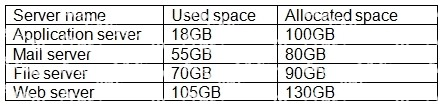
Which of the following instances represents the highest utilization?
Mail server
Application server
File server
Web server
A company wants to analyze the results of an email marketing campaign. The company identified different information sources it can use in combination with its current databases. It also contacted the CSP to use its solutions to ingest, transform, and process the information.
Which of the following is the company implementing?
Blockchain
Big Data
Social media
loT
Explanation: Big data is a term that describes the large and diverse datasets that are generated from various sources at high speed and require advanced analytics techniques to process and extract value from them. Big data can help organizations gain insights, uncover patterns, and make informed decisions12
The company is implementing big data because it is using different information sources in combination with its current databases, which implies that the data is large in volume and variety. The company is also using the CSP's solutions to ingest, transform, and process the information, which implies that the data is high in velocity and requires specialized tools and frameworks to handle it. The company is using big data analytics to analyze the results of its email marketing campaign, which can help it understand the effectiveness, impact, and return on investment of its marketing strategy34 Blockchain is not the correct answer, because blockchain is a technology that enables the creation and management of distributed, decentralized, and immutable ledgers of transactions. Blockchain can help organizations improve transparency, security, and trust in their business processes, but it is not related to the analysis of email marketing campaign results.
Social media is not the correct answer, because social media is a platform that enables the creation and sharing of content and information among users. Social media can help organizations communicate, engage, and interact with their customers, but it is not the main focus of the analysis of email marketing campaign results. Social media can be one of the information sources for big data, but it is not the same as big data. IoT is not the correct answer, because IoT is a concept that refers to the network of physical devices, sensors, and machines that are connected to the internet and can collect and exchange data. IoT can help organizations improve efficiency, productivity, and innovation, but it is not related to the analysis of email marketing campaign results. IoT can be one of the information sources for big data, but it is not the same as big data.
References:
1: (https://www.comptia.org/training/books/cloud-essentials-clo-002-)
study-guide, page 36 2: (https://cloud.google.com/learn/what-is-big-data)
3: (https://www.comptia.org/training/books/cloud-essentials-clo-002-study-guide,)
page 48 4: (https://www.ibm.com/cloud/blog/how-to-estimate-cloud-costs-a-pricing-crash-course)
: (https://www.comptia.org/training/books/cloud-essentials-clo-002-study-guide,)
page 40 : (https://www.comptia.org/training/books/cloud-essentials-clo-002-study-guide,)
page 38 : (https://www.comptia.org/training/books/cloud-essentials-clo-002-study-guide,)
page 39
Which of the following cloud principles will help manage the risk of a network breach?
Shared responsibility
Self-service
Availability
Elasticity
Explanation: Shared responsibility is the cloud principle that states that the security and compliance of the cloud service are shared between the cloud service provider and the cloud customer. The cloud service provider is responsible for securing the cloud infrastructure, such as the hardware, software, networking, and facilities, while the cloud customer is responsible for securing the cloud data, applications, and access, such as the encryption, backup, authentication, and authorization. By following the shared responsibility principle, the cloud customer can manage the risk of a network breach by implementing appropriate security measures and controls on their end, such as firewalls, antivirus, VPNs, and IAM. The cloud customer can also leverage the security features and services offered by the cloud service provider, such as encryption, monitoring, auditing, and incident response.
References:
CompTIA Cloud Essentials+ CLO-
002 Certification Study Guide, Chapter 5: Managing Cloud Security, Section 5.1: Understanding Cloud
Security Concepts, Page 1611
Which of the following are true about the use of machine learning in a cloud environment? (Choose two).
Specialized machine learning algorithms can be deployed to optimize results for specific scenarios.
Machine learning can just be hosted in the cloud for managed services.
Just one type of cloud storage is available in the cloud for machine learning workloads.
Machine learning can leverage processes in a cloud environment through the use of cloud storage and
auto-scaling.
Machine learning requires a specialized IT team to create the machine learning models from scratch.
Using machine learning solutions in the cloud removes the data-gathering step from the learning process.
Explanation: Machine learning is a subset of artificial intelligence that enables a system to autonomously learn and improve using neural networks and deep learning, without being explicitly programmed, by feeding it large amounts of data 1. Machine learning can be used in a cloud environment to leverage the benefits of cloud computing, such as scalability, flexibility, and cost-effectiveness. Some of the ways that machine learning can use cloud processes are: Specialized machine learning algorithms can be deployed to optimize results for specific scenarios.
Depending on the use case, an organization may choose different cloud services to support their machine learning projects, such as artificial intelligence as a service (AIaaS) or GPU as a service (GPUaaS)2.
AIaaS provides pre-trained models for common tasks, such as image recognition, natural language processing, or sentiment analysis, while GPUaaS provides access to high-performance computing resources for training custom models. These services can help organizations achieve better results faster and more efficiently. Machine learning can leverage processes in a cloud environment through the use of cloud storage and auto-scaling. Cloud storage provides a scalable and secure way to store and access large amounts of data, which is essential for machine learning. Cloud storage also enables data integration and collaboration across different sources and platforms 3. Auto-scaling is a feature of cloud computing that automatically adjusts the amount of resources allocated to a machine learning application based on the demand and workload. This helps optimize the performance and cost of machine learning in the cloud 4.
The other options are false because: Machine learning can just be hosted in the cloud for managed services. This is not true because machine learning can also be used in a hybrid or multi-cloud environment, where some components of the machine learning project are hosted on-premises or on different cloud providers. This can provide more flexibility and control over the machine learning process, as well as address security and compliance issues 2.
Just one type of cloud storage is available in the cloud for machine learning workloads. This is not true because there are different types of cloud storage available for machine learning workloads, such as object storage, block storage, or file storage. Each type of storage has its own advantages and disadvantages, depending on the data format, size, and access frequency. For example, object storage is suitable for storing unstructured data, such as images or videos, while block storage is suitable for storing structured data, such as databases or files 3. Machine learning requires a specialized IT team to create the machine learning models from scratch. This is not true because machine learning does not always require a specialized IT team to create the models from scratch. There are many tools and services available in the cloud that can help simplify and automate the machine learning process, such as data preparation, model building, testing, deployment, and monitoring. For example, Google Cloud AutoML is a service that allows users to create custom machine learning models with minimal coding and expertise 4.
Using machine learning solutions in the cloud removes the data-gathering step from the learning process.
This is not true because using machine learning solutions in the cloud does not remove the data-gathering step from the learning process. Data-gathering is a crucial step in machine learning, as it provides the input for the machine learning models to learn from. Data-gathering involves collecting, cleaning, labeling, and transforming data from various sources, such as sensors, databases, or web pages. Using machine learning solutions in the cloud can help with data-gathering, but it does not eliminate it3.
References:
1: What is Machine Learning? Types & Uses | Google Cloud
2: Machine Learning in the Cloud: Complete Guide [2023] - Run
3: Role: Artificial Intelligence & Machine Learning in Cloud Environment
4: Data science and machine learning on Cloud AI Platform
Showing 10 of 218 questions · Unlock the full set