Exit demo H12-224 HCIP-Routing & Switching (Fast Track) V2.0 PDF format · free preview

Huawei H12-224 - Questions & Answers

Free preview · every answer includes a full explanation

Product page: https://prepkeys.com/h12-224.html

Question 1
Multiple choice

Which statements about QinQ are true? (Choose two.)

A.

QinQ saves VLANs on the public network.

B.

To avoid VLAN conflict, the customer must negotiate with the service provider before modifying the VLANs on its private network.

C.

When the service provider upgrades the network, the configurations on the user network do not need to be modified.

D.

All of the above

Question 2
Single choice

Which statement about port isolation configuration is false?

A.

Port isolation can be used for Layer 2 isolation.

B.

In port isolation mode, ports are isolated at Layer 2 but can communicate at Layer 3 by default.

C.

Before the port isolation function takes effect on an interface, the port isolation function must be enabled first.

D.

The port-isolate enable command can run in the system view.

Question 3
Multiple choice

Which statements about MUX VLAN are true? (Choose two.)
A.

MUX VLAN contains a principal VLAN and subordinate VLANs. The principal VLAN and subordinate VLANs cannot communicate.

B.

MUX VLAN contains a principal VLAN and subordinate VLANs. The subordinate VLANs are classified into subordinate separate VLANs and subordinate group VLANs. The interfaces in the subordinate group VLAN can communicate with each other.

C.

The principal VLAN and subordinate VLANs can communicate.

D.

The interfaces of different subordinate separate VLANs can communicate with each other, but cannot communicate with the interfaces in the principal VLAN.

Question 4
Single choice

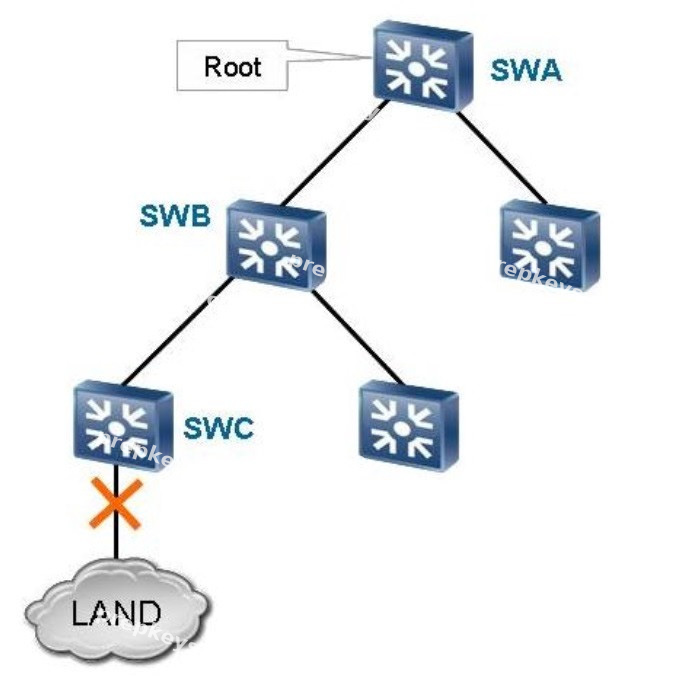
As shown in the figure, when the link between SWC and LAND is faulty, through which path are TCA BPDUs sent?

A.

From SWA to SWB

B.

From SWB to SWC

C.

From SWB to SWA

D.

From SWC to SWB

Question 5
Single choice

Two switches are directly connected to each other and they are working in full duplex mode. By default, RSTP will consider the link between the switches as point-to-point link.

A.

True

B.

False

Question 6
Single choice

On the RSTP network with STP devices, which packets does an RSTP switch use to notify the STP switches of the topology change?

A.

RSTP BPDUs with the TC flag

B.

STP BPDUs with the TCN flag

C.

RSTP BPDUs with the TCA flag

D.

STP BPDUs with the TCA flag

Question 7
Single choice

If the customer requires high mobility and easy management, the staff of different departments can be added to different VLANs. In addition, these VLANs are located on different IP subnets.

Which VLAN allocation mode can meet these requirements?

A.

VLAN allocation based on source IP addresses

B.

VLAN allocation based on destination IP addresses

C.

VLAN allocation based on source IP addresses and source MAC addresses

D.

VLAN allocation based on destination MAC addresses and destination IP addresses

Question 8
Single choice

Which statement about the trunk interface is true?

A.

A trunk interface is always connected to hosts.

B.

"multiple" VLAN IDs can be set on a trunk interface. The VLAN IDs can be the same as or different from the PVID.

C.

The trunk interface cannot have a PVID.

D.

If the trunk interface receives a packet with a VLAN not in the allowed VLAN list, the trunk interface broadcast the packet in the VLAN.

Question 9
Multiple choice

In RSTP, the port status can be discarding and learning.

Which statements about the port status are true? (Choose two.)

A.

The port in discarding or learning state does not forward data frames.

B.

The port in discarding state does not learn MAC addresses.

C.

The port in learning state does not learn MAC addresses.

D.

All of the above

Question 10
Multiple choice

Which statements about VLAN aggregation are true? (Choose three.)

A.

"multiple" VLANs (broadcast domains) are on the same physical network; therefore, different VLANs
belong to the same subnet.

B.

VLAN aggregation can save IP addresses.

C.

Only the super VLAN requires an IP address, but sub-VLANs do not need.

D.

The VLAN that is used to separate broadcast domains is called super VLAN.

Showing 10 of 803 questions · Unlock the full set