SalesForce IDENTITY-AND-ACCESS-MANAGEMENT-ARCHITECT - Questions & Answers
Free preview · every answer includes a full explanation
Product page: https://prepkeys.com/identity-and-access-management-architect.html
Uwversal Containers (UC) is building a custom employee hut) application on Amazon Web Services (AWS) and would like to store their users' credentials there. Users will also need access to Salesforce for internal operations. UC has tasked an identity architect with evaluating Afferent solutions for authentication and authorization between AWS and Salesforce.
How should an identity architect configure AWS to authenticate and authorize Salesforce users?
The executive sponsor for an organization has asked if Salesforce supports the ability to embed a login widget into its service providers in order to create a more seamless user experience.
What should be used and considered before recommending it as a solution on the Salesforce Platform?
Northern Trail Outfitters (NTO) utilizes a third-party cloud solution for an employee portal. NTO also owns Salesforce Service Cloud and would like employees to be able to login to Salesforce with their third-party portal credentials for a seamless expenence. The third-party employee portal only supports OAuth.
What should an identity architect recommend to enable single sign-on (SSO) between the portal and Salesforce?
Universal containers (UC) has multiple salesforce orgs and would like to use a single identity provider to access all of their orgs.
How should UC'S architect enable this behavior?
A pharmaceutical company has an on-premise application (see illustration) that it wants to integrate with Salesforce.
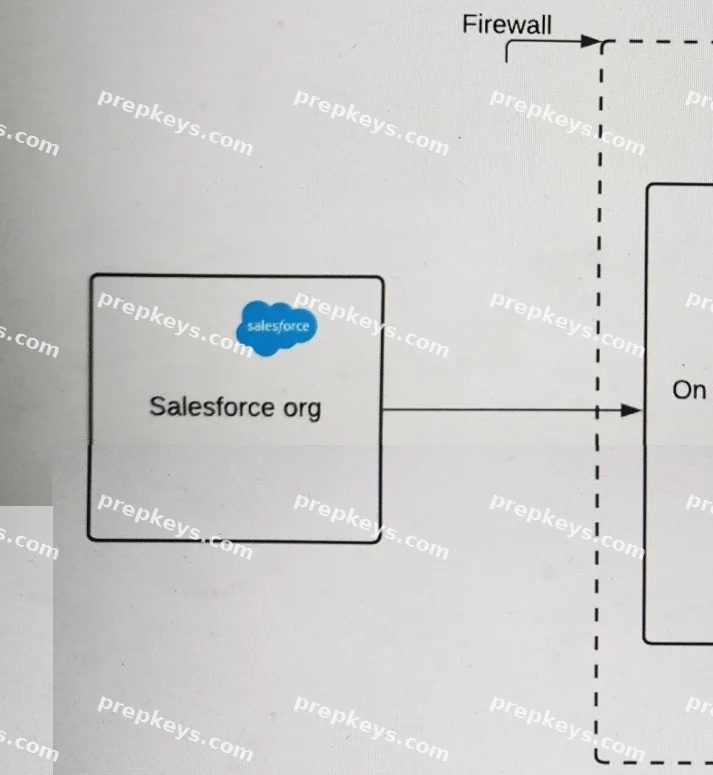
The IT director wants to ensure that requests must include a certificate with a trusted certificate chain to access the company's on-premise application endpoint.
What should an Identity architect do to meet this requirement?
The security team at Universal Containers (UC) has identified exporting reports as a high-risk action and would like to require users to be logged into Salesforce with their Active Directory (AD) credentials when doing so. For all other users of Salesforce, users should be allowed to use AD Credentials or Salesforce credentials.
What solution should be recommended to prevent exporting reports except when logged in using AD credentials while maintaining the ability to view reports when logged in with Salesforce credentials?
Universal Containers (UC) wants to build a custom mobile app for their field reps to create orders in salesforce. After the first time the users log in, they must be able to access salesforce upon opening the mobile app without being prompted to log in again.
What Oauth flows should be considered to support this requirement?
A global fitness equipment manufacturer uses Salesforce to manage its sales cycle. The manufacturer has a custom order fulfillment app that needs to request order data from Salesforce. The order fulfillment app needs to integrate with the Salesforce API using OAuth 2.0 protocol.
What should an identity architect use to fulfill this requirement?
An Enterprise is using a Lightweight Directory Access Protocol (LDAP ) server as the only point for user authentication with a username/password. Salesforce delegated authentication is configured to integrate Salesforce under single sign-on (SSO).
Mow can end users change their password?
Universal containers (UC) has a classified information system that it's call centre team uses only when they are working on a case with a record type of "classified". They are only allowed to access the system when they own an open "classified" case, and their access to the system is removed at all other times.
They would like to implement SAML SSO with salesforce as the IDP, and automatically allow or deny the staff's access to the classified information system based on whether they currently own an open
"classified" case record when they try to access the system using SSO.
What is the recommended solution for automatically allowing or denying access to the classified information system based on the open "classified" case record criteria?