Exit demo JN0-647 Enterprise Routing and Switching, Professional (JNCIP-ENT) PDF format · free preview

Juniper JN0-647 - Questions & Answers

Free preview · every answer includes a full explanation

Product page: https://prepkeys.com/jn0-647.html

Question 1
Single choice

Your network supports multicast traffic but your provider network does not. You want to allow multicast hosts outside of your network to receive multicast traffic sourced within your network.

How would you satisfy this requirement?

A.

Use MSDP peering with your provider.

B.

Use AutoVPN to connect to the remote hosts.

C.

Use an MP-BGP session to your provider to pass multicast traffic.

D.

Use an automatic multicast tunnel gateway at the edge of your network.

Question 2
Single choice

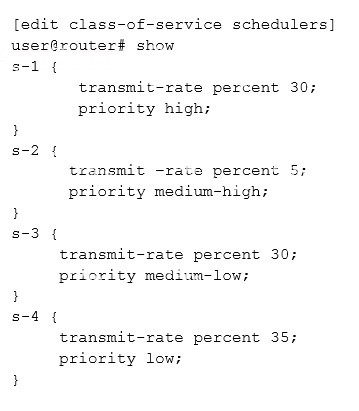
Click the exhibit.

Referring to the exhibit, traffic handled by the s-1 scheduler is out of profile.
Assuming bandwidth is available in this scenario, which statement is correct?

A.

Traffic handled by the s-1 scheduler is serviced immediately after traffic being serviced by the s-4 scheduler.

B.

Traffic handled by the s-1 scheduler is serviced immediately before traffic being serviced by the s-4 scheduler.

C.

Traffic handled by the s-1 scheduler is serviced immediately before traffic being serviced by the s-2 scheduler.

D.

Traffic handled by the s-1 scheduler is serviced immediately after traffic being serviced by the s-2 scheduler.

Question 3
Single choice

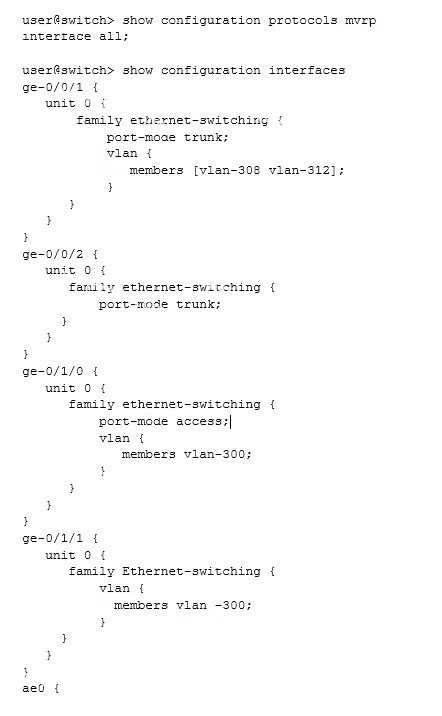
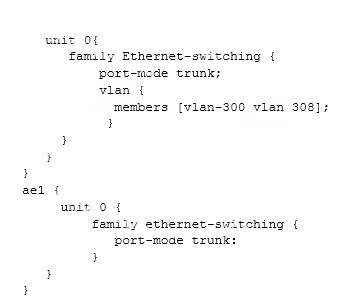
Click the Exhibit.

Referring to the exhibit, which set of interfaces will be registered by MVRP?

A.

ge-0/1/0, ge-0/1/1, ae0, ae1

B.

ge-0/1/0, ge-0/0/2, ae0, ae1

C.

ge-0/0/1, ge-0/1/1, ae0, ae1

D.

ge-0/0/1, ge-0/0/2, ae0, ae1

Question 4
Single choice

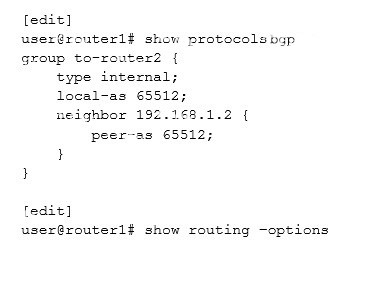
Click the Exhibit button.

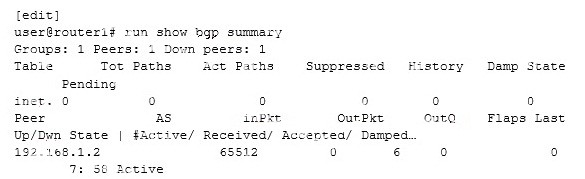
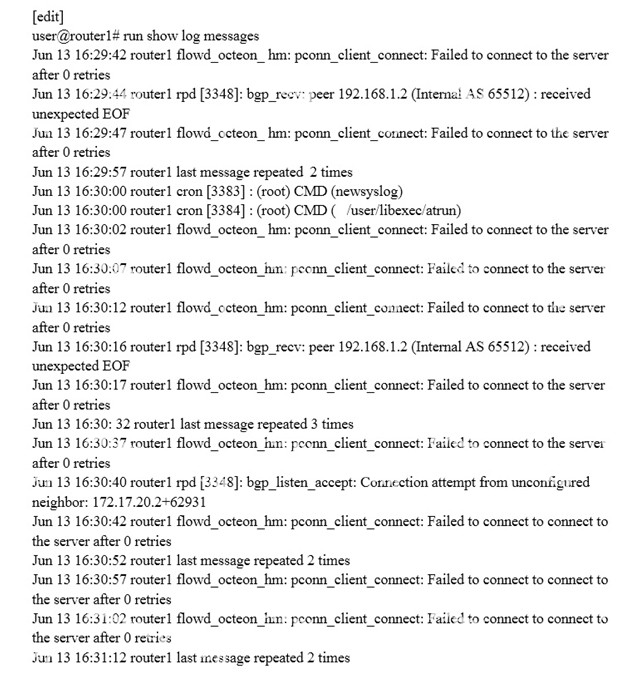
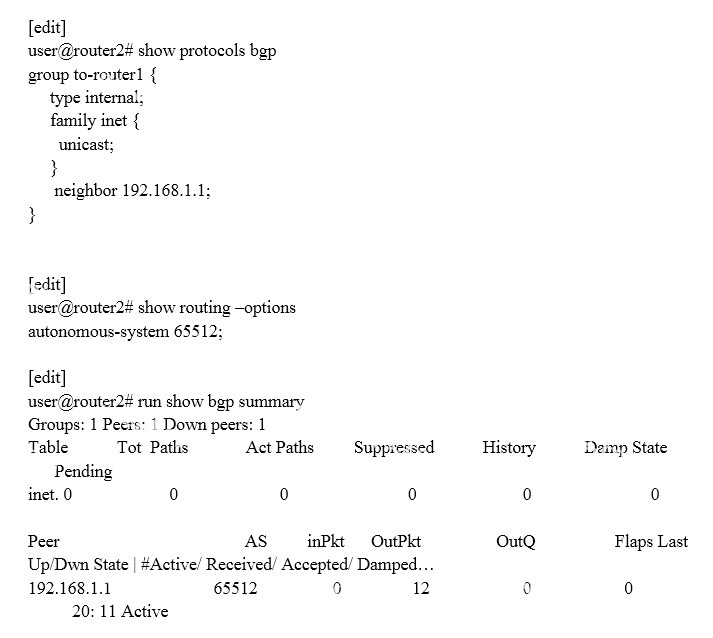
You are configuring a new BGP session between router1 and router2. The session does not establish.

Referring to the exhibit, what must be done to establish this session?

A.

You must define the peer-as number on router2.

B.

You must define the autonomous-system number under the [edit routing-options] hierarchy on router1.

C.

You must specify type as external on both devices.

D.

You must specify the local-address on both devices.

Question 5
Single choice

Which router ID is correct for OSFPv3?

A.

0.0.0.0

B.

2001:123:6::1

C.

::172.16.1.1

D.

172.16.1.1

Question 6
Single choice

Which type of BGP is used to peer with a different autonomous system?

A.

external

B.

classless

C.

dynamic

D.

static

Question 7
Single choice

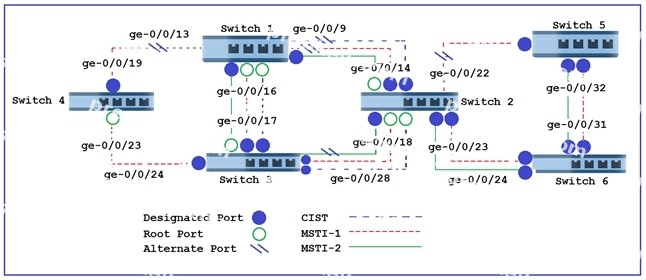
Click the Exhibit button.

Referring to the exhibit, what is the minimum number of MSTP regions where the topology would be implemented?

A.

3

B.

1

C.

2

D.

0

Question 8
Single choice

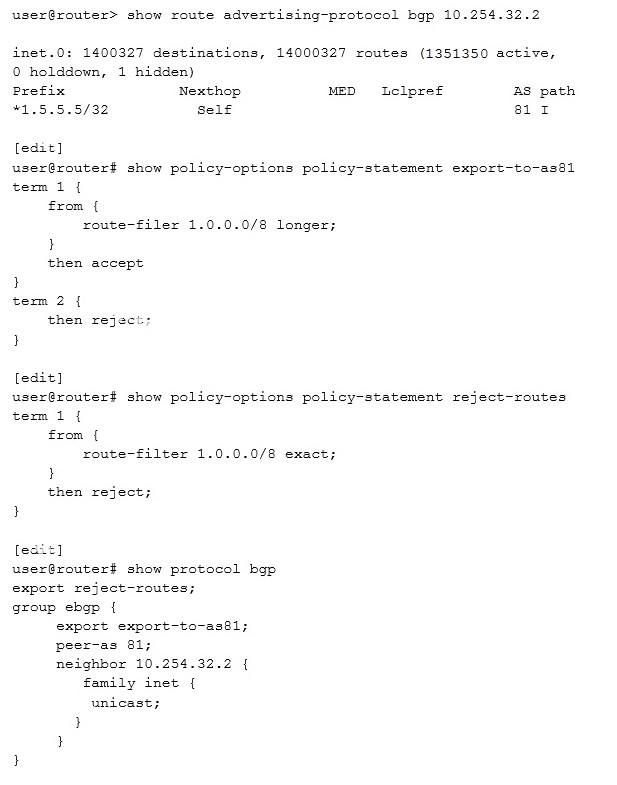
Click the Exhibit button.

You are asked to advertise the 1.0.0.0/8 and 1.5.5.5/32 routes to your 10.254.32.2 BGP peer.

Referring to the exhibit, which configuration change would satisfy this requirement?

A.

Remove the export-to- as81 policy.

B.

Change the export-to- as81 policy to or longer.

C.

Remove the reject-routes policy.

D.

Change the reject-routes policy to longer.

Question 9
Single choice

Your campus EX9200 core devices are highly oversubscribed on bandwidth and reporting massive dropped packets. To immediately address the issue, you decide to implement shaping on all interfaces.

Which action will accomplish?

A.

Apply the input-shape-rate 5G parameter to all interfaces under the [edit class-of service] hierarchy.

B.

Define a CoS input traffic control profile with the shape-rate 5G parameter and apply it to all interfaces.

C.

Define a CoS output traffic control profile with the shape-rate 5G parameter and apply it to all interfaces.

D.

Apply the shape-rate 5G parameter to all interfaces under the [edit class-of service] hierarchy.]

Question 10
Single choice

What allows non-Web enabled devices to access the network on a port configured for captive portal?

A.

A MAC address white list can be configured on the switch to allow specific MAC addresses to bypass the captive portal process.

B.

LLDP can be used to query the type of device that is attempting to access the network, and predefined device types can be allowed to bypass the captive portal process.

C.

Captive portal can be configured to only prompt for credentials when HTTP or HTTPS traffic is requested on a port to allow on-HTTP enabled devices access to the network.

D.

Authentication credentials for specific devices can be preconfigured on the switch for automatic authentication.

Showing 10 of 75 questions · Unlock the full set