Exit demo JN0-663 Service Provider Routing and Switching, Professional (JNCIP-SP) PDF format · free preview

Juniper JN0-663 - Questions & Answers

Free preview · every answer includes a full explanation

Product page: https://prepkeys.com/jn0-663.html
Question 1
Multiple choice

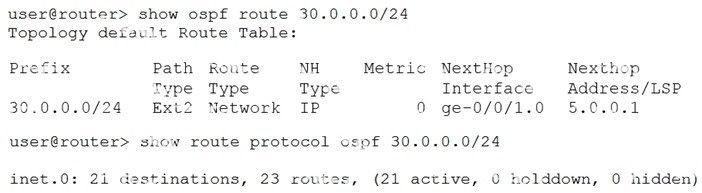
You notice an inconsistency between the routing table and the OSPF database, as shown in the exhibit.

What are two reasons for this behavior? (Choose two.)
A.

The LSA is a Type 4 LSA.

B.

An OSPF export policy is being applied to the route.

C.

An OSPF import policy is being applied to the route.

D.

The LSA is a Type 5 LSA.

Question 2
Multiple choice

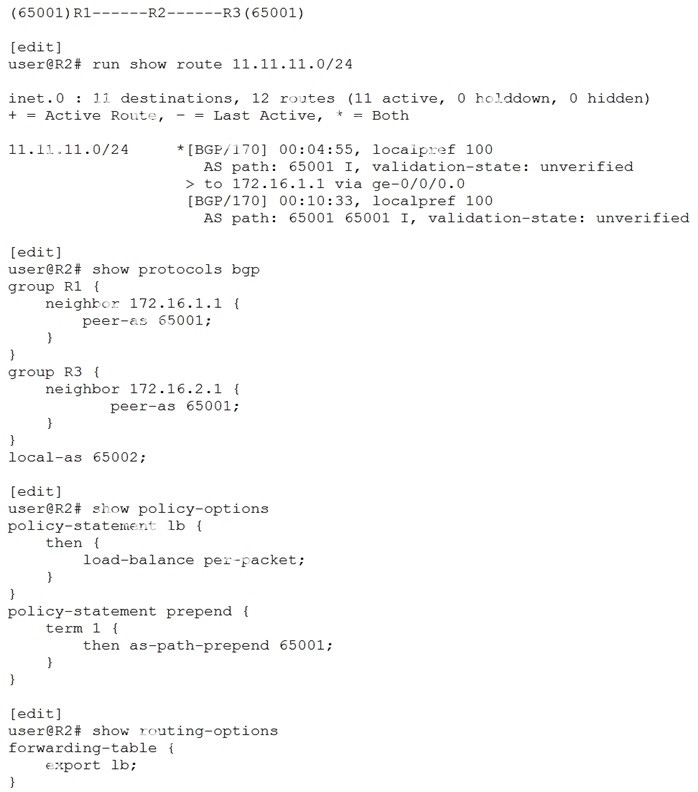
R2 is receiving the same route from R1 and R3. You must ensure that you can load balance traffic for that route.

Referring to the exhibit, which two configuration changes will allow load balancing? (Choose two.)
A.

Apply the prepend policy as an import policy under group R1.

B.

Configure multipath under the global BGP configuration.

C.

Configure multipath under group R1.

D.

Apply the prepend policy as an import policy under group R3.

Question 3
Single choice

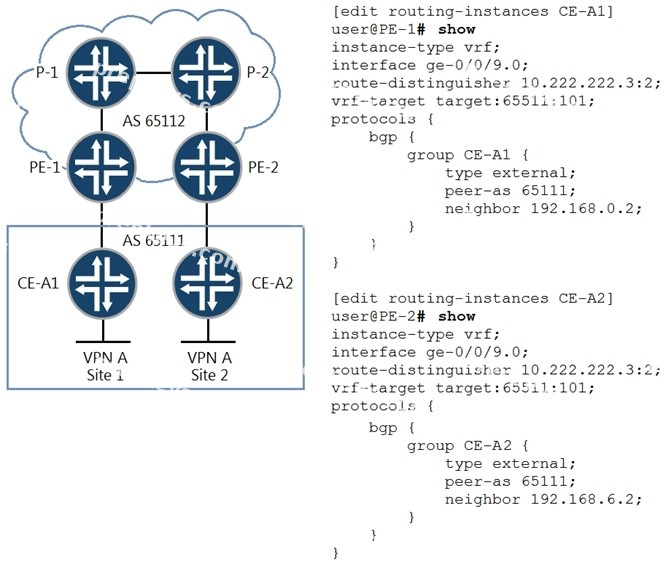
Referring to the exhibit, hosts in Site 1 and Site 2 are unable to communicate with each other through the Layer 3 VPN.

What is the problem?
A.

The two sites are in the same AS.

B.

The two sites are using the same instance type.

C.

The two sites are using the same route target.

D.

The two sites are using the same route distinguisher.

Question 4
Single choice

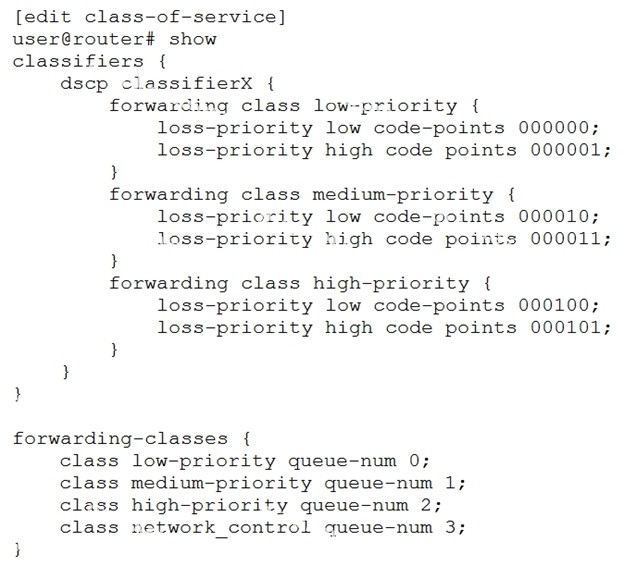
You manage an MX Series device which includes the configuration shown in the exhibit. Traffic marked with DSCP 000011 is entering the ge-1/0/4 interface at 102 Mbps. The traffic exits the device on the ge- 1/0/5 interface. No other traffic is transiting the router.

In this scenario, what happens to traffic exceeding 100 Mbps?

A.

Traffic exceeding 100 Mbps is redirected to a rate limiter.

B.

Traffic exceeding 100 Mbps is buffered.

C.

Traffic exceeding 100 Mbps is dropped.

D.

Traffic exceeding 100 Mbps is forwarded.

Question 5
Single choice

What is the purpose of the cluster-list attribute within a BGP route reflector group?
A.

to disable internal cluster re-advertisements

B.

to facilitate loop detection within the route reflector network

C.

to define the router that first advertised the route to the route reflector

D.

to override the router ID value within the cluster

Question 6
Multiple choice

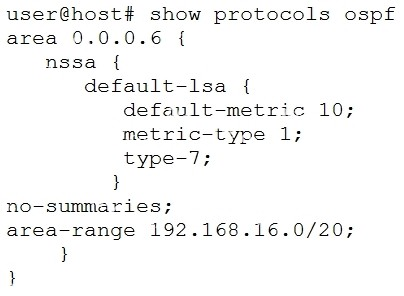
Referring to the ABR configuration shown in the exhibit, which three statements are correct? (Choose three.)
A.

The ABR advertises a default route to the NSSA using a Type 7 LSA.

B.

The ABR advertises a single Type 3 summary LSA to the backbone area for all Type 1 and Type 2 LSAs in the 192.168.16.0/20 range.

C.

The ABR advertises a Type 5 external LSA to the backbone area for each Type 7 LSA in the NSSA.

D.

The ABR does not summarize any routes within the 192.168.16.0/20 range.

E.

The ABR advertises a single Type 5 external LSA to the backbone area for all Type 7 LSAs in the NSSA.

Question 7
Multiple choice

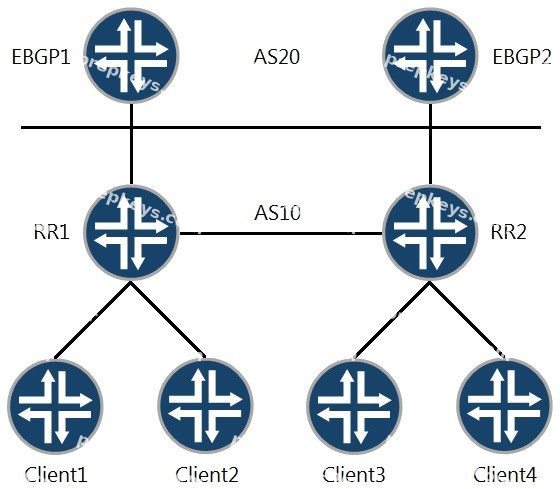
Referring to the exhibit, which two statements about route reflectors are correct? (Choose two.)
A.

RR1 advertises routes learned from Client1 to RR2 with itself as the next hop.

B.

RR2 advertises routes learned from Client3 to EBGP2 with itself as the next hop.

C.

RR1 and RR2 need the same cluster ID to exchange routes learned from their clients.

D.

RR2 adds its cluster ID when advertising routes from Client4 to Client3.

Question 8
Single choice

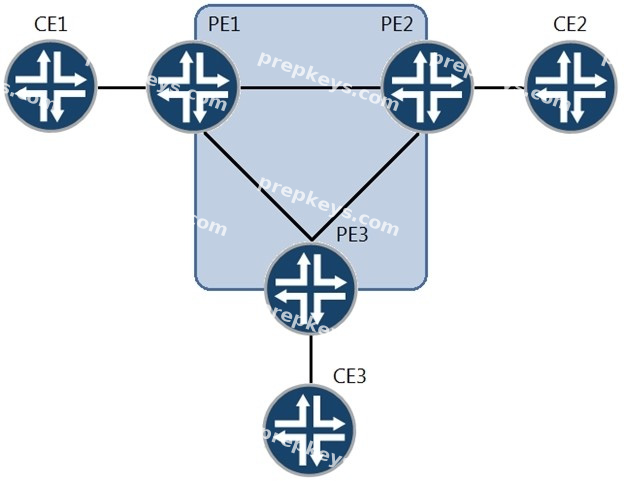
You are provisioning Layer 2 circuits between sites CE1, CE2, and CE3.

Referring to the exhibit, which statement is true?

A.

A point-to-multipoint LSP must be created between sites.

B.

Each site must have only one VLAN configured to the PE.

C.

Site PE1 must have a point-to-multipoint link configured towards the core.

D.

Two VLANs must be configured from PE 1 to CE 1.

Question 9
Multiple choice

What information is stored in a VRF table for a BGP Layer 2 VPN? (Choose three.)

A.

Layer 2 encapsulation

B.

local site ID

C.

remote interface of local CE device

D.

logical interlace provisioned to local CE device

E.

label-switched path

Question 10
Multiple choice

Which two statements about wide and narrow metrics used in IS-IS are correct? (Choose two.)

A.

Wide metrics are enabled with the wide-metrics-only parameter under protocols isis hierarchy.

B.

Narrow metrics are enabled by default and use 8 bits in TLVs to send information.

C.

Wide metrics are sent by default and use 24 bits in TLVs to send information.

D.

Disabling narrow metrics results in external routes being leaked from L1 to L2 areas automatically.

Showing 10 of 96 questions · Unlock the full set