Exit demo KX3-003 Certified RapidResponse Author Level 3 PDF format · free preview

Kinaxis KX3-003 - Questions & Answers

Free preview · every answer includes a full explanation

Product page: https://prepkeys.com/kx3-003.html

Question 1
Single choice

You have a report based on an InventoryTransfer table. Due to currency fluctuation, you are asked to report the difference between the future EffectiveUnitTransferCost and the cost to transfer it today.

Which expression will accomplish this task?

A.

EffectiveUnitTransferCost - (CONVERTONDATE(TransferCost, ShipDate) / Quantity)

B.

CONVERTONDATE(EffectiveUnitTransferCost, today) - (TransferCost / Quantity)

C.

EffectiveUnitTransferCost - (TransferCost / Quantity)

D.

EffectiveUnitTransferCost - (CONVERTONDATE(TransferCost, today) / Quantity)

Question 2
Single choice

You are asked to restrict a worksheet so that users can only see data for the demand of the countries that they should have permission to see. A field has been added to the IndependentDemand table, which is a reference to a custom table called Country. Each user may have permission to see the demands from one or more countries, and each country can be seen by one or more users. They should be able to see data from multiple countries in the worksheet at the same time.

In this scenario, what should you do to enable this capability?

A.

Create a $DmdCountry list workbook variable with a query generated list of values based on the Country table. Add the expression UserInGroup ($User, 'DemandPlanners') to the variable filter and then in the column properties conditionally hide the column using the $DmdCountry = False expression.

B.

Create a $DmdCountry text workbook variable with the expression UserInGroup ($User, 'DemandPlanners'). Add the $DmdPlanners = TRUE expression to the worksheet.

C.

Build a Responsibility definition based on the Country table and assign the users to all of the countries that they should have permission to see. Add a responsibility column to the worksheet so users can select their country.

D.

Create a $DmdCountry profile variable and assign the country names to each user. Add the expression
IF ($DmdCountry = "'*'", TRUE, User::DmdCountry IN eval($DmdCountry)) to the worksheet filter.

Question 3
Single choice

You have a worksheet based on the Part table. You want to know the total number of unique customers that have orders for each part.

Which expression accomplishes this task?
A.

COUNT IndependentDemands {Order.Customer:Sum}

B.

COUNT IndependentDemands {Order.Customer:By}

C.

COUNT IndependentDemands {Order.Customer<>''}

D.

SUM IndependentDemands{Order.Customer:Sum}

Question 4
Single choice

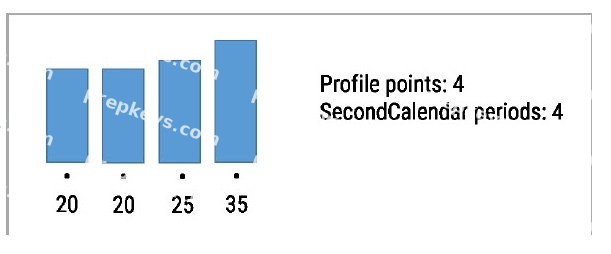
Forecasts are being received on a monthly basis and you are asked to spread these forecasts into weekly intervals. The month has four weeks, and you are using the spreading profile shown in the graphic where the first week is on the left. The monthly forecast is for a quantity of 500. The PlanningCalendars.ForecastCalendar=Month and PlanningCalendars.SecondCalendar=Week.

Referring to the graphic, what will the weekly forecast quantities be?
A.

100, 100, 125, 175

B.

100, 100, 135, 165

C.

100, 100, 140, 160

D.

125, 125, 125, 125

Question 5
Multiple choice

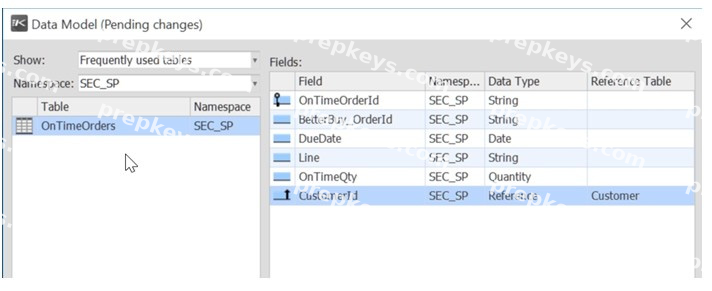
Which two violations of Kinaxis best practice are shown in the graphic? (Choose two.)

A.

The key field contains the table name.

B.

The Line should be a number field.

C.

The deployment name prefix is included in the OrderId field.

D.

OnTimeQty should specify the data type in the field name.

Question 6
Single choice

You need to create a new custom field to be used for record filtering that will be populated with the salesperson's name. Each order will have a single associated salesperson's name.

Following database design principles and Kinaxis best practices, which action accomplishes this task?

A.

Create a new Salesperson table referenced by the Customer table.

B.

Add a Salesperson string field on the DemandOrder table.

C.

Create a new Salesperson table referenced by the IndependentDemand table.

D.

Create a new Salesperson table referenced by the DemandOrder table.

Question 7
Multiple choice

Your suppliers need to receive a report listing their outstanding purchase orders. Each supplier should receive the report in the same format but it should only display the purchase orders associated with their supplier ID.

Based on this situation, which two actions will be required to support this requirement? (Choose two.)

A.

Define a profile variable to assign the supplier ID to the supplier's user group. Add the profile variable to the filter expression in the workbook.

B.

Define a list workbook variable to provide a selector for the supplier list. Add the workbook variable to the filter expression in the workbook.

C.

Assign a master Supplier group in the Advanced properties of the Alert properties window.

D.

Add the supplier's user group in the Notify tab of the Alert properties window.

Question 8
Multiple choice

A client wants to provide their sales staff the ability to add forecasts for the global total of demand across all SKUs by each customer by month. The client wants to use their historical demand to allocate from a monthly forecast to a weekly forecast.

Which three actions would accomplish this task? (Choose three.)
A.

Create a worksheet based on the HistoricalDemandActual table.

B.

Create workbook variables for Start Date and End Date.

C.

Create a workbook variable for Calendar with a value of Month.

D.

Define a custom Insert Definition.

E.

Include only columns for Part, Site, and Customer from the HistoricalDemandActual table.

Question 9
Single choice

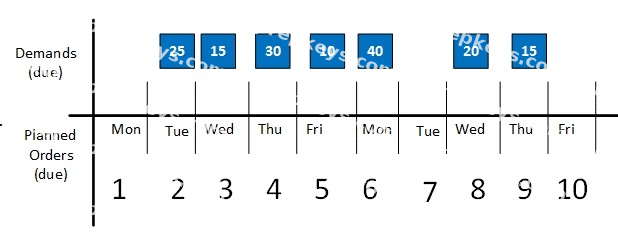
Given this information and referring to the graphic:

Number of Days of Supply: 2
DaysSupplyRule: ByPeriod
PeriodSupplyInterval: Week
PeriodSupplyDueCalendar: Week

Which statement about the planned order(s) that are created is true?

A.

Two planned orders will be created; one due on day 1 (first Monday) for a quantity of 80 and another on
day 6 (second Monday) for a quantity of 75.

B.

Two planned orders will be created; one due on day 2 (first Tuesday) for a quantity of 80 and another
on day 6 (second Monday) for a quantity of 75.

C.

A single planned order will be created due on day 2 (first Tuesday) for a quantity of 155.

D.

A single planned order will be created due on day 1 (first Monday) for a quantity of 155.

Question 10
Single choice

You are asked to populate the PartSource BaseKey to ensure unique key values.

In this situation, which expression would create uniqueness while saving memory?

A.

Part.Site.Value + `:' + TEXT(EffectiveInDate)

B.

TEXT(EffectiveInDate)

C.

Part.Name + `:' + Source.Supplier.ID

D.

Source.Id

Showing 10 of 60 questions · Unlock the full set