Mulesoft MCIA-LEVEL1 - Questions & Answers
Free preview · every answer includes a full explanation
Product page: https://prepkeys.com/mcia-level1.html
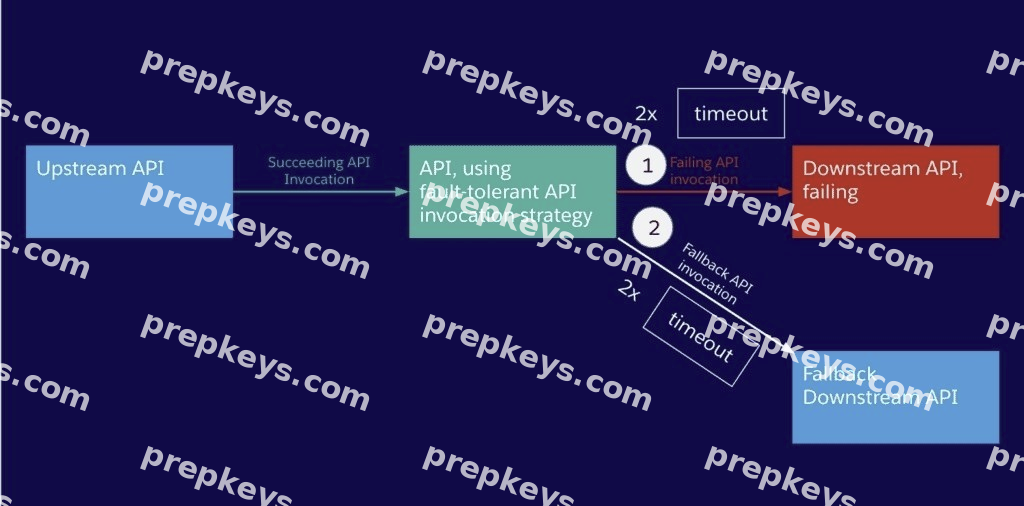
An API implementation is being designed that must invoke an Order API which is known to repeatedly experience downtime. For this reason a fallback API is to be called when the Order API is unavailable.
What approach to designing invocation of the fallback API provides the best resilience?
An organization has an HTTPS-enabled Mule application named Orders API that receives requests from
another Mule application named Process Orders.
The communication between these two Mule applications must be secured by TLS mutual authentication (two-way TLS).
At a minimum, what must be stored in each truststore and keystore of these two Mule applications to properly support two-way TLS between the two Mule applications while properly protecting each Mule application's keys?
As an enterprise architect, what are the two reasons for which you would use a canonical data model in the new integration project using Mulesoft Anypoint platform ( choose two answers )
Insurance organization is planning to deploy Mule application in MuleSoft Hosted runtime plane. As a part of requirement , application should be scalable . highly available. It also has regulatory requirement which demands logs to be retained for at least 2 years.
As an Integration Architect what step you will recommend in order to achieve this?
A project uses Jenkins to implement CI/CD process. It was observed that each Mule package contains some of the Jenkins files and folders for configurations of CI/CD jobs.
As these files and folders are not part of the actual package, expectation is that these should not be part of deployed archive.
Which file can be used to exclude these files and folders from the deployed archive?
As part of a growth strategy, a supplier signs a trading agreement with a large customer. The customer sends purchase orders to the supplier according to the ANSI X12 EDI standard, and the supplier creates the orders in its ERP system using the information in the EDI document.
The agreement also requires that the supplier provide a new RESTful API to process request from the customer for current product inventory level from the supplier' s ERP system.
Which two fundamental integration use cases does the supplier need to deliver to provide an end-to-end solution for this business scenario? (Choose two.)
A MuteSoft developer must implement an API as a Mule application, run the application locally, and execute unit tests against the Running application.
Which Anypoint Platform component can the developer use to full all of these requirements?
A global organization operates datacenters in many countries. There are private network links between these datacenters because all business data (but NOT metadata) must be exchanged over these private network connections.
The organization does not currently use AWS in any way.
The strategic decision has Just been made to rigorously minimize IT operations effort and investment going forward.
What combination of deployment options of the Anypoint Platform control plane and runtime plane(s) best serves this organization at the start of this strategic journey?
A key Cl/CD capability of any enterprise solution is a testing framework to write and run repeatable tests.
Which component of Anypoint Platform provides the te6t automation capabilities for customers to use in their pipelines?
An automation engineer needs to write scripts to automate the steps of the API lifecycle, including steps to create, publish, deploy and manage APIs and their implementations in Anypoint Platform.
What Anypoint Platform feature can be used to automate the execution of all these actions in scripts in the easiest way without needing to directly invoke the Anypoint Platform REST APIs?