Mulesoft MCPA-LEVEL1 - Questions & Answers
Free preview · every answer includes a full explanation
Product page: https://prepkeys.com/mcpa-level1.html
A code-centric API documentation environment should allow API consumers to investigate and execute API client source code that demonstrates invoking one or more APIs as part of representative scenarios.
What is the most effective way to provide this type of code-centric API documentation environment using Anypoint Platform?
An API has been updated in Anypoint Exchange by its API producer from version 3.1.1 to 3.2.0 following accepted semantic versioning practices and the changes have been communicated via the API's public portal.
The API endpoint does NOT change in the new version.
How should the developer of an API client respond to this change?
An Anypoint Platform organization has been configured with an external identity provider (IdP) for identity management and client management.
What credentials or token must be provided to Anypoint CLI to execute commands against the Anypoint Platform APIs?
How are an API implementation, API client, and API consumer combined to invoke and process an API?
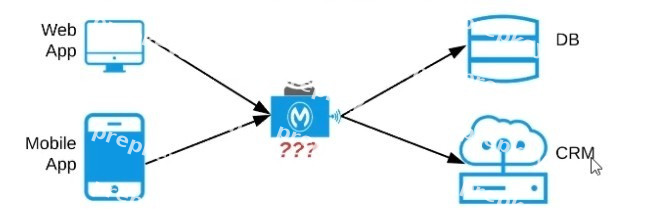
Refer to the exhibit. An organization needs to enable access to their customer data from both a mobile app and a web application, which each need access to common fields as well as certain unique fields.
The data is available partially in a database and partially in a 3rd-party CRM system.
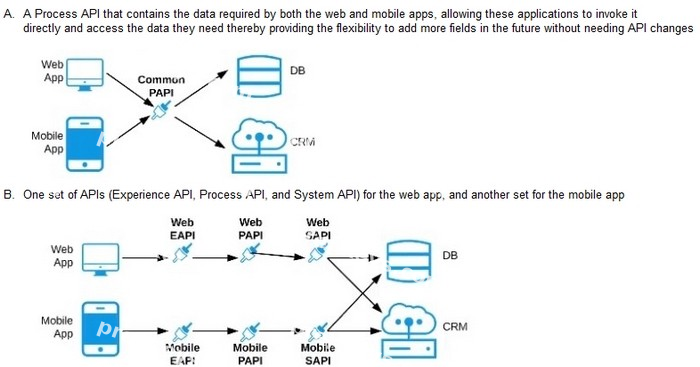
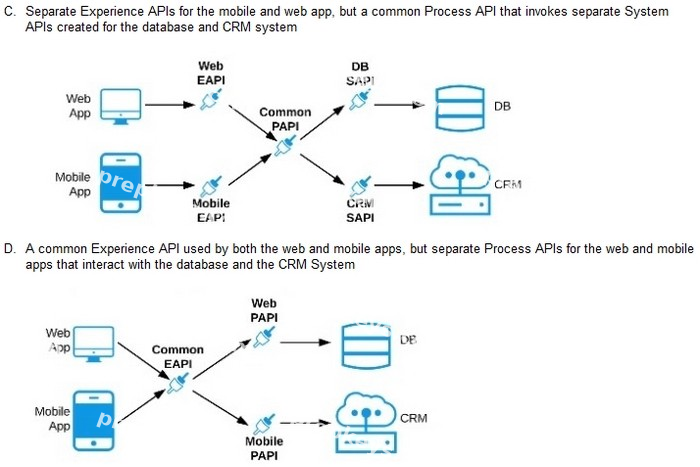
What APIs should be created to best fit these design requirements?
An API implementation is deployed to CloudHub.
What conditions can be alerted on using the default Anypoint Platform functionality, where the alert conditions depend on the end-to-end request processing of the API implementation?
Traffic is routed through an API proxy to an API implementation. The API proxy is managed by API Manager and the API implementation is deployed to a CloudHub VPC using Runtime Manager. API policies have been applied to this API.
In this deployment scenario, at what point are the API policies enforced on incoming API client requests?
Mule applications that implement a number of REST APIs are deployed to their own subnet that is
inaccessible from outside the organization.
External business-partners need to access these APIs, which are only allowed to be invoked from a separate subnet dedicated to partners - called Partner-subnet. This subnet is accessible from the public internet, which allows these external partners to reach it.
Anypoint Platform and Mule runtimes are already deployed in Partner-subnet. These Mule runtimes can already access the APIs.
What is the most resource-efficient solution to comply with these requirements, while having the least impact on other applications that are currently using the APIs?
A system API is deployed to a primary environment as well as to a disaster recovery (DR) environment, with different DNS names in each environment. A process API is a client to the system API and is being rate limited by the system API, with different limits in each of the environments. The system API's DR environment provides only 20% of the rate limiting offered by the primary environment.
What is the best API fault-tolerant invocation strategy to reduce overall errors in the process API, given these conditions and constraints?
What is a key requirement when using an external Identity Provider for Client Management in Anypoint Platform?