Exit demo MULESOFT-PLATFORM-ARCHITECT-I Salesforce Certified MuleSoft Platform Architect (Mule-Arch-201) PDF format · free preview

SalesForce MULESOFT-PLATFORM-ARCHITECT-I - Questions & Answers

Free preview · every answer includes a full explanation

Product page: https://prepkeys.com/mulesoft-platform-architect-i.html

Question 1
Single choice

When must an API implementation be deployed to an Anypoint VPC?

A.

When the API Implementation must invoke publicly exposed services that are deployed outside of CloudHub in a customer-managed AWS instance

B.

When the API implementation must be accessible within a subnet of a restricted customer-hosted network that does not allow public access

C.

When the API implementation must be deployed to a production AWS VPC using the Mule Maven plugin

D.

When the API Implementation must write to a persistent Object Store

Question 2
Single choice

Which of the following sequence is correct?

A.

API Client implementes logic to call an API >> API Consumer requests access to API >> API
Implementation routes the request to >> API

B.

API Consumer requests access to API >> API Client implementes logic to call an API >> API routes the
request to >> API Implementation

C.

API Consumer implementes logic to call an API >> API Client requests access to API >> API
Implementation routes the request to >> API

D.

API Client implementes logic to call an API >> API Consumer requests access to API >> API routes the
request to >> API Implementation

Question 3
Single choice

Due to a limitation in the backend system, a system API can only handle up to 500 requests per second.

What is the best type of API policy to apply to the system API to avoid overloading the backend system?

A.

Rate limiting

B.

HTTP caching

C.

Rate limiting - SLA based

D.

Spike control

Question 4
Single choice

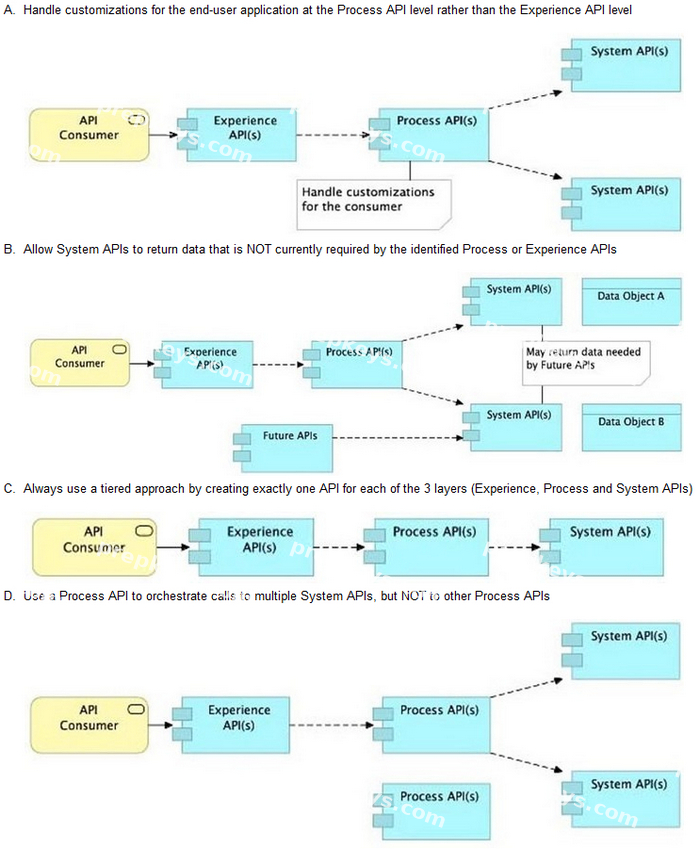
Refer to the exhibit.

What is the best way to decompose one end-to-end business process into a collaboration of Experience, Process, and System APIs?
A.

Option A

B.

Option B

C.

Option C

D.

Option D

Question 5
Single choice

How can the application of a rate limiting API policy be accurately reflected in the RAML definition of an API?

A.

By refining the resource definitions by adding a description of the rate limiting policy behavior

B.

By refining the request definitions by adding a remaining Requests query parameter with description, type, and example

C.

By refining the response definitions by adding the out-of-the-box Anypoint Platform rate-limit-enforcement securityScheme with description, type, and example

D.

By refining the response definitions by adding the x-ratelimit-* response headers with description, type, and example

Question 6
Single choice

What best describes the Fully Qualified Domain Names (FQDNs), also known as DNS entries, created when a Mule application is deployed to the CloudHub Shared Worker Cloud?

A.

A fixed number of FQDNs are created, IRRESPECTIVE of the environment and VPC design

B.

The FQDNs are determined by the application name chosen, IRRESPECTIVE of the region

C.

The FQDNs are determined by the application name, but can be modified by an administrator after deployment

D.

The FQDNs are determined by both the application name and the Anypoint Platform organization

Question 7
Single choice

An API implementation is deployed on a single worker on CloudHub and invoked by external API clients (outside of CloudHub).

How can an alert be set up that is guaranteed to trigger AS SOON AS that API implementation stops responding to API invocations?

A.

Implement a heartbeat/health check within the API and invoke it from outside the Anypoint Platform and alert when the heartbeat does not respond

B.

Configure a "worker not responding" alert in Anypoint Runtime Manager

C.

Handle API invocation exceptions within the calling API client and raise an alert from that API client when the API Is unavailable

D.

Create an alert for when the API receives no requests within a specified time period

Question 8
Single choice

In which layer of API-led connectivity, does the business logic orchestration reside?

A.

System Layer

B.

Experience Layer

C.

Process Layer

Question 9
Single choice

What is typically NOT a function of the APIs created within the framework called API-led connectivity?

A.

They provide an additional layer of resilience on top of the underlying backend system, thereby insulating clients from extended failure of these systems.

B.

They allow for innovation at the user Interface level by consuming the underlying assets without being aware of how data Is being extracted from backend systems.

C.

They reduce the dependency on the underlying backend systems by helping unlock data from backend systems In a reusable and consumable way.

D.

They can compose data from various sources and combine them with orchestration logic to create higher

E.

level value.

Question 10
Single choice

The responses to some HTTP requests can be cached depending on the HTTP verb used in the request.
According to the HTTP specification, for what HTTP verbs is this safe to do?

A.

PUT, POST, DELETE

B.

GET, HEAD, POST

C.

GET, PUT, OPTIONS

D.

GET, OPTIONS, HEAD

Showing 10 of 154 questions · Unlock the full set