Exit demo NSE7_SDW-7.2 Fortinet NSE 7 - SD-WAN 7.2 PDF format · free preview

Fortinet NSE7_SDW-7.2 - Questions & Answers

Free preview · every answer includes a full explanation

Product page: https://prepkeys.com/nse7-sdw-72.html

Question 1
Multiple choice

What are two benefits of using forward error correction (FEC) in IPsec VPNs? (Choose two.)

A.

FEC supports hardware offloading.

B.

FEC improves reliability of noisy links.

C.

FEC transmits parity packets that can be used to reconstruct packet loss.

D.

FEC can leverage multiple IPsec tunnels for parity packets transmission.

Question 2
Single choice

Exhibit A shows the system interface with the static routes and exhibit B shows the firewall policies on the managed FortiGate.

Exhibt A
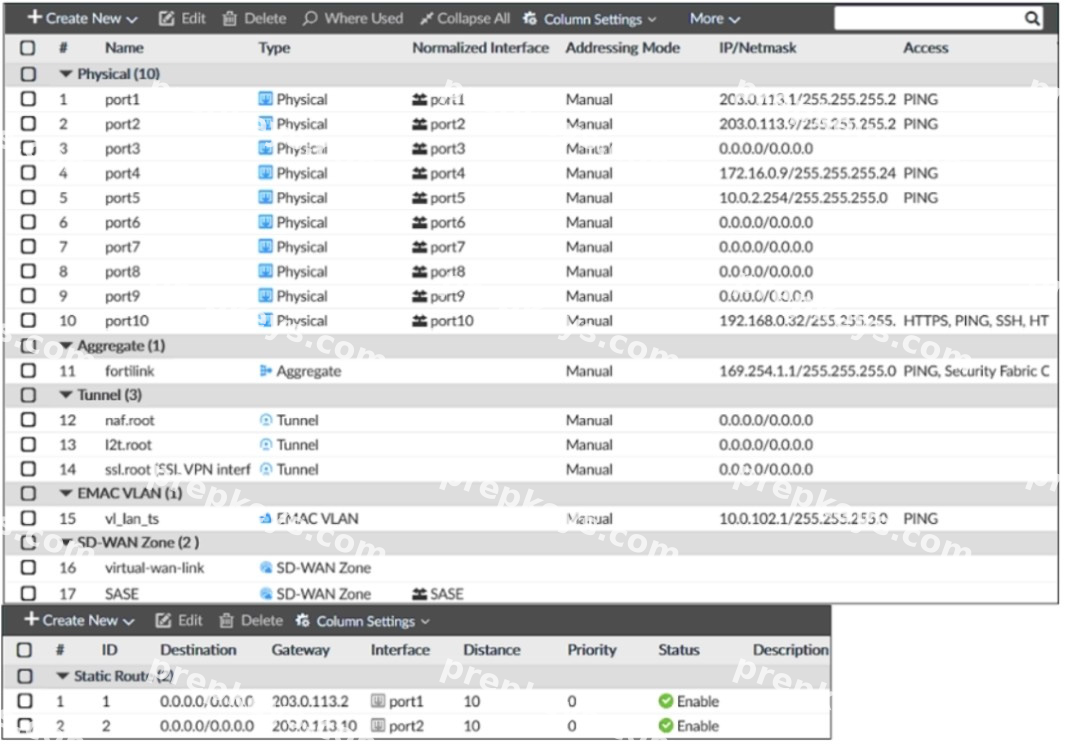
Exhibit B

Based on the FortiGate configuration shown in the exhibits, what issue might you encounter when creating an SD-WAN zone for port1 and port2?

A.

port1 is assigned a manual IP address.

B.

port1 is referenced in a firewall policy.

C.

port2 is referenced in a static route.

D.

port1 and port2 are not administratively down.

Question 3
Single choice

What is the route-tag setting in an SD-WAN rule used for?

A.

To indicate the routes for health check probes.

B.

To indicate the destination of a rule based on learned BGP prefixes.

C.

To indicate the routes that can be used for routing SD-WAN traffic.

D.

To indicate the members that can be used to route SD-WAN traffic.

Question 4
Multiple choice

In the default SD-WAN minimum configuration, which two statements are correct when traffic matches the default implicit SD-WAN rule? (Choose two )

A.

Traffic has matched none of the FortiGate policy routes.

B.

Matched traffic failed RPF and was caught by the rule.

C.

The FIB lookup resolved interface was the SD-WAN interface.

D.

An absolute SD-WAN rule was defined and matched traffic.

Question 5
Multiple choice

Which two statements about SD-WAN central management are true? (Choose two.)

A.

The objects are saved in the ADOM common object database.

B.

It does not support meta fields.

C.

It uses templates to configure SD-WAN on managed devices.

D.

It supports normalized interfaces for SD-WAN member configuration.

Question 6
Multiple choice

What are two advantages of using an IPsec recommended template to configure an IPsec tunnel in an hub-and-spoke topology? (Choose two.)

A.

It ensures consistent settings between phase1 and phase2.

B.

It guides the administrator to use Fortinet recommended settings.

C.

It automatically install IPsec tunnels to every spoke when they are added to the FortiManager ADOM.

D.

The VPN monitor tool provides additional statistics for tunnels defined with an IPsec recommended template.

Question 7
Single choice

Which CLI command do you use to perform real-time troubleshooting for ADVPN negotiation?

A.

get router info routing-table all

B.

diagnose debug application ike

C.

diagnose vpn tunnel list

D.

get ipsec tunnel list

Question 8
Multiple choice

Which two statements reflect the benefits of implementing the ADVPN solution to replace conventional VPN topologies? (Choose two.)

A.

It creates redundant tunnels between hub-and-spokes, in case failure takes place on the primary links.

B.

It dynamically assigns cost and weight between the hub and the spokes, based on the physical distance.

C.

It ensures that spoke-to-spoke traffic no longer needs to flow through the tunnels through the hub.

D.

It provides direct connectivity between all sites by creating on-demand tunnels between spokes.

Question 9
Multiple choice

Which two statements about SLA targets and SD-WAN rules are true? (Choose two.)

A.

SD-WAN rules use SLA targets to check if the preferred members meet the SLA requirements

B.

Member metrics are measured only if an SLA target is configured

C.

When configuring an SD-WAN rule you can select multiple SLA targets of the same performance SLA

D.

SLA targets are used only by SD-WAN rules that are configured with Lowest Cost (SLA) or Maximize Bandwidth (SLA) as strategy

Question 10
Single choice

Which action fortigate performs on the traffic that is subject to a per-IP traffic shaper of 10 Mbps?

A.

FortiGate applies traffic shaping to the original traffic direction only.

B.

FortiGate shares 10 Mbps of bandwidth equally among all source IP addresses.

C.

Fortigate limits each source ip address to a maximum bandwidth of 10 Mbps.

D.

FortiGate guarantees a minimum of 10 Mbps of bandwidth to each source IP address.

Showing 10 of 99 questions · Unlock the full set