Exit demo OMG-OCUP-100 OMG-Certified UML Professional Fundamental PDF format · free preview

OMG OMG-OCUP-100 - Questions & Answers

Free preview · every answer includes a full explanation

Product page: https://prepkeys.com/omg-ocup-100.html

Question 1
Single choice

What is an element in UML 2.0?

A.

member of a set

B.

instance of a class

C.

constituent of a model

D.

abstract metaclass with only one superclass

E.

substance not separable by ordinary chemical means

Question 2
Single choice

What is a relationship in UML 2.0?

A.

the state of being related

B.

an element that has no derived union

C.

an element that has no derived composition

D.

an element that must have two owned elements

E.

an element that specifies a connection between elements

Question 3
Multiple choice

What is true about a comment in UML 2.0? (Choose two)

A.

is shown as a note symbol

B.

must be attached to at most one element

C.

contains only machine-readable symbols

D.

can be attached to more than one element

E.

connections are always shown with a dashed line

Question 4
Single choice

What is true about every named element that is a member of a namespace?

A.

It is owned by the namespace.

B.

It has one unique name within the namespace.

C.

It is identified by its name within the namespace.

D.

It can be distinguished from other members in the namespace.

Question 5
Single choice

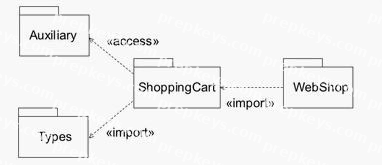
What is true of the import example in the exhibit?
A.

Webshop is imported into ShoppingCart and then further imported into Auxiliary and Types.

B.

Auxiliary and Types are imported into ShoppingCart, but neither can be further imported into WebShop.

C.

Public members of WebShop are imported into ShoppingCart and then further imported into Auxiliary or

Types.

D.

Public members of Types and Auxiliary are imported into ShoppingCart and then further imported into WebShop.

E.

Public members of Types and Auxiliary are imported into ShoppingCart and those from Types are further imported into WebShop.

Question 6
Single choice

What does an {ordered} designator do for a multiplicity?

A.

specifies that values are sequentially ordered

B.

specifies an inclusive interval of non-negative integers

C.

indicates the correct sequence of messages in a sequence diagram

D.

indicates that the upper bound must be greater than the lower bound for the multiplicity

Question 7
Single choice

What is an expression in UML 2.0?

A.

comment placed on a diagram

B.

symbol or symbols signifying a set of value

C.

graphical addition to a diagramming element

D.

language-specific string used to describe the meaning of a diagram

E.

language-specific text string used to describe the contents of a diagram

Question 8
Single choice

Constraints are shown using what symbols?

A.

[ ]

B.

( )

C.

{ }

D.

?"

E.

" "

Question 9
Single choice

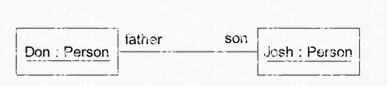
The instance diagram in the exhibit contains father and son without underlines.

What is the meaning of this?
A.

The Don class is a superclass of the Josh class.

B.

An association having end names father and son.

C.

The diagram is a mixture of class and instance diagrams.

D.

A link of an association having end names father and son.

E.

The names are incorrectly specified, because underlined names are required.

Question 10
Single choice

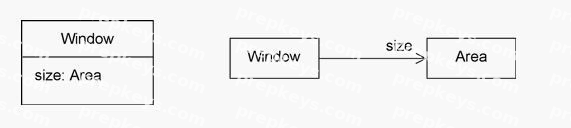
In the exhibit, what is the meaning of size in these two diagrams?
A.

Only one or the other should be used, not both, in order to avoid a name conflict.

B.

The size end name on the association indicates data storage and the attribute does not.

C.

There is one size property diagrammed both as an attribute and as an association end.

D.

There are two size properties that have no name conflict as long as each size is private.

E.

The size attribute in the class indicates that it will be stored within the class and the end name does not.

Showing 10 of 168 questions · Unlock the full set