OMG OMG-OCUP2-FOUND100 - Questions & Answers
Free preview · every answer includes a full explanation
Product page: https://prepkeys.com/omg-ocup2-found100.html
Which technique does Abstraction incorporate?
agile modeling
information hiding
complexity coupling
context-driven decision making
Abstraction in UML and software modeling often incorporates the technique of information hiding. Information hiding is a principle that supports abstraction by ensuring that unnecessary details about software components are not exposed to other parts of the system. This encapsulation strengthens modularity and keeps various parts of the program independent of one another, which simplifies complexity in large systems. Abstraction and information hiding are closely related;
abstraction focuses on the high-level structure of the system, while information hiding protects the internal states and functionality of components, allowing changes without extensive impact on other system parts.
Which scenario would be modeled most appropriately in a state machine?
the use of buttons to control a digital watch
the exchange of messages in a client-server system
the data flows and processes in an office automation system
the nature of the transitions from ice to water to steam in a physical system
the overview ofbehavior and message exchange in a distributed medical insurance system
State machines are ideal for modeling systems or objects that exhibit distinct states and transitions between them based on events or conditions. Let's analyze why option D is the best fit and why others are less suitable: D - Transitions in a Physical System:The transitions between different states of matter (ice, water, steam) are governed by well-defined conditions (changes in temperature and pressure). State machines can effectively represent these states and the rules governing the changes between them. Other Options: A - Control of a Digital Watch: While a state machine could model some aspects of a watch (e.g. time display mode, set mode), interactions with buttons are better represented by event-driven models or user interface flow diagrams.
B - Client-Server Messaging: Sequence diagrams or communication diagrams are more suitable for modeling message exchanges, as they focus on the interaction between different components. C - Office Automation Workflows: Business process modeling notations (BPMN) or data flow diagrams would be more appropriate for capturing the processes and data movements in an office system. E - Distributed Medical Insurance System: A combination of sequence diagrams (for message exchanges), activity diagrams (for processes), and state machines (for behavior within individual system components) would likely be needed to model a complex system like this.
References:
UML Specification (Superstructure) Version 2.5.1: The section on state machines is a primary reference for their capabilities (https://www.omg.org/spec/UML/2.5.1)
. Modeling Guides: Various resources on UML modeling techniques often provide insights into when different diagram types are most appropriate.
Consider the following diagram:
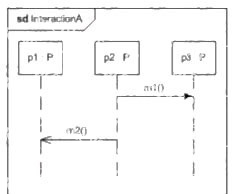
Whichdiagram presents a view of interactionA thatis consistent with the one shown above?
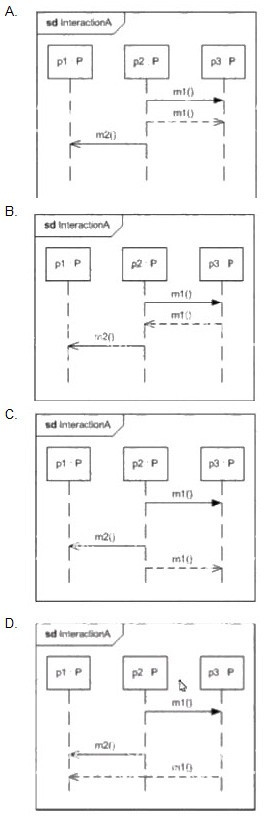
Option A
Option B
Option C
Option D
Consider the following diagram:
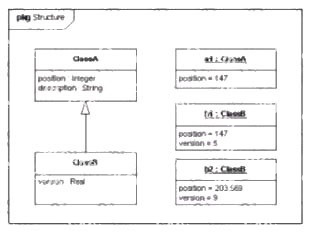
Which change could the modeler make to fix the UML error in this model?
Specify a unique value in the position slot for each instance specification
Add a description slot to a 1.
Change the type of ClassB.version from Real to Integer
Change the type of ClassA.position from Integer to Real.
In the UML diagram given, we see two classes, ClassA and ClassB, with ClassB inheriting from ClassA ClassA. has two attributes, position of type Integer and description of type String ClassB. introduces an additional attribute, version of type Real.
Looking at the instance specifications (the right part of the diagram), we have three instances: a1 of type ClassA, b1 of type ClassB, and b2 also of type ClassB. In UML, an instance specification must comply with the structure of its classifier, which means an instance of ClassA must show slots for both position and description, whereas an instance of ClassB must show slots for position description,, and version.
In the provided diagram, instance a1 of ClassA only shows a slot for position. This is an error because it does not show a slot for description, which is a defined attribute of ClassA. To correct this error, we would need to add a description slot to a1.
This means that the correct answer is:
B. Add a description slot to a1.
The other options do not correct the error in the model:
A) Specifying unique values for position does not address the missing description slot in a1.
C) Changing the type of ClassB.version from Real Integer to is not required by any UML constraint in the context given.
D) Changing the type of ClassA.position from Integer Real to does not address the missing description slot in a1 and is unrelated to the inheritance structure.
What is an advantage of modeling as a part of the software analysis and design process?
It reduces the risk of inconsistent or improper implementations.
It reduces the risk of incorporating technology constraints into a design.
It reduces the risk of using an incorrect or improper programming language.
It reduces the risk of the solution being strongly related to business practices.
Modeling as part of the software analysis and design process offers several advantages, one of the primary being the reduction in the risk of inconsistent or improper implementations. By using models, developers can visualize the structure and behavior of the system before actual coding begins, allowing for the identification and correction of potential issues in the early stages of development. This practice helps ensure that all components of the software work together as intended, reducing the likelihood of bugs and inconsistencies that could arise if parts of the system were developed in isolation. UML, as a standardized modeling language, provides a coherent and universally understood set of diagrams and symbols, which facilitates clear communication among team members and stakeholders, further mitigating the risk of misunderstandings that could lead to improper implementations.
Which diagram is invalid?
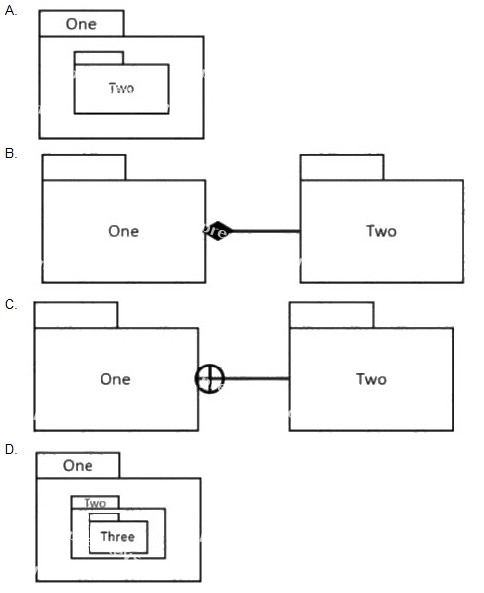
Option A
Option B
Option C
Option D
Option C shows a UML diagram where a class (One) appears to have an aggregation relationship with itself. In UML, an aggregation is a special type of association that represents a whole-part relationship between the aggregate (whole) and a component part. However, it does not make sense for a class to aggregate itself; such a relationship implies that instances of the same class are parts of each other, which is conceptually invalid.
Let's consider the other options:
A) This diagram shows a class contained within another, which is a valid use of nesting classes.
B) This diagram shows a composition relationship, which is a form of aggregation with a stronger lifecycle dependency between the whole and the part. This is a valid relationship in UML. D) This diagram shows a class containing two nested classes, one of which contains another nested class. This is also a valid representation of nested classes in UML.
Consider the following diagram:

0
1
2
3
5
The correct answer is E. 5. Based on the image you provided, the diagram depicts the following sequence of steps involved in creating an order: Create Order: This signifies the initiation of the order process.
Fill Order Request: This step likely involves gathering information or processing details about the order.
Create Invoice: An invoice is typically generated after an order is finalized.
Notify Customer: The customer is informed about the order, possibly confirmation or receipt.
The key here is that the process starts with creating the order (step 1) and ends with notifying the customer (step 4). Steps 2 and 3 (filling the order request and creating an invoice) can happen concurrently and don't necessarily follow a specific order in relation to each other. Therefore, following the logic of the sequence, there are five steps (0-based indexing), making E. 5 the most suitable answer.
The Sensor Controller state machine shown below is at rest in the Ready state. The acquireData event occurs.
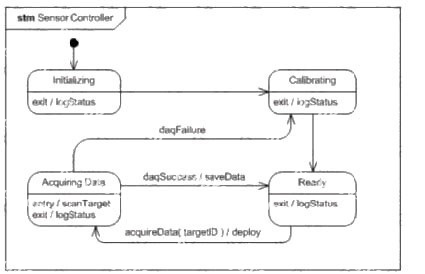
What Is the complete sequence of behaviors that executes before the state machine comes to rest in the Acquiring Data state?
deploy
logStatus. deploy
deploy, scanTarget
logStatus. deploy. scanTarget
logStatus. deploy. scanTarget. logStatus
The provided image depicts a block diagram of a sensor controller represented as a state machine. The state machine transitions between the following states: Initializing Calibrating Ready Acquiring Data
The question specifies the state machine starts in the Ready state and theacquireDataevent triggers the transition.
Analyzing the image, we can identify the following behaviors for the scenario: logStatus: This behavior is depicted in the diagram as the first action upon exiting the Ready state. It most likely logs the current state of the sensor controller. deploy: The transition from Ready to Acquiring Data triggers the deploy behavior.
This likely involves preparing the sensor for data acquisition. scanTarget: Upon entering the Acquiring Data state, the scanTarget behavior is initiated. This suggests the sensor controller is actively collecting data from the target. Therefore, the complete sequence of behaviors islogStatus, followed bydeploy, and lastlyscanTarget, before reaching the Acquiring Data state.
Justification for excluding other options: Option A (deploy only) excludes the initial state logging and target scanning actions.
Option B (logStatus.deploy) excludes the target scanning upon entering the Acquiring Data state.
Option C (deploy, scanTarget) omits the initial state logging.
Option E (logStatus.deploy.scanTarget.logStatus) includes an extra logStatus action after target scanning, which is not supported by the diagram. In conclusion, based on the state machine diagram and the behavior descriptions, option D (logStatus.deploy.scanTarget) accurately reflects the sequence of actions that occur before the sensor controller arrives at the Acquiring Data state.
Which sequence of behavior executions occurs if the state machine below is in state S11 and an event of type E occurs?
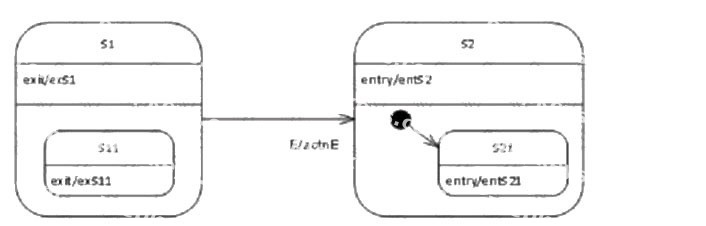
actnE; exS1; exS11: entS21; entS2
actnE; exS1; exS11: entS2; entS21
exS11; actnE; entS2
gxSH; exS1; actnE; entS2
exS11; exS1; actnE; entS2; entS21
The image depicts a state machine with the following states:
S1
S11 S2 S21 The state machine transitions are labeled as follows: gxSH - This triggers the transition from the initial state to S1.
E - This event triggers the transition from S11 to S21. exS1 - This signifies exiting state S1. exS11 - This signifies exiting state S11. entS2 - This signifies entering state S2. entS21 - This signifies entering state S21. actnE - This indicates an action associated with the E event. Given the state machine is currently in state S11 and an event of type E occurs, here's the sequence of behavior executions: actnE: The action associated with event E is executed. exS11: The state machine exits state S11. exS1: Since S11 is nested within S1, exiting S11 also implicitly triggers exiting S1. entS2: The state machine enters state S2. entS21: The state machine enters the nested state S21.
Justification for excluding other options: Option A (actnE; exS1; exS11: entS21; entS2) has the order of entering S2 and S21 reversed.
Option C (exS11; actnE; entS2) omits the execution of the action associated with event E.
Option D (gxSH; exS1; actnE; entS2) includes the irrelevant initial transition trigger (gxSH).
Option E (exS11; exS1; actnE; entS2; entS21) has an extra exiting of state S1, which is not part of the valid transition path.
Following the state transitions and action triggers depicted in the state machine diagram, option B accurately reflects the sequence of behaviors that occur when event E triggers a transition from state S11.
Which category of stakeholders should have prime responsibility for making decisions on the contents of a domain model, and why?
The customers, as they will own the system when it is delivered
The users, as they will be using the system when it is operational.
All involved stakeholders, as they are knowledgeable and concerned.
The development team, as they are responsible for the final implementation.
Project managers, as they are responsible for delivering the right product to the customer
The testing team, as test-driven design is proven to be an effective approach to development
The system architects, as they are responsible for the design of the system and its proper functioning.
In the development of a domain model, the prime responsibility for decision-making should ideally rest with the users, as they are the ones who will be using the system operationally. Users have the most direct and frequent interactions with the system, making them best positioned to provide relevant insights into what the system should do and how it should behave to meet their needs effectively. While other stakeholders such as customers, project managers, and developers play significant roles, the users' intimate knowledge of the domain processes and their requirements make them key contributors to ensuring that the domain model aligns closely with real-world application and utility.
Showing 10 of 108 questions · Unlock the full set