Exit demo PW0-071 Certified Wireless Technology Specialist - Sales PDF format · free preview

CWNP PW0-071 - Questions & Answers

Free preview · every answer includes a full explanation

Product page: https://prepkeys.com/pw0-071.html

Question 1
Single choice

When implementing a wireless LAN, what is the area covered by an AP and usable by a client station called?

A.

Basic Service Area

B.

Independent Basic Service Set

C.

Infrastructure Basic Service Set

D.

Service Set Identifier

E.

Basic Service Set Identifier

Question 2
Single choice

Manufacturers design hardware used for wireless LANs based on a common set of criteria or rules known as standards.
The name of the organization responsible for creating 802.11 WLAN standards is what?

A.

IEEE

B.

Wi-Fi Alliance

C.

IETF

D.

WiMAX Forum

E.

ITU

Question 3
Single choice

Select the statement that correctly describes the Wi-Fi Alliance's primary role in the WLAN industry.

A.

The Wi-Fi Alliance is a WLAN industry analyst firm that reports market trends and developments.

B.

The Wi-Fi Alliance ensures interoperability of band selection and power settings across regulatory domains.

C.

The Wi-Fi Alliance creates compliance standards around which vendors can develop products.

D.

The Wi-Fi Alliance creates recommended practices by which the IEEE can test and certify product interoperability.

E.

The Wi-Fi Alliance tests and certifies product interoperability based upon standards created by the IEEE.

Question 4
Single choice

What wireless network access technology is used to cover a city with 802.11 or another wireless networking technology?

A.

WPAN

B.

WMAN

C.

WWAN

D.

WLAN

Question 5
Single choice

Given: Your branch office AP is configured with WPA2-Personal, and you have decided that CWTS4me is a good passphrase. You have also configured your laptop with the same passphrase, which is used by the access point to validate the laptop's identity when it attempts to connect to the WLAN.

What is this process of identity validation called?

A.

Affiliation

B.

Association

C.

Authentication

D.

Activation

E.

Accounting

Question 6
Multiple choice

You are hired by ABC Company to recommend an appropriate solution for their wireless network. They would like to operate in the 2.4 GHz ISM frequency band and will require data throughput in excess of 10
Mbps. To meet that need, you recommend equipment compliant with the ______ or ______ amendments to the 802.11 standard. (Choose 2)

A.

802.11a

B.

802.11b

C.

802.11i

D.

802.11g

E.

802.11n

Question 7
Single choice

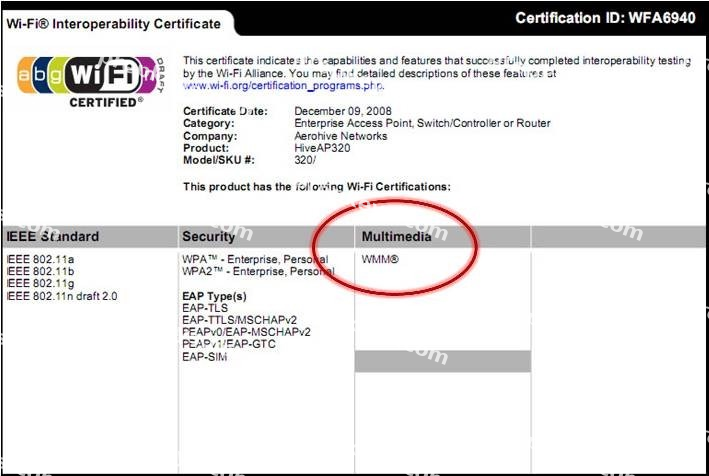
Exhibit:

The Wi-Fi Multimedia (WMM) certification, which is illustrated in the exhibit, pertains to which topic?

A.

Fast BSS Transition

B.

Radio Resource Measurement

C.

Quality of Service

D.

Mesh Networking

E.

Dynamic Frequency Selection

F.

Security Enhancements

Question 8
Single choice

The two most common modes of WLAN discovery are passive scanning, where a client station listens for _________ frames, and active scanning, where a client sends and receives _________ frames.

A.

Data ; Null

B.

SSID ; Management

C.

Beacon ; Probe

D.

Probe Response ; Broadcast

E.

Discovery ; Control

Question 9
Single choice

What is a difference between an Infrastructure Basic Service Set (BSS) network and an Ad Hoc network?

A.

In an Ad Hoc network, only one WLAN controller is used. A BSS allows multiple WLAN controllers to be connected together to form a mobility domain.

B.

An Ad Hoc network allows only legacy security options such as WEP. A BSS allows the creation of a robust security network (RSN) using security methods such as WPA2- Personal.

C.

A BSS is recommended for enterprise WLANs, while Ad Hoc deployments are recommended for small and medium businesses.

D.

In a BSS, an access point is used for connectivity to the wired network infrastructure. In an Ad Hoc network, client stations communicate directly with each other.

Question 10
Single choice

Given: Several users are required to transfer files among themselves in a conference room. No APs are available for connections to the network infrastructure. All users have laptops with 802.11 wireless adapters installed and operational.

What can you implement to allow users to transfer files when 802.11 adapters are available, but no wireless LAN infrastructure is accessible?

A.

ESS

B.

BSS

C.

IBSS

D.

BSSID

E.

SSID

Showing 10 of 70 questions · Unlock the full set