USMLE USMLE-STEP-2 - Questions & Answers
Free preview · every answer includes a full explanation
Product page: https://prepkeys.com/usmle-step-2.html
You evaluate a 38-year-old man who complains of muscle weakness. Her appearance is remarkable for a periorbital heliotrope rash with edema and erythema on his upper chest, neck, and face.
Which of the following is the most likely diagnosis?

You evaluate a 38-year-old man who complains of muscle weakness. Her appearance is remarkable for a periorbital heliotrope rash with edema and erythema on his upper chest, neck, and face. Which of the following is the most likely diagnosis?
Which of the following examination findings would this patient most likely have?
A 30-year-old woman is visiting you in your primary care office as a new patient. Overall, she is healthy. On taking a family history, you learn that her mother was diagnosed with colorectal cancer at the age of 50.
When should this patient start being screened for colorectal cancer?
A70-year-old man presents to urgent care complaining of a painful, swollen left knee. He previously has had no problems with this knee. Three days prior to onset, he went out dancing for 23 hours but recalls no specific injury. Examination of the knee reveals a moderatesized effusion and mild pain with any range of motion. Plain x-ray shows no fracture.
Which of the following is the best next management?
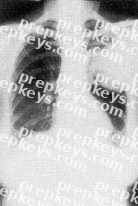
A 59-year-old woman complains of shortness of breath and aching left-sided chest pain that radiates to the left shoulder. Physical examination shows no abnormalities; her CXRs are shown in Figure below.
Which of the following statements is true concerning this disease?
A 23-year-old woman presents with "skipped heartbeats" and on cardiac examination is found to have a midsystolic click followed by a late systolic murmur. Echocardiogram shows prolapse of the mitral valve.
Which of the following is true about this condition?
A 19-year-old high school senior complains of feeling "fat and ugly" despite being extremely thin. She takes small amounts of food at meals and occasionally gags herself to induce vomiting after meals.
Which of the following is commonly associated with this disorder?
A 59-year-old woman had a left modified radical mastectomy for intraductal carcinoma 2 years previously. She presents with confusion, lethargy, and thigh pain. X-rays reveal a lytic lesion in the shaft of the femur.
Which of the following blood abnormalities is most likely?
A 59-year-old woman had a left modified radical mastectomy for intraductal carcinoma 2 years previously. She presents with confusion, lethargy, and thigh pain. X-rays reveal a lytic lesion in the shaft of the femur.
Which of the following is the most appropriate initial therapy?
A55-year-old retired policeman has had hypertension for about 15 years for which he takes hydralazine. He has a 35 pack-year tobacco history and continues to smoke one pack a day. On his visit, he complains about the appearance of his nose and asks if something can be done to decrease the redness.
Which of the following statements is correct?